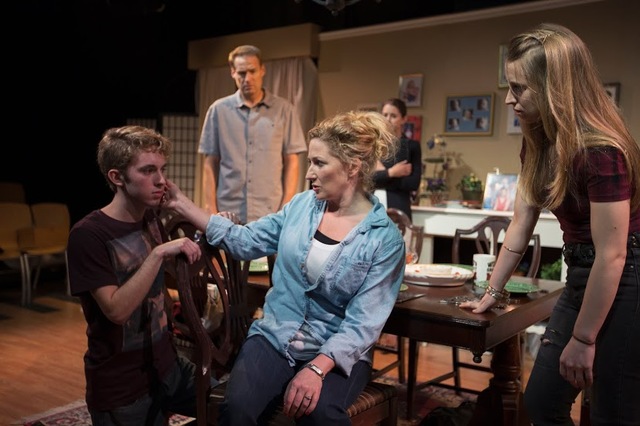
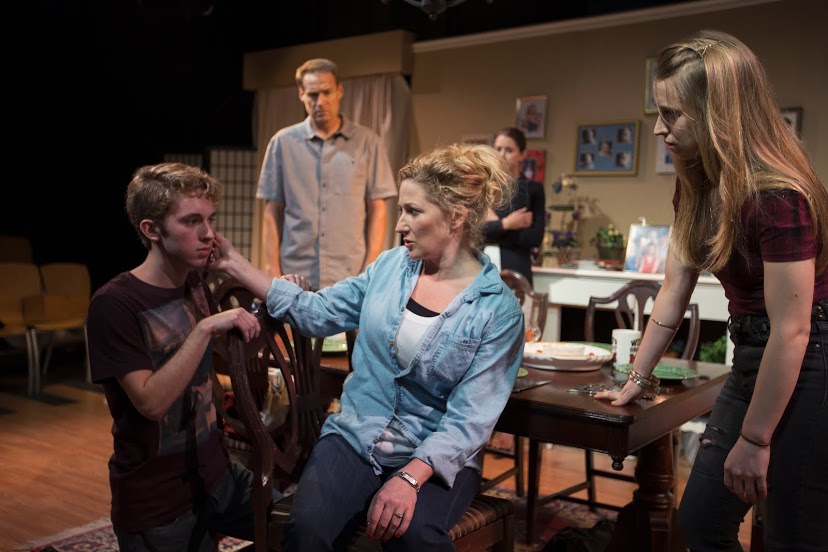
 The cast of One in the Chamber at Mead Theatre Lab at Flashpoint. Photo: Noah Chiet and Ian Armstrong
By DCist Contributor Jonelle Walker
A social worker has intruded into something that makes her extremely uncomfortable. That becomes blatantly clear as she stands in the middle of a rural American living room, the center of a bustling family, which is nonetheless still and quiet. She is as deeply unsettled as the audience is watching her from less than five feet away.
Marja-Lewis Ryan’s One in the Chamber, which is having its East Coast premiere at the Mead Theatre Lab at Flashpoint, is an unflinching zoom into the individual tragedies that comprise a national epidemic: accidental gun deaths. The play begins with a slice-of-life examination of Charles (Dwight Tolar) and Helen’s (Adrienne Nelson) idyllic rural home. Their daughter Ruthie (Grace Doughty) dances with abandon; Helen folds clothes; Charles reads the paper in his boxers; they worry about where their rebellious eldest, Kaylee (Danielle Bourgeois), disappeared to last night. The illusion of normalcy is neatly cracked by the arrival of Jennifer Schwartz (Liz Osborn), a social worker who visits the home to determine whether their teenaged son Adam (Noah Chiet) should be released early from his parole. His crime? Accidentally shooting and killing his younger brother, Joey, with the family handgun six years prior. What follows is a series of routine interviews that peels back the family’s thinly veiled turmoil.
Actors Adrienne Nelson and Liz Osborn are also credited as producers for this piece, and it’s obvious why the two would champion this work. One in the Chamber is an actor’s play (particularly in this production) providing meaty, hyper-dramatic monologues for each of the performers. Forgiving the occasional touch of melodrama, the cast is roundly excellent, with Nelson and Osborn turning in particularly moving work. Marja-Lewis Ryan’s script runs Helen through the gamut of emotional upheaval, but Nelson admirably keeps her performance grounded, even as the script flies momentarily off the handle. Yet Osborn steals the best moments for herself as the social worker, in the quiet transitions when she is left alone in this domestic maelstrom. A small, silent scene where she contemplates a family picture is one of the more moving moments in the play.
Though the acting is great, set designer Katie Sullivan achieves the most memorable work of the artistic team. Her meticulously detailed living room set is so true to life that it feels impossible to believe that it’s anything less than a point-by-point recreation of her own childhood home. From perfectly-strewn mail to dinosaur stickers on the unused desk, Sullivan’s set begins telling the story of One in the Chamber before anyone says a word. In such an intimate setting—the house has 45 seats at most —being so close to the family’s eerily realistic space enhances the emotional intensity.
While actors and designers bring their A game for One in the Chamber, the play itself has some moments of weakness, particularly when it comes to its shocking, but unsatisfying, conclusion. Ryan wrote the play in response to a 2013 New York Times article, and her play retains and repurposes some of its source’s journalistic structure. While the typical blunt ending of investigative journalism suits that medium well, cutting off at the climax is a bit rough on a theater audience and should, arguably, be used sparingly to make a point. In this case, Ryan’s finale reads more as an inappropriately simple way to close a complicated, messy conversation.
Perhaps the key to One in the Chamber’s finale is the production team’s disclaimer both on their Website and in press materials: “This play is not political in nature, but rather, is a fictionalized account of how one of these families managed after their loss.”
This statement would not be half as baffling if the play didn’t dwell on Jennifer (a stand-in for “the system”) as a useless bureaucrat in the face of human tragedy. It would not be a quarter as baffling if the production team didn’t have talk backs on gun control for many, if not most, performances. Why does the team and playwright insist that this is not political play? Perhaps the idea is a carryover from when the play premiered in Los Angeles, where audiences might be turned away. But this is D.C. One in the Chamber has something important to say, a short walk from the places where this kind of advocacy can make a real difference; the political message should be emphasized, if anything.
Just like Jennifer, the audience stumbles into something really uncomfortable during One in the Chamber, but that’s a good thing. One in the Chamber will leave you questioning how Americans think about gun violence and talk about families touched by tragedy. Disclaimer be damned: see the show and discuss its politics until your lungs give out.
One in the Chamber runs at the Mead Theatre Lab @ Flashpoint through September 6. Tickets are available online.