 Rachel Sadon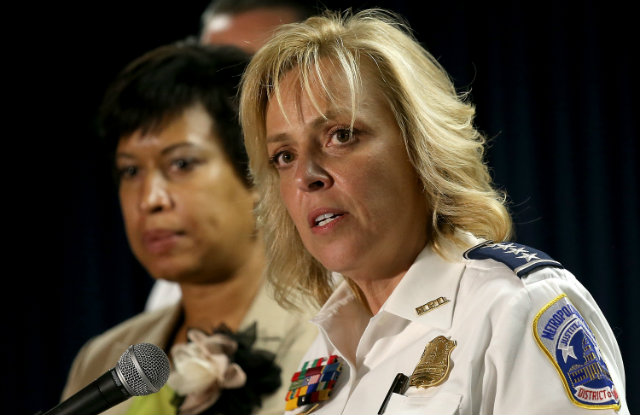
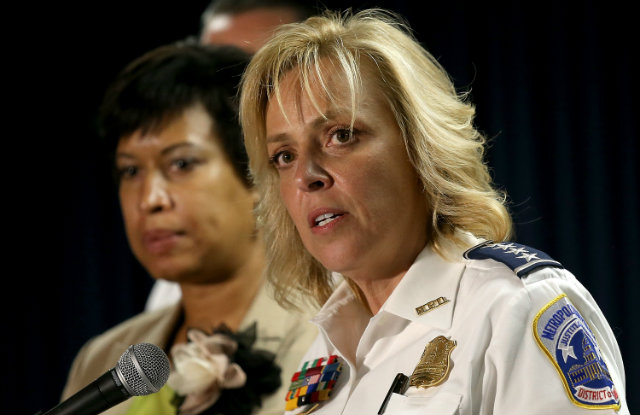 Mayor Muriel Bowser, left, listens as Chief of the Metropolitan Police Department Cathy Lanier, right, speaks at a press conference at police headquarters on May 21, 2015. (Photo by Win McNamee/Getty Images)
A day after Black Lives Matter activists disrupted a press conference in which Mayor Muriel Bowser outlined her police agenda for combating the city’s recent spike in violent crime, Police Chief Cathy Laner announced three arrests in homicide cases in a 24-hour period.
On Wednesday morning, Kenneth Stewart was charged with second degree murder in the shooting death of Eric Jackson on August 8th in Southeast.
Later that evening, Maureko Hill was arrested in the brutal killing of Latroia Smith on November 2, 2014, in Southeast. Police said that Hill sexually assaulted Smith before shooting her to death and then severely burning her body.
And yesterday morning, Milkiyas Bayisa was charged with second degree murder in the death of Kassahun Edo on August 22nd in Northwest. Police said Edo died after being punched and falling on his head.
“I bring these arrests to your attention to keep our community informed of the work MPD is doing to arrest and remove violent offenders from the community, We aren’t doing it alone. Your help continues to be appreciated,” Lanier said in a release. She encouraged residents to keep calling in tips and engage with the authorities in their neighborhoods. “Continue to share information about what is happening and who is contributing to the violence. Together, we will continue to make D.C. safer and stronger.”
But the “Safer, Stronger D.C.” plan outlined by Bowser yesterday came under sharp criticism from Black Lives Matter activists who said that a larger police presence won’t solve the problem.
The proposals include increased police patrols, focusing on repeat violent offenders, increasing penalties for violent crimes committed on public transportation or parks and recreation centers, incentivizing businesses to put up security cameras, implementing a new grant program for community non-profits, narrowing the definition of assault on a police officer, and repealing some traffic violations that are often seen as pretexts for a stop.
But it was the emphasis on adding officers that drew particular ire. “We’ve put more officers on the streets—especially in communities that have been hit hardest by crime. By using overtime, we have 182 more officers on the streets, in the city’s most vulnerable areas. Additionally, we have 235 officers working 12-hour shifts who focus on narcotics,” Bowser said, as dozens of people shouted over her with chants of “We don’t need more police!” and “We want jobs!”
“The real issue is job training,” former Council candidate and local activist Eugene Puryear told DCist. “From our perspective, on a cosmetic level, the mayor appears to be presenting a comprehensive plan, but when you get deeper into it, what you start to see is that her plan has many, many holes in it, it doesn’t address the root causes, and that it is also based on a loose understanding of what is going on in the streets.”
Lanier—who is now facing the first no-confidence vote of her tenure by the D.C. Police Union— went on the Kojo Nnamdi show earlier today, where she spoke about the spike in crime and the tensions with activists who are opposed to more officers on the street.
Lanier defended Bowser’s proposals and pointed out that, of the main points, “only one was really about police.”
“None of us think that the police or arrests are the answer to the problem. There’s a larger problem, there’s poverty, there’s unemployment, there’s education—all of those things lead to where we are right now,” Lanier said. But those problems can’t be solved immediately, and the city’s leaders need to stop the killings now, she said, adding that among the problems is the specter of vigilante justice.
“There’s a very delicate balance here. When people in the community don’t feel the police department can keep them safe and take violent offenders off the street, they take justice in their hands,” Lanier said. “We know who violent offenders are and we need to have the ability to get those violent offenders off the street, otherwise people will take matters into their own hands. Retribution is a huge part of it.”
As for the no-confidence vote, Lanier noted the timing—the union is coming up on an election and it is during an “all hands on deck” initiative that the leaders have opposed. “I don’t think the union speaks for every police officer but they are the representation for the union members so this is their right,” she said.