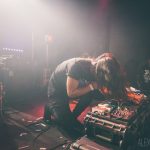
 This should be a safe space. Always. (Via Shutterstock).
“Chill out, he’s married.”
This was a bystander’s reaction to my protests after being grabbed multiple times at Screaming Females’ show Friday night at the Rock & Roll Hotel. I found what I thought would be a safe space about 12 feet from the stage near the left corner; an area where I thought I had smartly placed myself away from the mosh pit, therefore avoiding any irritating rock show discomfort. Silly me.
Let me say first that I am a strong supporter of mosh pits, which is not always a popular opinion to have. Though they certainly have the potential to be annoying and/or dangerous, they usually only occupy a small percentage of audience space, so that people who want to avoid it have lots of other options. I have leapt and spun my way around a meaty, sweaty hurricane of flesh plenty of times and had the time of my life. And although many audience members at this particular show did indeed have some unpleasant mosh pit experiences (more on that later), my frustrations came from something less actively violent, but far more problematic.
As I stood relatively still and bobbed along to the music, a man of about 30 stood to my right. Every minute or so, we would endure a wave from the mosh pit, despite standing on its outskirts. But the man on my right once—instead of just swaying back into his place—delicately rested his hand on my left shoulder (crossing my back to do so) for a moment, then brought it down to my waist, hovering briefly.
I shrugged it off, turned to him and, amidst the cacophony, made a silent slashing motion with my hand at my neck while shaking my head—a nonaggressive but obvious way to say, “I do not like that.”
He put his hands up in the defensive “Sorry, geez” gesture and turned away. My boyfriend leaned over to try to figure out what was going on, which prompted a friend of the guy to say, “chill out, he’s married.”
But that wasn’t the end of it.
About a minute later, he inexplicably grabbed the upper part of my right arm. Let me be clear: at the time, we were not being knocked around by the pit. He simply grabbed me, for no apparent reason at all. I repeated my previous action, this time with a stern but calm, “No, man, I don’t like that. Please don’t do that.”
“YOU bumped into ME!” he responded, then waved his hand in my face. After that, I threw my hands up in frustration and left the area. My boyfriend and I snaked our way back towards the merch stand—a far more visually obstructive area—because it was the only area around where I felt comfortable.
But the saddest part of this experience is that almost any woman who goes to live shows has at least one story like this.
I didn’t feel threatened so much as shocked that this guy and his friends saw no problem in what he was doing. There’s an obvious difference between the touch that happens when you bump into someone and the intentional one. When you are the receiver, it’s instantly obvious which one has occurred.
This is a just one example of what the term “safe spaces” is all about. It sounds like a generic phrase, but its vagueness allows for application in all sorts of situations. A safe space is one in which all participants can feel comfortable, at ease, and accepted.
A sidewalk isn’t a safe space when a person is catcalled. A bar is not a safe space when patrons grab or grope others, become verbally violent, or incite fights. A concert venue is not a safe space when the crowd is so rowdy it becomes dangerous for bystanders or when audience members use the proximity as a cover for touching other people in unwelcome ways.
Unfortunately, both instance of the latter occurred on Friday night. Although I did not personally experience problems directly influenced by moshing, many others did. Twitter became an airing of grievances when the show ended.
women/girls/humans should be able to go to @Screamales shows without being groped
or any shows
or anywhere
— Katie Park (@katiepark) August 29, 2015
Man, really a bummer that at Screaming Females people still have to deal with knuckledragging bro misogynists.
— Dan Trombly (@stcolumbia) August 29, 2015
@katiepark We are very sorry that was your experience. Had we of known of what was going on we would have had done something.
— Screaming Females (@Screamales) August 29, 2015
In 2012, WMATA began its first anti-harassment campaign, prompted by action from Collective Action for Safe Spaces, a local non-profit that “aims to expose and combat street harassment as well as provide an empowering forum in this struggle.” While their focus is mainly on street harassment, CASS has done training and workshops to end harassment at places like bars and venues across the city. Earlier this month, representatives from CASS partnered with In It Together Fest to raise awareness about sexual harassment at local concerts.
It’s a problem that isn’t unique to D.C. Last year, pop-punk band Joyce Manor made waves when frontman Barry Johnson called out a stage diver (a grown-ass man of 190 pounds, because of course) for jumping onto a teenage girl—needless to say, the Internet had thoughts on Johnson’s tactics. And a month before that, the band Joanna Gruesome tweeted that a girl at one of their shows was sent to the hospital after an incident in a mosh pit.
Most recently, music journalist Jessica Hopper put out a call on Twitter for examples of marginalized people who were made to feel less-than in the music industry/scene. She got hundreds of responses. Reading through them will make you very sad.
I don’t blame the venue nor the artist. Though I appreciate Screaming Females’ readiness to speak out about these problems, a band’s job is, first and foremost, to perform. These incidents aren’t usually blatant; they’re actions so slight that they’re undetectable from the stage or even from just a few feet away. And as a result of that privacy, they leave a person feeling acutely unsafe and uncomfortable.
Harassment comes in all forms. Just because you’re not catcalling girls on the sidewalk doesn’t mean you’re not behaving in an unacceptable way. And just because you don’t stage dive or mosh doesn’t mean you can’t harm someone next to you in a crowd. I’ve been going to shows my whole life and somehow I always manage to get through the entire night—for hours at a time—without putting my hands on other people in unwelcome ways.
My only regret is that I didn’t have the courage to really call this guy out. I removed myself from the situation, reluctantly putting myself in a position in which my 5-foot 5-inch frame couldn’t see a damn thing the rest of the night.
Would Screaming Females’ Marissa Paternoster have done that? Should anyone have to do that? It’s a question that, in 2015, shouldn’t even have to be posed. And yet, here we are.