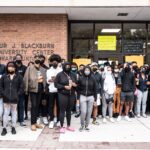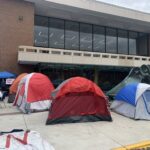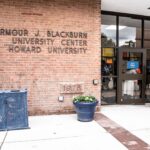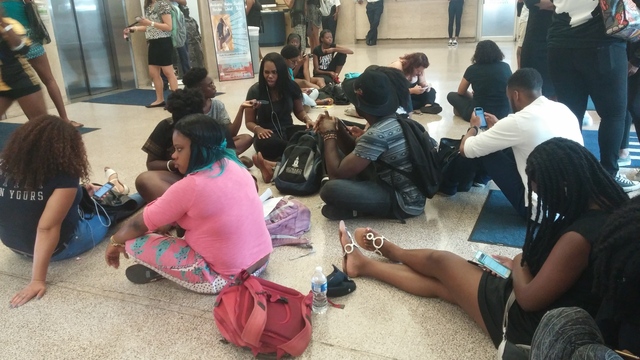
After days of a virtual protest united by the hashtag #TakeBackHU, Howard University students assembled in the school’s administration building this morning for a peaceful in-person protest.
They had made headlines this week after voicing a series of complaints on Twitter about their treatment at the historically black institution. Frustrations were spurred by operational dysfunctions that students faced coming into the new school year.
Aliyah Jones, an organizer of the movement, paced the room this morning, stopping to speak with groups and individual students. “It all started in a GroupMe chat [of Howard students] where everyone was complaining about the school,” she recounted.
So Jones strategically took to Twitter in rant-fashion on Wednesday at 2 p.m., a time she knew people would be online and paying attention. Soon, students and alumni began to retweet and adopt the hashtag. The conversation went viral.
After a meeting with student leaders, Howard’s president Wayne A. I. Frederick issued a statement on Thursday evening. He ensured students that they had been heard and the administration would work toward effective solutions.
Soon after, the Office of Student Affairs also announced that a “Student Customer Service Help Desk” would be put in place today. Still, Jones and other leaders decided that an organized protest would make a greater statement—and nearly 50 students joined them.
Near the entrance of the administration building, Brittney Dawkins stood gazing at a pillar plastered with post-it notes written by student protesters. “I wrote about ten of these,” said Dawkins, a sophomore studying to earn a Master’s of Physician Assistant.
A primary grief is the university’s delay in issuing her housing. “By the grace of God, I got housing last minute,” she said, adding that the university seems to allot most of its resources to freshman because they need the new money. “They don’t care about upperclassmen.”
Across the lobby, a student who referred to herself as “Day” sat quietly on the floor, legs crossed. This year, housing was an issue for her as well. “All they did was work on the lobby so it could look [presentable] for parents—they should have started with the rooms,” says Day, a senior majoring economics.
Her first room in the Howard Plaza Towers was infested with bugs, so she requested a new room. The cabinets in the second room were not properly installed. Again, she requested a new room, where she finally settled. “The light in the bathroom isn’t working, so I’m using a lamp for light.”
Financial aid is another common gripe for undergraduate students; tuition at the private institution is $21,450 per year. Dawkins receives no financial assistance from the university, so she searched for external scholarships. “I called every day to make them send my transcript and they could not send it on time—they said they forgot.”
Terry, a senior television, radio, and film major, finished in the top of his class in high school. Howard awarded him a full scholarship. “I wanted to go to an HBCU and Howard gave me a chance,” he said.
Still, he sat in protest because he only recently received his stipend, which—along with refund checks from Pell grants—students use to pay for books and day-to-day essentials. “I usually get it over the summer—I just got it three days ago,” he said.
While Howard has a history of graduating record numbers of Black students, it has also been wracked with financial troubles. Next year, Terry and others in the class of 2016 will become Howard alumni—a group the institution looks to for monetary support.
“I won’t give back unless they repair their relationship with students,” Terry said.
Jones and other leaders of the movement are continuing to strategize to make that possible. In a statement issued by the group, they vowed to remain peaceful and professional in their call to action, while addressing “a plethora of barriers and obstacles from administration.”