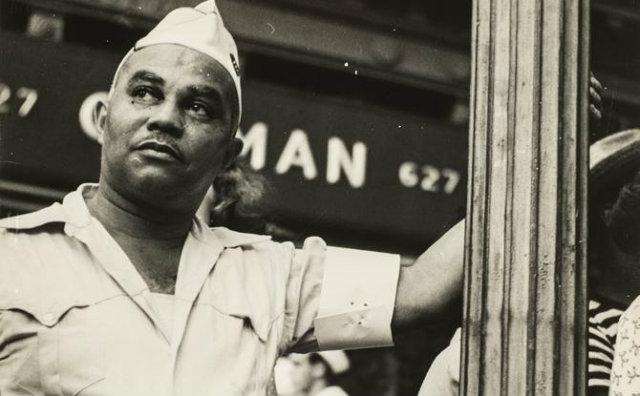
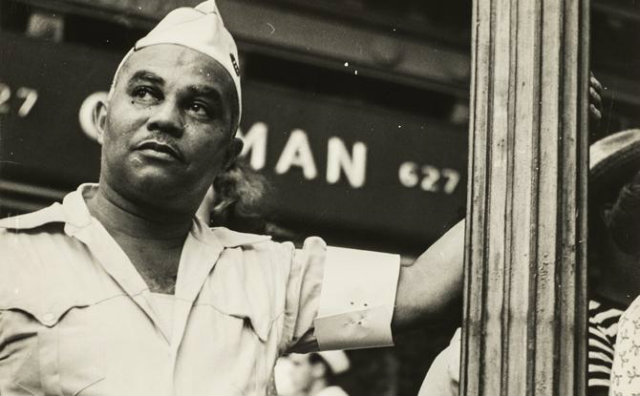
 Esther Bubley, Untitled (Washington, D.C.), 1943 (Photograph by Lee Stalswort, courtesy of the National Museum of Women in the Arts)
By DCist contributor Becky Little.
In 1949, a Life picture editor told photojournalist Esther Bubley, “your pictures are wonderful, but you just don’t have a Life personality.” He likely meant that she didn’t seem as aggressive as the men who shot for his magazine, but that didn’t scare her away. Two years later, her work made the cover.
Esther Bubley Up Front, a new exhibit at the National Museum for Women in the Arts, explores the work of this remarkable woman, who, unlike the stereotype of the virile male photographer, was reticent and petite. These qualities, paired with her eye for the offbeat, were an asset, allowing her to capture candid photos of people who seemed not to register her presence, or to have forgotten she was there.
“Her small size also enabled her to take photographs from various angles,” says Stephanie Midon, the exhibit’s curator. “There are anecdotes about her climbing on furniture, lying on the floor, etc.”
Bubley was a midwestern girl who came east in 1940 to make her way. After briefly working at Vogue, she moved to the Office of War Information (OWI) in Washington, D.C. There, she documented wartime America by capturing “ordinary moments” and “intriguing facial expressions,” says Midon.
After the OWI, Bubley joined Standard Oil’s new set of photographers, whom the company likely assembled to deal with a PR problem (they’d been aiding Nazi Germany). Her most famous series for Standard Oil was a profile of Tomball, Texas, an oil town where she stayed for six weeks—long enough to meet its residents and fade into the background, the unnoticed photographer.
Esther Bubley Up Front features photos from her time at the OWI and Standard Oil, but most of the images come from her later magazine work and personal projects, in which she continued to use an immersive method of staying with her subjects for several weeks. One of the most interesting series comes from a Life assignment, where she captured behind-the-scenes photos of the 1957 Miss America Pageant in Atlantic City.
These pageant photos have a quirky charm. In one, the most intriguing figure isn’t Miss Pennsylvania, posing in a bathing suit in the center of a crowd—it’s a woman behind her, in dark glasses, staring straight at Bubley. In another, Miss Alabama and Miss West Virginia smile vacantly, while Miss Hawaii smiles crookedly, like she’s trying to keep from laughing. The key photo, though, is one of young girls on the Atlantic City boardwalk. Too young for makeup and other feminine trappings, they are removed from the pageant, but still living in its world.
I sometimes suffer from museum-fatigue, and was pleased that Esther Bubley Up Front is small enough to offer a glimpse of her portfolio without overwhelming the viewer. The only thing that feels left out are Bubley’s original photo captions from her magazine stories, which the exhibit brochure promises were “clever and observant.” These are conspicuously missing from the exhibit, save for an excerpt from Bubley’s field notes on the Miss America Pageant.
Part of the reason I wanted to read Bubley’s commentary was to give myself the illusion that I could glimpse into her mind. Who, I kept thinking, was this talented woman who looked kind of like Katie Crutchfield? And why did she take that particular photo? And what did she hope I’d see?
I don’t know what she wanted me to see, but I know what I saw. In my favorite image, a shockingly well-dressed toddler marches through Rockefeller Center in 1950. Her face is determined, yet casual, and she’s wearing this incredible bonnet. Her parents may have been just a few steps behind her; but in the photo, she appears to be walking through New York City all by herself.
Esther Bubley Up Front is on view at the National Museum for Women in the Arts (1250 New York Ave NW) through January 17, 2016.