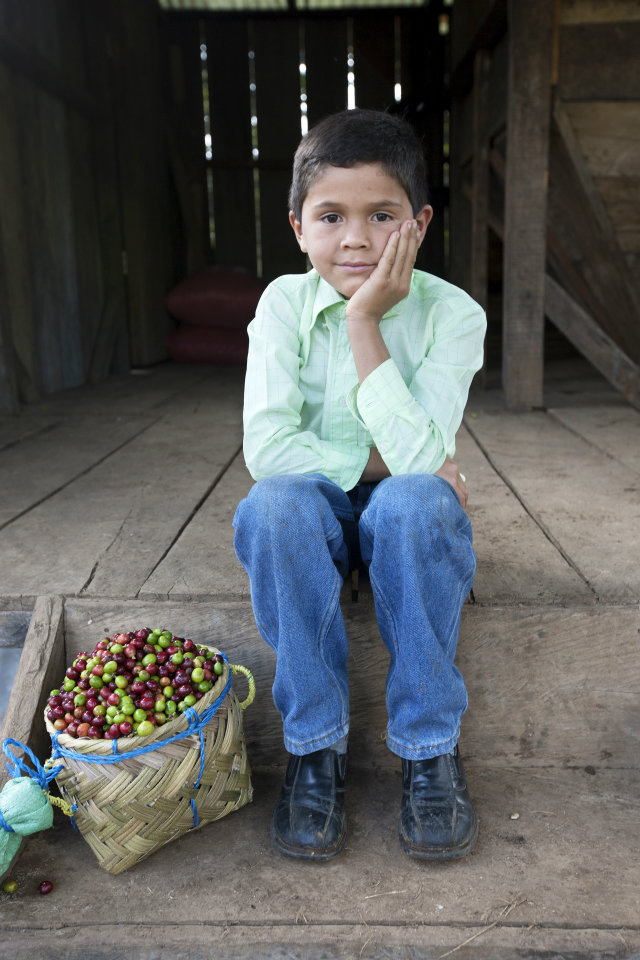
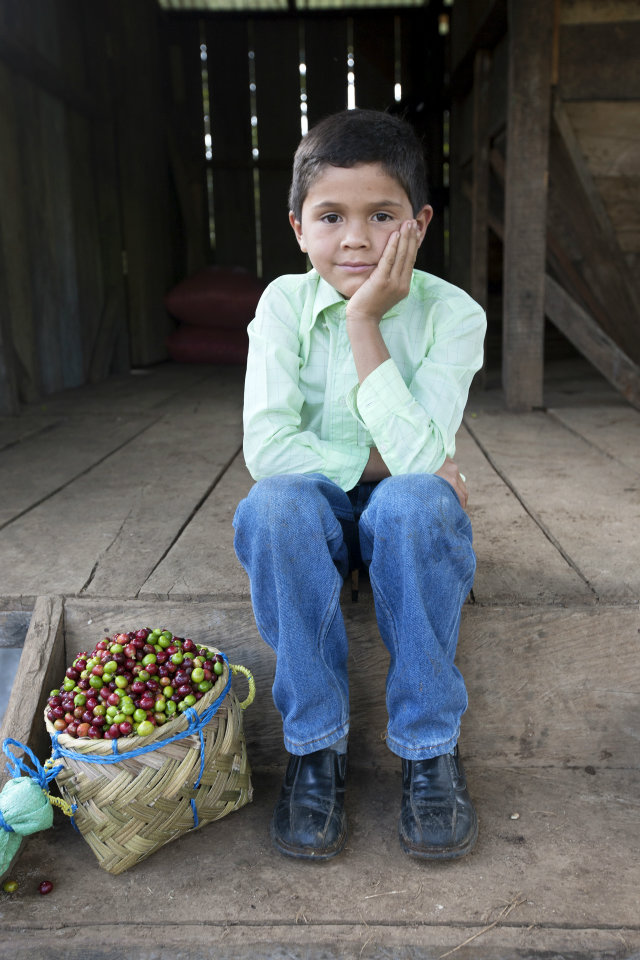
 Courtesy of the Newseum.
By DCist contributor Becky Little.
If you haven’t heard of the farmer, philanthropist, and photographer Howard Buffett, you’ve probably heard of his father, Warren. Not everyone has a dad with a net worth of $60.2 billion; or, to quote Warren Buffett himself: “In this ovarian lottery, my children received some lucky tickets.”
But Howard Buffett seems to have used his ovarian lottery ticket wisely. We’re so used to hearing about the party girls and boys of wealthy parents that it’s refreshing to learn about this Buffett, whose photography went on view last week at the Newseum’s “40 Chances: Finding Hope in a Hungry World.”
Thanks to his dad’s dough, Buffett has been funding food security initiatives for over 15 years through the the Howard G. Buffett Foundation (full disclosure: my employer, National Geographic, is one of the foundation’s partners.) He was drawn to hunger as a farmer, and was compelled to photograph it as he observed that food insecurity is caused by systemic issues like poverty and lack of opportunity for women.
“40 Chances” features 40 photographs from Buffett’s philanthropic and journalistic trips around the world, documenting what hunger looks like through themes like “Poverty” and “Fear.” Many of the photos are of children, and I had to fight back tears while I looked at them. In Bangladesh, a boy scavenges a garbage dump for things to eat or sell; in Sierra Leone, a ten-year-old works a ten-hour day digging for diamonds to earn just 12 cents and a cup of rice; in Niger, Buffett photographs an emaciated toddler a few days before she died.
The exhibit also features photos from Pulitzer Prize-winning Anja Niedringhaus, a photojournalist killed in Afghanistan in 2014, and Heidi Levine, winner of the International Women’s Media Foundation’s first Anja Niedringhaus Courage in Photojournalism Award. Positioned between the exhibit’s themes of “Women” and “War,” these images take the viewer to conflicts in Iraq, Afghanistan, and Gaza. In the most haunting photo, a teenager lies in a hospital, her face dotted with shrapnel scars that look like the marks of a Biblical disease.
The narrative behind the conditions photographed in these countries is not always strong, but the point is made. The exhibit is presented through a partnership with Buffett’s organization and the IWMF, and it’s clear that “40 Chances” is meant to elicit an emotional response from viewers strong enough to motivate them to do something about the horror that they see. At the end of the exhibit, an interactive screen tells viewers about the anti-hunger organizations that they can get involved with.
Next to the information about anti-hunger organizations is the exhibit’s final theme: “Hope.” The photos show girls going to school in a Central African Republic refugee camp, girls displaced by war preparing to return home in Sudan, and Mohair, a woman in Mali who has begun taking a sewing class. Mohair’s story is devastating: she was born poor, forcibly married, raped, and then left to care for her children (it made me uneasy that Buffett said that “Mohair’s beauty … drew me to photograph her”).
“Hope” is the obvious theme for “40 Chances” to end on. A person needs hope to want to get involved in the organizations highlighted at the end of the exhibit. But it is hard to look at the picture of Mohair and think of that word; and it is hard to come away from these photos with anything like hope.
“40 Chances: Finding Hope in a Hungry World — The Photography of Howard G. Buffett” is on view at the Newseum (555 Pennsylvania Avenue NW) through January 3, 2016.