By DCist Contributor Nathan Wilkinson
It’s easy to take our cocktail scene for granted. D.C. drinkers live in a paradise where quality cocktails can be enjoyed at every local watering hole and any bartender worth a muddler can make you an obscure classic drink. Just look at almost any restaurant’s cocktail menu. They’re full of cleverly contrived drinks that expand our alcohol knowledge as well as our taste palates. Then you can go to a number of stores and buy a variety of flavored bitters and obscure fortified wines to mix with. But it wasn’t always like this.
A cocktail scene doesn’t happen by itself; it takes the hard work of many individuals to maintain interest and push the boundaries of mixology.
“In a sense, good bartenders have always been here in D.C.,” says Derek Brown, owner of the award-winning Columbia Room, writer, and chief spirits advisor for the National Archives Spirited Republic exhibit. He explains that even back when cocktails were out of fashion, “underneath there was a small scene. Key people have been making great cocktails since the 80s.” While New York had Dale DeGroff and the Rainbow Room, more recently D.C. has bartenders like Krishna Ramasundar at Aroma in Cleveland Park and Chantal Tseng at the Tabard Inn near Dupont Circle. “Before that, the 70s and 80s were a bad time for cocktails,” Brown says, “but there were always fantastic bartenders that—now we as bartenders are discovering—were holding the line.”
Brown and other bartenders elevated D.C.’s cocktail scene in 2007 with the opening of Hummingbird To Mars, an underground cocktail club that explored the classic cocktails. “We literally took over Bourbon in Adams Morgan for private parties,” Brown says. He credits The Gibson and Todd Thrasher’s PX with kicking off the speakeasy scene: “Before that, restaurants had their cocktail programs. The Gibson was the first of the stand-alone cocktail bars,” Brown recounts. The opening of The Passenger and The Columbia Room in 2009 marked the beginning of what Brown calls “the explosion of cocktail bars—the renaissance we have today.”
But it didn’t have to happen this way. The progress made during the golden age of cocktails in the early 20th century ended with the enactment of prohibition, sending the most skilled bartenders overseas. Many of the classic cocktails came about during this time in Paris at places like Harry’s New York Bar, where American ex-patriots enjoyed the freedom to consume rare and wonderful spirits. When Prohibition was rescinded, the scenes in Paris and the U.S. continued to develop in separate ways.
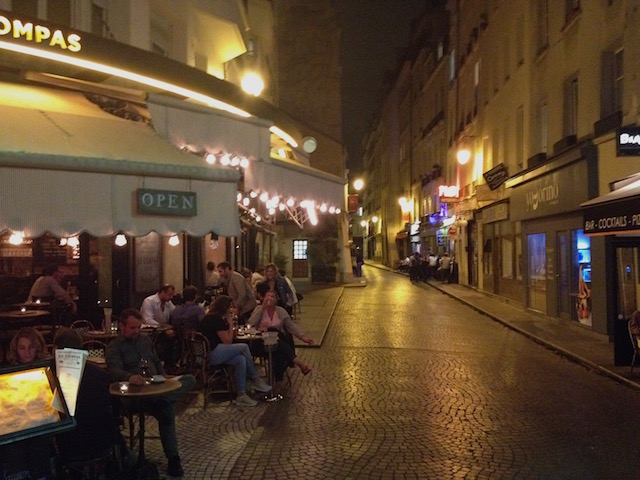
On a recent visit to Paris, I discovered that the current cocktail scene there is similar to what we had in the early 2000s. Harry’s Bar was still there doing classic cocktails and speakeasies are keeping the tradition going, but there was a notable lack of cocktail menus at restaurants. Yes, there are endless cafés, all advertising cocktails on their awnings. But the best most places could come up with were watery Mojitos, bland margaritas, and sweet champagne cocktails made sweeter by the addition of sugar cubes. What became of the amazing liqueurs and absinthes for which Paris is renown?
French restaurants are remarkably egalitarian and laissez-faire about their menus—very different from the D.C. cocktail scene where innovation and competition are everything. Just as all cafés make omelets and croque monsieurs, all restaurant bars make sweet and mild drinks for the few patrons who enjoy them. The mixed drinks in one Paris bar were identical to those in every other. Unlike bars in the U.S., there was no attempt to provide every option for drinkers: cafés have only one brand of each base liquor, (a rum, a bourbon, a vodka), most of which would belong in the “call” category in American bars. With these liquors they made artless gin & tonics and rum & cokes with none of the passion they reserve for wine.
The Experimental Cocktail Club (7 Rue Saint-Sauveur, 75002 Paris) proved to be the exception to this rule. It’s a speakeasy style joint with a nondescript plaque on the door and heavily curtained windows. They had a wonderful selection of liqueurs and sherries and put them to good use in their cocktails.
Max, the head bartender, has been working at the ECC for seven years when few had even heard of high-class cocktails in Paris. “Now there are 15 good bars for cocktails,” he says. “They’re doing the speakeasy thing too, which might be a good or a bad thing.” On the one hand these bars are exclusive, but they are making well-crafted cocktails available for about twelve euros apiece when luxury hotels charge 25 euros for a Manhattan. And speakeasies are reviving an interest in little-known French spirits like Quinqui Noix and Amer Picon. “Some of these bottles are painful to find,” Max says.
With the rebirth of the cocktail scene, Max noticed that “French people are realizing that we are from the country that produces some of the best liqueurs in the world, but most of them are enjoyed elsewhere.” He says the cocktail scene nearly died when it became something done on the cheap. Parisians “appreciate wine,” he says, “but they feel liqueurs are not of the same significance.”
In some ways it seems like Paris is a polar opposite of what D.C. drinkers experience today, but their scene is merely on a different course. When I told Derek Brown about Paris, he reminded me that it wasn’t long ago when the D.C. left much to be desired.
“What we consider good today is so much better than what we started out with. It’s a different world entirely from 2005.” Brown says. “Now everything is available. Before we were making our own orange bitters, rye whiskey was nowhere, no one had heard of it. Now there’s been a 500 percent rise in rye sales. At one time, there were 10 top bartenders in D.C. Now there’s hundreds. That’s good for cocktails; that’s good for everyone.”
L’Hommage Bistro Francais (450 K Street NW) just opened last month and offers cocktails made with the best of French liquors available in the U.S. In a sense, they are doing French cocktails in D.C. the way Paris would if they took full advantage of their liqueurs.
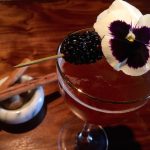
Their Annabelle is a cognac drink mixed with Trimbach Poire (a pear brandy I tried neat on Boulevard de Grenelle, Paris) and the old Normandy liqueur standby, Benedictine. It has a strong citrus bite, but underneath you can taste pear spirit and the smoothness of barrel-aged cognac. Then there’s the Saint-Tropez, a Beefeater cocktail that makes use of Crème de Yvette, which is a violet and berry flavored brandy liqueur invented by Charles Jacquin, a French émigré to Phillidelphia. (Though production halted in 1969, Crème de Yvette has been revived by the maker of St. Germain. Such are the ups and downs of the spirit world.) Saint-Tropez is a red, fruity drink with blackberries, pomegranate, and lemon juice to compliment the flowery spirits. Finally, I can’t ignore a drink that uses Chartreuse, the liqueur made by French monks from a secret recipe of 130 herbs. The Beau Gitan balances this powerful spirit with bitter citrus of Aperol, grapefruit juice, and Beefeater gin.
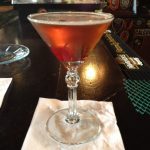
I brought a bottle of Picon Bière home with me from France. It is an orange bitter liqueur that is intended for adding complexity to light beer. It is not as strong, nor the same formula as the coveted Amer Picon, which is no longer available in the U.S., but, having no substitute, I used it to make a few cocktails at home. This is the recipe for the Manhattan’s neighbor, The Brooklyn Cocktail.
• 1 1/2 oz. rye
• 1/2 oz. dry vermouth
• 1/4 oz. Luxardo
• 1/4 oz. Amer Picon (Picon Bière used)
Combine all ingredients in a mixing glass with ice. Stir and strain into a chilled cocktail glass.