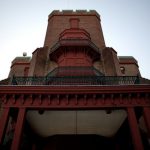
Once the largest and only federally-run mental hospital in the United States, St. Elizabeths now sits largely abandoned on a sprawling corner of Southeast. For years, D.C. has been promising big changes to the 173-acre east campus (the west campus has been slated as the new home for the Department of Homeland Security employees, though it is already more than a decade behind schedule). But with a proposal to build a new pro-basketball complex garnering support from the current administration and excitement in the community, movement finally seems imminent. In the meantime, though, DCist is delving into the campus as it stands now and digging into the archives to learn more about what it once was. Contributor and relentless explorer Pablo Maurer has roamed much of the grounds and scoured historical resources to find the stories hidden at St. Elizabeths for this five-part series.
I’m sitting in the Still Picture Research Room at the National Archives in College Park, Maryland, and a research assistant has just wheeled out a cart with two boxes of very old lantern slides, depicting life at St. Elizabeths Hospital. Some are almost 150 years old.
They’re breathtaking.
They were originally intended to be viewed in a projector, but I’ve laid them out on a light table and am taking photos.
As I lay at them out one by one, I turn the lights back on at St. Elizabeths. They were right to call these “magic lantern” slides. It’s as if you’d opened up the case files, the x-rays and what not, and put them up to take a good look.
In the mid-19th century, St. Elizabeths — at the time known as the Government Hospital for the Insane — was designed for “moral” treatment. Kindness, respect, decent food, clean surroundings, freedom from restraints, and work in hospital farms and gardens were all considered essential to a patient’s chance at improving. At the time, such therapy was near unheard of in the United States.
That respect for patients shows in the slides. The grounds are beautifully manicured. In one slide, a man feeds pigeons near some huge birdhouses. Another shows a small zoo: the hospital housed animals from the National Zoo during its construction in the late 19th century. In another image, a streetcar crawls up Nichols Avenue (now Martin Luther King Ave, SE.)
Gently, one by one, I pull the images out of their jackets. This one shows a billiards table in the center building, a goliath, multi-level structure now undergoing renovation on the west campus. The next slide shows a sign on a wall at the hospital: “Things to be remembered.” The last item on the list: “The law of kindness has no exceptions here.”

Across town at the National Museum of Health and Medicine in Silver Spring, is an entirely different collection of lantern slides, evoking a different range of emotions.
Wrapped in old paper, bundled together with twine, the slides at the NMHM are a window into the darker side of St. Elizabeths and of many large mental institutions in this country. These slides aren’t available to the public; they’re part of the St. Elizabeths Hospital Collection in the museum’s archives. Eric Boyle, the chief archivist at the museum, lays them out for me. He is endlessly helpful, and handles the slides — which have seen better days — with exceptional care.
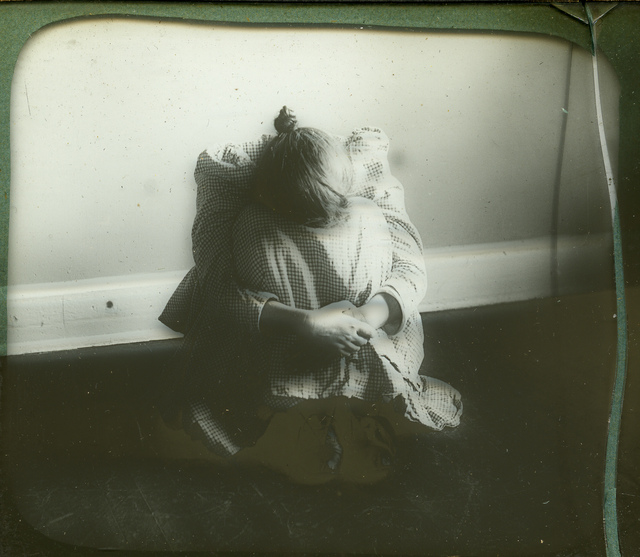
There are hundreds of them. Some are relatively uninspiring—instructional slides used during exercises with patients, or images of famous artwork, generic landscapes or still lives. But what I see in call number OHA 293.25, Boxes 4 and 5, is heartrending. The first slide is a female patient in a gingham dress, hunched over on the floor, holding herself in despair. Others are no less haunting—an emaciated man lies in bed, on the verge of death. In another bundle is the split image of a patient.: a crack in the damaged slide runs straight through the man’s forehead.
In other slides, there’s a bit of cheer. A baseball game at the hospital. A boxing match. In the 1940s patients huddle around an upright piano. A man dances happily in the foreground, but my eyes are drawn to a forlorn fellow leaning against the piano’s backboard.
And then there’s “Case: J.S. . . . As a little fellow he used to fear his mother and says he never had a real mother’s love.” What a face! Whoever prepared the images cut half of it away to conceal his identity.
The patients’ lives are like that. We see just a section, just a slide. I turn off the lights at St. Elizabeths for now, come back to the present, and head home.