Rachel Kurzius
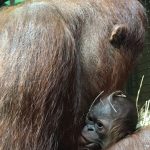
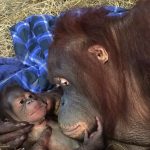
The orangutans at the Smithsonian National Zoo get to make a lot of decisions for themselves. “They are a great ape and we are a great ape as well,” says Erin Stromberg, a primate keeper at the zoo. “We want to offer them a lot of choice and control in their lives.”
During Orangutan Caring Week, an international effort to focus on the species, the zoo puts a special emphasis on showing off the different activities it offers to Batang, Bonnie, Iris, Kiko, Lucy, and Kyle.
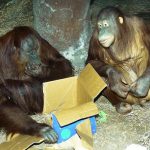
“Obviously we care about our orangutans every week, but it’s a nice way to feature them. We’re just constantly trying to find new ways to keep them active and their minds stimulated,” Stromberg says.
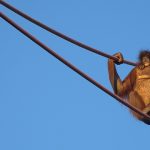
The Orangutan Transport System—more often known as the O-Line—allows the primates to swing across the cables to go to and from the Great Ape House and the Think Tank building. Celebrating its twentieth anniversary this year, the O-Line allows the primates to “choose where to spend the night and who to spend the night with,” according to Stromberg.
Of course, they’re not entirely free to make decisions about their lives. The Association of Zoos and Aquariums acts as a matchmaker. It determines a “Species Survival Plan,” which examines the primates’ genetics to decide who should reproduce together.
The SSP says that female Batang and male Kyle, both 19-years-old, are a breeding pair. Both are Bornean orangutans. Batang had been on human birth control (“We have to make responsible choices because orangutans can live past 50,” explains Stromberg), but was recently taken off the contraception to get things going with Kyle.
“She’s starting to feel her hormones a little bit, and that’s making her feel a little frisky,” says Stromberg. However, neither Kyle nor the other male, Kiko, have responded with interest.
The SSP might have its ideas about mating, but the orangutans get a say, too. “There might be a love connection on paper, but it doesn’t always work out,” says Stromberg. “It’s not like you can flip a switch and make things happen.”
Complicating matters is that Kyle already has a “lady friend”—Bonnie, born in 1976 and described on the website as “a particularly intelligent orangutan” and self-taught whistler.
Primate keepers know that Kyle and Bonnie are into each other because “they copulate all of the time,” says Stromberg. Are keepers worried about the drama that might ensue? “We’re actually hoping for jealousy from Batang. Everyone holds their breath when Kyle and Batang interact.”
Go for it, Batang. D.C. is already the city with the fourth-highest rate of women making the first move.
However, Stromberg cautions against ascribing too much of our human experience to the orangutans. A smile, for instance, means very different things to a human and to an orangutan. “They have unique facial expressions and vocalizations, though they don’t have as many as other primates because they’re the only great ape that doesn’t live in a social group.”