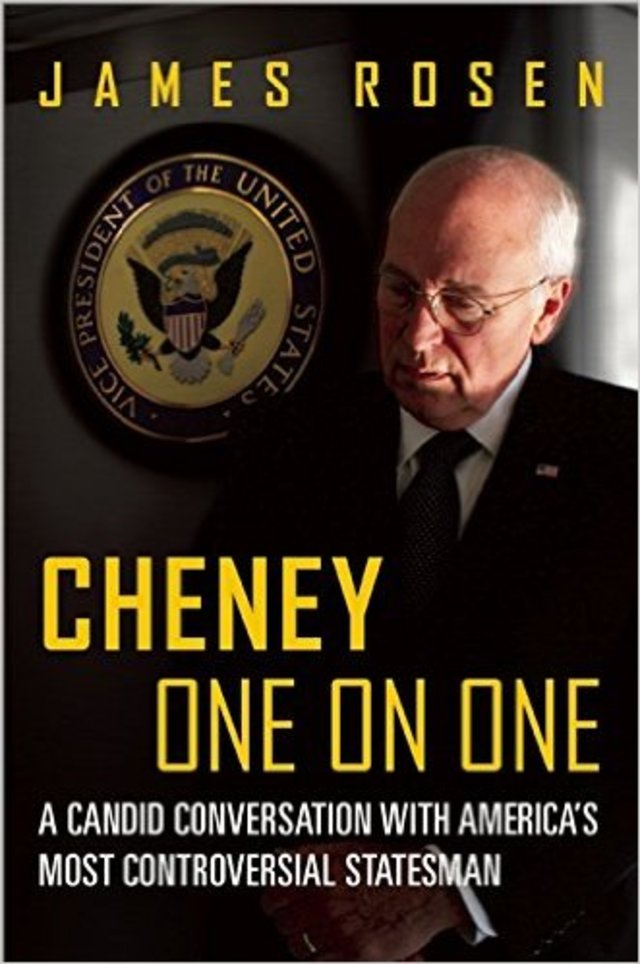
 What would it be like to talk with Dick Cheney for 10 hours? Now is your chance to ask James Rosen, who interviewed the former VP for his book Cheney One on One: A Candid Conversation with America’s Most Controversial Statesman (Regnery, $28). (You may have seen part of the interview adapted in this year’s April issue of Playboy, which, with 650 million hits, became the magazine’s most widely circulated article ever.) Rosen, a Fox News journalist, will discuss the book this Saturday, November 21st at Politics and Prose at 6 p.m.
Cheney One on One shares Rosen’s entire interview with the man sometimes called “Darth Vader” for his brevity and general gloom-and-doom demeanor. Rosen notes that Cheney sought no reward or editorial control, and only approved, but did not change, an interview outline ahead of time. Cheney also spoke with Rosen for four hours more than the time originally allotted.
The two leave few stones unturned: How Cheney’s religious identity formed during his World War II-era childhood. His back-to-back DUI arrests and failing out of Yale. His no-nonsense view of the world after serving in Congress on the House Select Committee on Intelligence and as Secretary of Defense under George H.W. Bush. His relationships with Colin Powell, George W. Bush, and Condoleeza Rice. And, of course, everything post-9/11 from invading Iraq to the Patriot Act and the CIA’s “enhanced interrogation techniques.”
Cheney seeks to put the whole Iraq debacle into context. As he describes it, they thought they were preempting another attack on the U.S. The response was not just to 9/11 but the threat that Iraq posed in the 1990s, and warnings that they were developing WMDs before he and Bush 43 were sworn in:
You’ve got to remember the situation we inherited when we took over. There were no-fly zones established north and south. Saddam Hussein was firing on our aircraft north and south. Two years prior to the time we arrived, [Congress] had passed legislation, appropriated funds, for the Iraq Liberation Act to support regime change … It’s very important when we talk about Iraq and what we did in Iraq to remember the circumstances at the time. And there is a tendency for the critics lots of times to sort of operate on the basis of “Uhhh, Bush and Cheney are sittin’ around the Oval Office on a Saturday morning and saying, ‘Well, let’s go do Iraq.'” Not true. Didn’t happen that way.
Unsurprisingly, Cheney does not approve of how President Barack Obama has handled troop withdrawal from Iraq, Syria, and other national security threats. Part of the interview is also spent on what Cheney would do differently.
Though the interview took place before Bush 41’s recent comments about Cheney’s “iron-ass” approach — different than the one he knew when Cheney was defense secretary, and perhaps a side effect of his heart trouble — Cheney told Rosen that “the question always comes up in terms of: ‘Does your heart disease affect your mind?’ And I have never been in a position where I felt the two were related … And there’s, I think, ample evidence to indicate that in my case, that hasn’t been a problem.”
Cheney still defends the decision to invade Iraq, and when Jon Meacham, who conducted the Bush interview, asked Cheney to respond, he said there was “no question” that he was “much harder-line after 9/11” than before.
Prior to joining Fox News in 1999, Rosen was a researcher for CBS News anchor Dan Rather. He is currently Fox’s chief Washington correspondent and hosts the online show “The Foxhole.” Cheney One on One is his second book following The Strong Man: John Mitchell and the Secrets of Watergate. Rosen lives in D.C. with his wife and their two sons.
The event is free and open to the public.