If you’re reading this, you’re likely familiar with D.C. United, the Major League Soccer franchise that’s called RFK Stadium home since 1996. If you’re a bit older, you might even be familiar with the Washington Diplomats, the club that played there from 1976 through 1982.
But you’ve probably never heard of Team America. Not the movie. The soccer team. They played a single season at RFK in 1983 and folded very shorty thereafter.
I wrote about Team America at length for a long-form on MLSsoccer.com—if you want the full, 5,000-word-long picture, feel free to take a look at that. Here, though, is the short version:
In the spring of 1983, with the North American Soccer League in a tailspin and the U.S. national team over 30 years removed from their last World Cup appearance, the NASL and the U.S. Soccer Federation banded together to form Team America.
The idea was straightforward, but innovative. The NASL’s 12 franchises would each loan a few of their top American players to Team America; Team America, in turn, would compete as an all-American super-club within the league, and would also double as the U.S. national team in training. The NASL, which at the time was suffering from plummeting attendance numbers and losing over $25 million a year, hoped the club would inspire young American fans to turn out in droves.

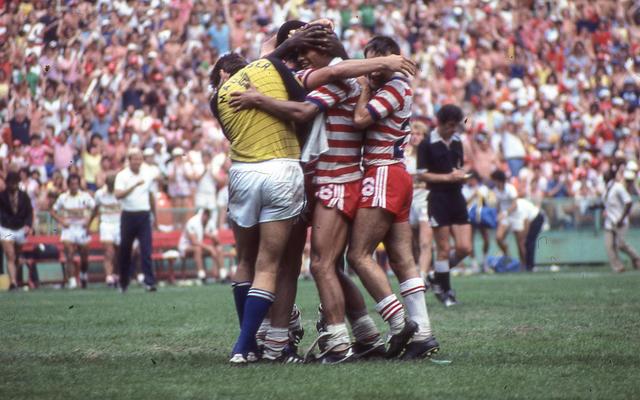
Photos by Tony Quinn.
The U.S. Soccer Federation also stood to gain from the arrangement—the 1984 Olympics were rapidly approaching and the 1986 World Cup was up for grabs after host nation Colombia backed out, citing financial instability. If the U.S. could put on a good showing at the Olympics and demonstrate a commitment to the game on an international level, they could perhaps land the rights to host the ’86 tournament, which would be a massive boon to soccer’s popularity in the U.S.
The club took up residence at RFK, signing an 8-year lease. D.C. residents were skeptical; in the 15 years prior, they’d seen four franchises—the Washington Whips, Darts, and two different incarnations of the Diplomats—come and go.
Undeterred, Team America’s front office pressed on with a full-court blitz of Americana. They signed a $1,000,000 sponsorship deal with Winston Cigarettes, lined up post-game events like fireworks displays and even a Beach Boys concert, and bedecked their players in red, white, and blue. General Manager Beau Rogers took a particular liking to the uniforms: “Tip a player on his side and what have you got? An American flag!” he told Sports Illustrated before the club’s first match.
Hell, Team America even visited the White House, something very, very few soccer teams had ever done up until that point.

Photo courtesy of the Ronald Reagan Library
What seemed like a great idea, though, was fraught with complications. Several top American players wanted nothing to do with the Team America concept and chose, instead, to refuse the loan and remain with their current clubs. The players who did join the team formed a rag-tag, defensively oriented bunch who played a low-scoring, hard-nosed brand of soccer that didn’t quite connect with the average American fan.
Injuries piled up, and attendance began to plummet. Team America started out strong, going 8-5, but finished the year having lost 13 of their last 15 matches. By year’s end, team owner Robert Lifton had lost nearly a million dollars. He pulled the plug on the project shortly after the club’s last home match. Team America was supposed to take the U.S. national team back to the promised land, but it had lasted less than a year.

Photos by Tony Quinn.
The entire league, which once featured such greats as Pelé, Franz Beckenbauer, Johan Cruyff and George Best, folded after the 1984 season.
In Team America’s aftermath, the U.S. did little at the ’84 Olympics; in May of 1983 the ’86 World Cup was awarded to Mexico, and the U.S. national team didn’t even manage to qualify for it.
Since then, Team America has since been relegated to the dustbin of U.S. soccer, an oft-forgotten footnote in our national team’s history. Which is a shame—in doing my research for my MLSsoccer.com piece, I chatted with a multitude of former Team America members who spoke of the pride they felt representing their country, the risks they took in leaving their former clubs to try something completely new, and their utter dejection at the concept’s failure.
A little bit of that comes to life in these photos, negatives and slides so graciously lent to me by D.C.-area photographer Tony Quinn, a dear friend who’s been shooting photos of soccer across the globe for decades. In grainy black-and-white and in warm, luminous Kodachrome, Team America springs back into action on a sun-soaked day at RFK. Enjoy!

Photo by Tony Quinn.