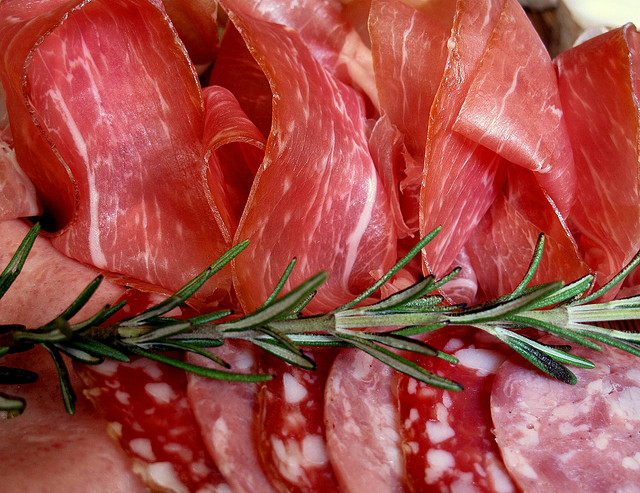
 Photo by LaTur.
Each month The Federal Forager explores some of the perks, puzzles, and pitfalls of eating and living more organically, locally, sustainably, and creatively in the D.C. region.
By DCist Contributor Bridget Dicosmo
You won’t find Ben Thompson, a Virginia butcher specializing in artisan pork products, cooking up pork chops very often for a family dinner. You’re more likely to find Thompson, of Rock Barn in Arrington, Virginia, serving up a homemade soup or stew, filled with fresh vegetables and flavored with a few ounces of a rich, smoky sausage like Andouille.
“You basically don’t have to always look for 12 ounces of protein in the center of the plate,” Thompson says. “Nobody eats 10 ounces of prosciutto at a time.”
In talking to Thompson and other folks who know their charcuterie and the science behind it, his approach—using rich, high quality meats as accent rather than entrée—is a common one.
Like other moderately health-conscious carnivores—and lovers of sopressata and bratwurst—I regarded with mild alarm the October International Agency for Research on Cancer classification marking red and processed meats as carcinogenic.
Sure, the idea that something that tastes as good as bacon does is probably bad for us didn’t exactly break new ground from a conceptual standpoint. But the agency’s definition’s of “processed meats,” covers any meat—including poultry—that’s been salted, cured, fermented, smoked, or otherwise tampered with to enhance its flavor or make it last longer. That description, overlapping with the definition of charcuterie, captures everything from deli-sliced turkey breast to fancier things like bresaola, regardless of whether the meat was processed in a factory or by hand.
The definition got me thinking. Am I actually being any healthier by choosing artisan meat products over factory processed? Is the risk the same? Nearly everything in that category that one comes across at Whole Foods claims to be nitrate-free—is that claim strong enough to guard against the risk? And haven’t we been preserving meat with salt since…well, since we figured out meat tastes good? What I learned is that, like most food health and safety puzzles, it’s not super simple.
According to Jason Story of Straw Stick & Brick (5111 Georgia Avenue, NW), artisan preserved meats generally contain less water compared to their industrial brethren, making the handmade variety taste “much more meaty.” And artisanal salumi is dry aged over a period of time—sometimes years. (Salumi is a catch-all term referring to the craft of salting and air drying meat. It’s different from salami, a type of fermented sausage that falls into that category.)
Artisanal butchers also usually offer a wide range of products culled from cuts of the animal you might not find in the grocery store aisle. “As a small butcher, you have to be resourceful” in utilizing more of the pig, Thompson says. The Rock Barn’s list of offerings runs the gamut from Mexican chorizo and smoked Tasso ham to a loin cut known as “man bacon.”
And though even artisanal products do generally contain some form of nitrates, they tend to be “less processed in general” than industrial deli meat, says Urvashi Rangan, director of Consumer Report’s consumer safety and sustainability group.
The nitrates issue is an old one, dating back to the 1960’s. Nitrates are naturally occurring substances found in soil and, as a result, in a variety of vegetables. They are used in meat preservation to kill harmful pathogens and improve the flavor and color of the meat.
The cancer risks stem from n-nitroso compounds or nitrosamines, produced from high concentrations of nitrates or when nitrates are heated above a certain temperature. “The evidence has been there for years,” Rangan says.
But changes in the curing industry since the 1960’s have led to a drop in the concentration of nitrates that must be added to meats, according to Joseph Sebranek, chair of the Iowa State University’s animal science department.
“The artisan, organic, natural cured meat products introduce more variety, but in general there is little difference in the nitrite content of these from conventional products,” Sebranek says. He adds that while there are a very small number of “similar-to-cured” products that actually do not include any nitrites, they have never been well-received in the market due to having off colors and flavoring.
Marion Nestle, professor at New York University’s nutrition, food studies, and public health department, says that her understanding is that the cancer-causing compounds are formed during curing. “I can’t think of any reason why artisanally made products should be any cleaner, but somebody would have to test to find out,” Nestle says.
But Sebranek says the nitrate used these days is at concentrations that are “essentially insignificant relative to health” and that nitrosamine formation has been largely eliminated by changes in curing.
“There are safe, controlled ways to do this,” The Rock Barn’s Thompson says. He has experimented with various types and concentrations of nitrates to arrive at a formula he believes offers a safe way to inhibit pathogens in a one-time application without residual levels of nitrates that could cause health risks. “We try to take as much time as we can to address each meat, do we need [additives], do we not need it,” and what is the lowest level that will achieve the desired result.
And Straw Stick & Brick’s Story says that most artisan meats are smoked at temperatures around 160 degrees Fahrenheit, lower than the heat needed to produce the compounds of concern. Frying up some bacon or heating a pepperoni-laden pizza in a hot oven might result in that type of heat, but not most curing processes, he says.
So if nitrate use is nearly ubiquitous even among artisan producers, why are so many deli meats, sausages, and other meat products labeled nitrate-free? Natural nitrates, or those derived from plants, such as celery salt, are not subject to United States Department of Agriculture labeling requirements.
That can be a double-edged sword, because synthetic and natural nitrates share the same sort of chemistry. However, with synthetic nitrates, USDA requires the concentration to be labeled. Natural nitrate additives do not have to be labeled as such, so those products that claim to be “nitrate-free” might actually be far from it. “Its just ludicrous,” Rangan says of the labeling loophole.
Still, Rangan points out that it can pay off to seek out artisanal meat producers because you have a better chance of learning where they get their meat. “If the animals are managed better, the meat itself can often be produced better as well,” she says.
Looking to crib some charcuterie? Here are a few good spots:
The Carving Room
The Carving Room’s (300 Massachusetts Avenue NW) menu features a number of house-cured meats, including its 21-day wet cured corned beef and a pastrami that is dry-cured over nine days. Don’t forget to also check out the homemade sides and in-house pickled veggies.
Cure Bar and Bistro
Dedicated to the art of curing and preserving food, Cure’s (10th & H Street NW) bar and dinner menus feature a charcuterie platter where you can sample a chef’s selection of a number of locally made cured meats, accompanied by spicy beer mustard and jalapeño jam.
Red Apron
Red Apron (multiple locations) has an exhaustive list of cured meat offerings, including “porkstrami,” summer sausage, half smokes, nduja, muffuletta, and more. The Partisan (709 D St NW), situated next to Red Apron’s Penn Quarter location and B Side, attached to the store in the Mosaic District (8296 Glass Alley, Fairfax, Va.), serve a bevy of the butcher’s products.
The Rock Barn
The Rock Barn (2387 Oak Ridge Road, Arrington, Va.) offers a wide range of pork products, including a number of hand-cured sausages and smoked meats. “Our core strength is smoked sausage, ham, and bacon,” Thompson says. The Rock Barn features an $80 monthly Porkshare that includes seven or eight selections of fresh cuts, sausages, and smoked meats from shoulders, loin, belly, and legs.
Straw Stick & Brick Deli
Straw Stick & Brick (5111 Georgia Avenue NW) uses meat from several local farms and offers more than two dozen varieties of cured meats, including biltong, bratwurst, pancetta, chorizo, and jerky, to name a few. Previously known as Three Little Pigs, the hand-cured salumi and charcuterie star in several of this deli’s hefty sandwiches.