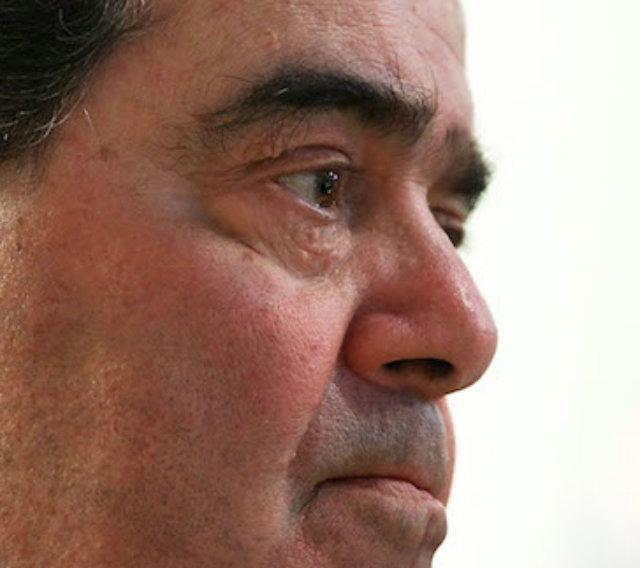
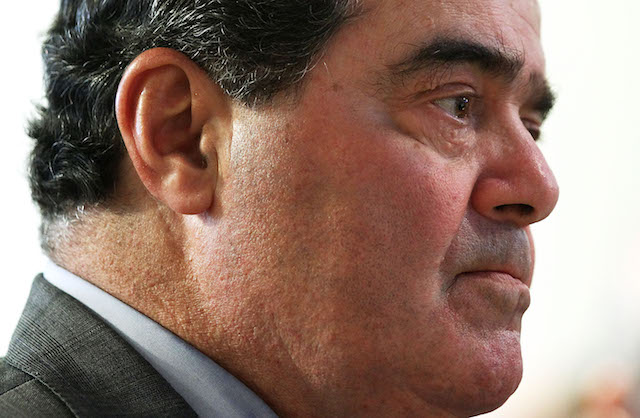
 U.S. Supreme Court Justice Antonin Scalia (Photo by Alex Wong/Getty Images)
In oral arguments today, U.S. Supreme Court Justice Antonin Scalia said that black scientists would benefit from going to less challenging schools than they do under affirmative action. He said, “Most of the black scientists in this country do not come from the most advanced schools” and that they would instead benefit from a “slower track.”
Scalia, an affirmative action critic, was discussing the case Fisher v. University of Texas-Austin, which was brought on behalf of a white woman who wasn’t accepted by the university. The case argues the university’s practice of taking race into consideration is unconstitutional. Talking Points Memo summarizes the case this way:
The case is unique in that the University of Texas accepts three-quarters of its students in a race-blind program (which actually was designed to increase diversity) that automatically accepts Texas high school students who are in the top 10 percent of their class. The other quarter of students are accepted through a qualitative “holistic” review that includes race along with a number of other personal and academic factors.
Citing an amicus brief, Scalia said “that it does not benefit African-Americans” that don’t do well in school to attend schools through affirmative action programs. He said, “They’re being pushed into schools that are too advanced for them.”
“I don’t think it stands to reason that it’s a good thing for UT to admit as many blacks as possible,” he said.
Scalia was referencing an amicus brief by UCLA law professor Richard Sander. Here’s a sample argument from the brief:
In “competition mismatch”, students receiving large preferences are at a competitive disadvantage, tend to receive lower grades, and become academically discouraged, which can lead to switching to a less competitive field of study or dropping out of school. A common example of “competition mismatch” occurs in the sciences at selective schools.19 Students with an interest in science who are admitted to a very competitive school via a large preference tend to drop out of the sciences at a much higher rate than do otherwise similar students who attend somewhat less competitive programs. Competition mismatch appears to be a major factor in the low rate at which African-American students become scientists, despite high levels of interest in the sciences.
Sander’s work is cited often by those hoping to abolish affirmative action, including columnist George Will (who pioneered the idea of rape victims being a “coveted status”) and the conservative think tank Heritage Foundation.
Some have pointed out the Scalia ignored another filed brief that points out the flaws in this research:
So basically Scalia n’dem took the first brief and ignored the brief that pointed out the flaws in Mismatch Theory. Because WHY NOT.
— Elon James White (@elonjames) December 9, 2015
We’re curious to hear what people like the Harvard-educated, outspoken Neil deGrasse Tyson has to say about Scalia’s comments. In the meantime, plenty of people are speaking out:
After Scalia’s remarks, the (white) education reporter next to me asked, “Who was that who just said that straight up racist thing?”
— Irin Carmon (@irin) December 9, 2015
As a graduate of THE University of Texas, undergrad AND law school, I find Scalia to be a waste of skin. @TexasExes https://t.co/i4mA7CXgZ6
— April (@ReignOfApril) December 9, 2015
If I listened to #Scalia I never would have applied to and graduated from 2 Ivy League schools. This level of ignorance is dangerous.
— Vanessa K. De Luca (@Vanessa_KDeLuca) December 9, 2015
shorter scalia: maybe n****** are just dumb.
#ElectionsMatter https://t.co/H86Zx0kRFw
— Oliver Willis (@owillis) December 9, 2015
#SCOTUS Justice Scalia says affirmative action sends black kids to schools that are too advanced for them. Is this:
— Yes, You’re Racist (@YesYoureRacist) December 9, 2015