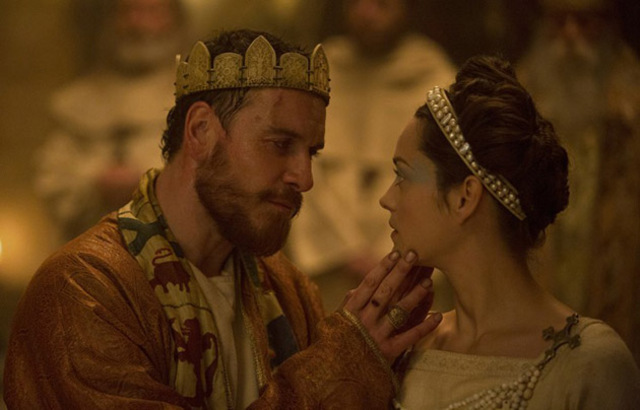
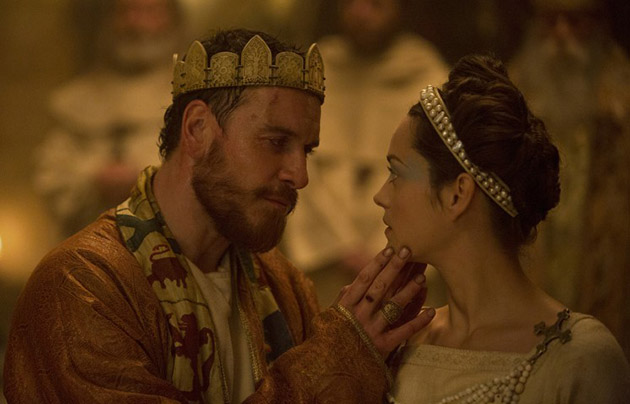
 Michael Fassbender and Marion Cotillard (TWC)
Do we really need another Shakespeare movie? If studios can reboot contemporary franchises like Spider-Man, why not revisit and reinterpret great literature whose rich characters and language may resonate in different ways for different generations, with different actors and different personalities? The latest version of one of the Bard’s bloodiest and most frequently adapted tragedies is a more than respectable entry in the vast catalogue of Shakespearean cinema. Australian director Justin Kurzel gives us a Macbeth that is gory, brutal and moody, full of sound and fury and signifying something: a stark world whose leaders have visions of demonic witches that spur them on to greater evil.
Kurzel (The Snowtown Murders) takes a modern approach—not in costume, which stays close to period, but in execution. The film is informed by the ghosts of Shakespearean cinema past, but it’s powerful enough that you don’t miss them. Blood-red tinted frames suggest silent cinema. If the gore sometimes reaches horror-movie levels, the grit and grime of soiled battle garments and bedclothes keep these doomed players immersed in historical filth.
The film departs from the play immediately. Shakespeare opens with the three witches, as if everything that follows is seen from their demonic omniscience. Kurzel throws the viewer onto a tragic battlefield where Macbeth (Michael Fassbender) and his wife (Marion Cotillard) mourn the death of their son. The ensuing slow-motion battle montage is inspired, on a smaller scale, by Kurosawa’s Ran, which taught Kurzel the valuable lesson that the visceral power of combat doesn’t need a bloodcurdling soundtrack to be effective. Kurosawa’s epic battle was scored to the mournful strains of music by Tôru Takemitsu, but Kurzel settles on a near silent soundtrack to convey visual horror.
Watching this horror from the field is the misty vision of the three weird sisters, joined by another of Kurzel’s inventions, a spectral child as young as Macbeth’s dead boy. This implies that the witches use the general’s loss to manipulate him into doing their bidding, for what seems to be his own advantage. These aren’t witches with a traditional cauldron, but apparitions that watch over bloody fields as if emerging from the underworld to direct the action on earth.
For all the film’s violence, Fassbender and a strong supporting cast are for the most part subdued, as if resigned to their fate as the witches’ pawns. On the other hand, Cotillard’s Lady Macbeth is more aggressive, wielding her sexuality as power. As she encourages her husband to kill Duncan (David Thewliss), she ravages him in a makeshift church. Kurzel avoids the obvious staging of her famous “out, damn’d spot” speech, relegating her hand-washing to a brief insert shot as she addresses the line to a ghost. This is an adaptation that manages to be both traditional and fresh, and with the help of Adam Arkapaw’s brooding cinematography, Kurzel makes it cinema that’s vital enough that it needs to be seen on the big screen.
—
Macbeth
Directed by Justin Kurzel
Written by Jacob Koskoff, Michael Lesslie and Todd Louiso, based on the play by William Shakespeare
With Michael Fassbender, Marion Cotillard, David Thewliss, Paddy Considine.
Rated R for strong violence and brief sexuality
113 minutes
Opens today at Landmark E Street Cinema and Angelika Mosaic