Rachel Kurzius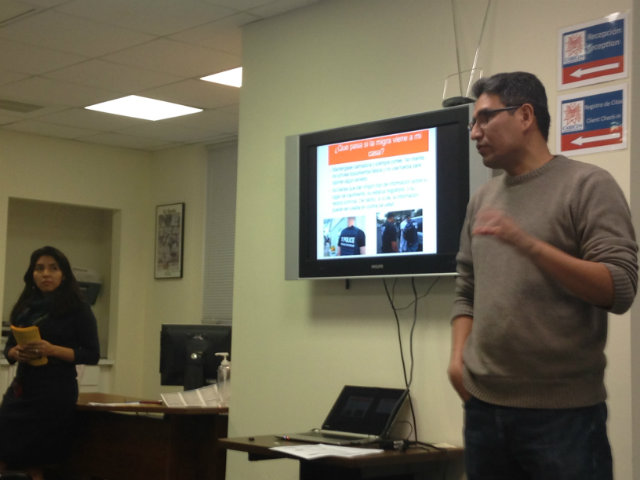
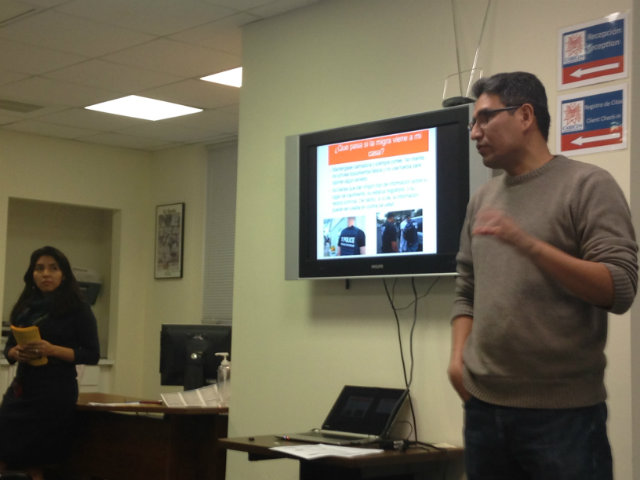 CARECEN Director of Legal Services Eleonor Velasquez and Executive Director Abel Nuñez lead a “Know Your Rights” workshop. (Photo by Rachel Kurzius)
Stay calm. Do not open the door. Make an emergency plan for your kids.
At a “Know Your Rights” presentation from the Central American Resource Center (CARECEN) this Saturday, a steadily growing group of attendees learned about what they should do in the event of a knock on the door from law enforcement.
For many undocumented immigrants, 2016 started with foreboding news: the Department of Homeland Security would be increasing its deportation raids.
According to DHS Secretary Jeh Johnson, the targets of these operations are those apprehended after May 1, 2014 crossing the southern border who “have been issued final orders of removal by an immigration court, and…have exhausted appropriate legal remedies, and have no outstanding appeal or claim for asylum or other humanitarian relief under our laws.”
D.C. Police does not cooperate with Immigration and Customs Enforcement officers, and Montgomery County Executive Ike Leggett and the county council spoke out against the policy.
“We are very concerned that any federal enforcement actions in our county not undermine this trust and threaten public safety in our community. We want all of our community members to know that they are free to go about their daily lives, to go to schools and work, social service agencies, hospitals and medical clinics, community organizations and public buildings, as well as grocery stores and other commercial areas,” said Leggett in a statement.
Advocates say those concerns are well-founded. “People are afraid, especially of law enforcement,” says Sarah Palazzolo, communications coordinator of CARECEN. “We’ve definitely seen an escalation of fear.”
And some local government officials like it that way. “I’m going to do the very best that I can to encourage illegal aliens who want to commit crimes to leave Prince William County, in fact to leave Virginia all together, go up to Maryland, because you’re welcome up there,” said Prince William County Board Chair Corey Stewart told WUSA.
While ICE doesn’t have the right to enter a person’s house without a warrant, the Southern Poverty Law Center is investigating whether the agency “used coercion and deception as part of the raids.” Palazzolo says that ICE agents operating in the D.C.-area often pretend to be local law enforcement, and provide documents other than warrants to gain access to people’s homes.
Much of the informational session revolved around how to identify a warrant. “It needs a judge’s signature and the name of a court to be valid,” said Eleonor Velasquez, CARECEN’s director of legal services, in Spanish, to the crowd. It also has to include a person’s exact address.
Velasquez handed out examples of valid warrants and other legal documents, like deportation orders, so that attendees could compare them.
When asking officers to provide a warrant, people should tell them to slide the documents under the door, Velasquez said. As soon as you open the door, you grant officers entrance into your home. “Don’t open the door, and tell your kids not to open the door,” she said, until you can confirm that the warrant is legitimate.
If the warrant is for real, Velasquez reminded folks that they have the right to remain silent, and told them not to give fake information or use force to prevent an arrest.
Abel Nuñez, CARECEN’s executive director, underlined the importance of prevention in dealing with deportations. While it’s possible to win in the courts, he said it was better to prevent a deportation case altogether by exercising caution when dealing with law enforcement.
“It’s better to maintain silence than lie,” he said. “You have rights.”
CARECEN passed out this card for attendee’s use, which has the 4th and 5th amendments in English and Spanish.
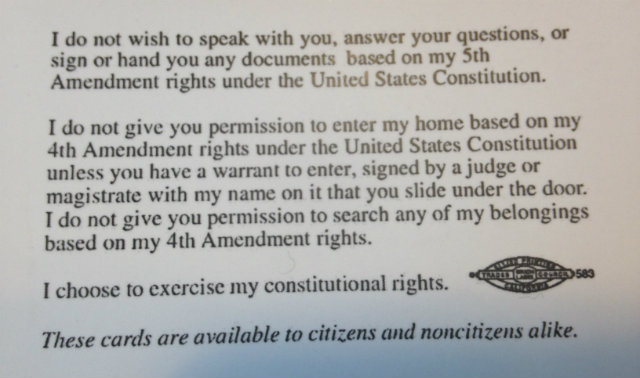
But just in case, Nuñez recommends that people memorize a phone number to call and have plans in place for childcare.
While this informational session was planned in response to the new policy announcement, Palazzolo says that raids aren’t new.
“ICE carries out raids routinely,” says Palazzolo. “There are always raids going on in D.C., Maryland, and Virginia.”
This Saturday, activists will take to the White House to protest the policy.