Rachel Kurzius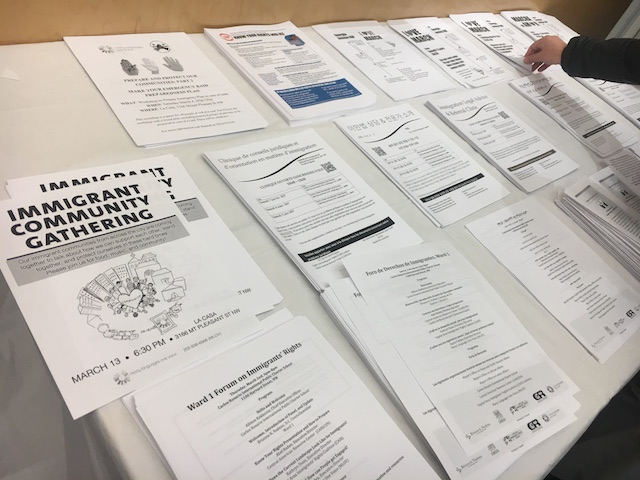
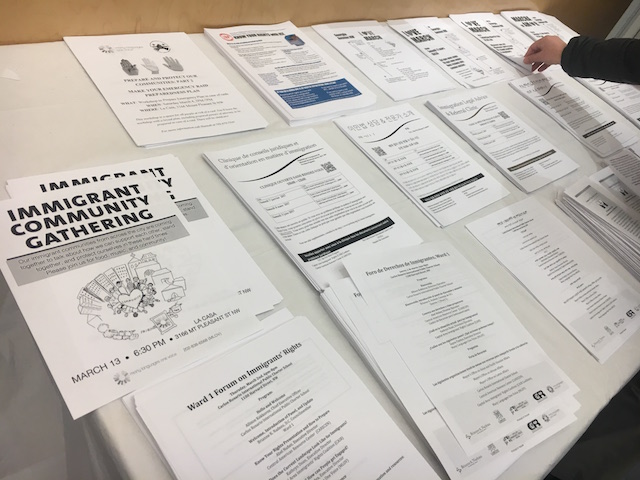 Information about future workshops and resources at the Ward 1 Forum on Immigrants’ Rights. (Photo by Rachel Kurzius)
Undocumented immigrants in D.C. need to have a plan in place in case they’re apprehended by U.S. Immigration and Customs Enforcement, advocates say.
“The moment you’re in front of an ICE officer, there’s a 99 percent chance you’ll get detained and taken by ICE,” Abel Nunez, executive director of the Central American Resource Center, said at an immigrants’ rights forum on Thursday evening. But there’s still hope, he said. “Being detained is not being deported. It’s not game over when you’re in front of ICE and it’s not game over when you’re detained.”
The 400-seat auditorium at Carlos Rosario International Public Charter School was packed with people, many of whom were listening to the speakers through translator devices. Near the front of the auditorium, the murmur of translators putting the speakers’ words into Spanish (the most common language in the area other than English), Amharic, French, and Vietnamese was audible.
“The new presidential administration has raised fears in our immigrant community,” said Ward 1 Councilmember Brianne Nadeau, whose office organized the forum. “It’s difficult as an elected official who supports you all to calm the fears because they’re very real.”
As a matter of safety, attendees were told not to take photographs or livestream the event, and the organizers advised those who asked questions to avoid giving out any personal or identifying information.
The forum provided practical advice for dealing with ICE, like the the need for people to know who will take care of their children and their finances if they are detained “The best weapon to have in the struggle is knowledge, and also solidarity,” says Nunez, whose organization regularly holds “know your rights” workshops.
Regardless of immigration status, everyone has two major rights: the right to remain silent, and the right to be safe in one’s own home, meaning that, without a signed warrant from a federal judge, people can refuse ICE entrance to their house. “The moment you crack that door open, you’re giving them authority to come in,” warned Nunez.
While there have not been any reported ICE raids in D.C. since Donald Trump became president, according to Edith Hinson, a staff attorney with the Capital Area Immigrants’ Rights Coalition, there have been several in Maryland and Virginia. D.C. has about 70,000 immigrants, and roughly 25,000 are undocumented. Immigrants make up a quarter of the city’s workforce.
“Immigration law has not changed. The president cannot unilaterally change the law,” said Hinson. “What he can change is how we’re enforcing the law.” She added that her organization has seen the expanded use of detention.
If someone is detained, she advises not to sign any documents. “You have the right to an interpreter,” she said. Then, the case works its way through immigration court, which she said took three to six months for a detained person, and one to two years for someone out of detention. The tricky difference between immigration and criminal court is that there’s no right to a free attorney in immigration court.
Mayor Muriel Bowser has affirmed that D.C. remains a sanctuary city, and her administration launched a new $500,000 grant program for immigration services, including representing D.C. residents in deportation hearings.
“Washington will value all immigrants, regardless of immigration status,” Jackie Reyes, the executive director of the Mayor’s office on Latino Affairs, told DCist on Thursday evening. “We do get calls about people being scared, and that has increased, but we want to be on message: keep repeating and repeating that we’re a sanctuary city.”
“Sanctuary city” is a designation that largely carries symbolic power and some protections for undocumented immigrants. ICE can still operate in the District. But D.C. law enforcement officers can’t inquire about immigration status during stops, and the city limits cooperation with federal authorities to turn people over for deportation.
The executive director of Many Languages One Voice, Sapna Pandya, outlined her organization’s demands for strengthening D.C.’s protections, including saying “no” to ICE in D.C.
“Keep an eye on the police and the jails,” she said. “We believe that no one’s information should be shared with ICE, but currently police and jails are violating that policy.”
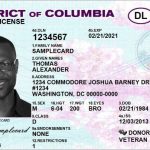
Another demand from MLOV is “One city, one license,” Pandya said. While undocumented immigrants can also get driver’s licenses or IDs in D.C., they have a marking that distinguishes them. Nadeau, At-large Councilmember David Grosso, and Ward 2 Councilmember Jack Evans have introduced legislation at the D.C. Council to change this.
While the forum focused on what immigrants can do, the panelists suggested some ideas for allies. Hinson said that the bail process was tough for undocumented immigrants, who often lacked someone with secure status to pay the fee in person. Pandya suggested Sanctuary DMV, a new group strategizing ways to protect immigrants locally. “You need to be willing to risk what you have,” Hinson told allies.
One thing that doesn’t help? Posting about ICE raids or checkpoints without confirmation, which they all said needlessly increased fear.
Attendees wanted to know if there were any places that ICE could not go. “ICE and other law enforcement agencies don’t have to respect ‘safe spaces’ like churches, schools, and courthouses,” said Nunez, even though the previous administration generally did so. He cautioned against relying on those spaces for safety.
The leader of the Washington Archdiocese, Cardinal Donald Wuerl, had a similar sentiment in an interview with The Washington Post. He spoke out against deportation but added that “when we use the word sanctuary, we have to be very careful that we’re not holding out false hope. We wouldn’t want to say, ‘Stay here, we’ll protect you,’ ”
Still, people from more than 150 religious congregations have attended meetings by Sanctuary DMV.
ICE agents arrested a group of men outside of an Alexandria church on February 8. Rising Hope Mission Church’s Reverend Dr. Keary Kincannon spoke out against the ICE crackdown in a press conference with elected officials and nonprofits on Thursday afternoon.
“These new policies of the Trump administration exist to incite fear,” said Congressman Don Beyer (D-VA). “They exist to make immigrants feel unwelcome, to make them flee. We are here to make sure that we do not destroy the remarkable, inimitable fabric of our nation of immigrants with scorched earth immigration policies.”
Alex, an undocumented immigrant originally from Guatemala who lives in D.C., says that some of his friends, fearing deportation, have already left for El Salvador and Mexico.
“Before the inauguration it was a little scary,” Alex, who requested we not publish his last name (one former DREAMer was arrested by ICE shortly after speaking out at a press conference in Mississippi). When Trump moved into the White House, Alex said it got “more scary.”
While he now knows not to open the door for ICE agents, he didn’t seven years ago, when officers came knocking at 3 a.m. at his Virginia home. They gathered everyone in the living room, he said, and checked their IDs to see if they had criminal records. “Thank God nobody had bad records. If I knew my rights at the that time, I would have let my other friends know not to open the door.”
Now, though, with changed priorities for ICE, Alex and his housemates all would have likely been arrested, despite their lack of criminal history. He calls his life in the D.C. area “a miracle” and can remember the exact hour he arrived stateside in April 2004. It hasn’t been without challenges—he described multiple instances of “working hard for many hours and not getting paid by contractors”—but here he “met a girl, who is my wife now. She’s the reason why I’m still going on.”
Alex, who is of Mayan descent, prefers the term Native American to undocumented immigrant. “People who don’t like immigration have to remember who was there first, before they came,” he said. “That should be a reminder for them about “illegal immigration.”
D.C. Bar Pro Bono Center is hosting an Immigration Legal Advice and Referral Clinic at Carlos Rosario International Public Charter School (1100 Harvard Street NW) on Saturday March 4 from 10 a.m. to noon. Many Languages One Love is hosting a workshop for preparing an emergency plan in case of raids on Saturday, March 4 from 5 to 7 p.m. at La Casa (3166 Mount Pleasant Street NW).