 Rachel Sadon
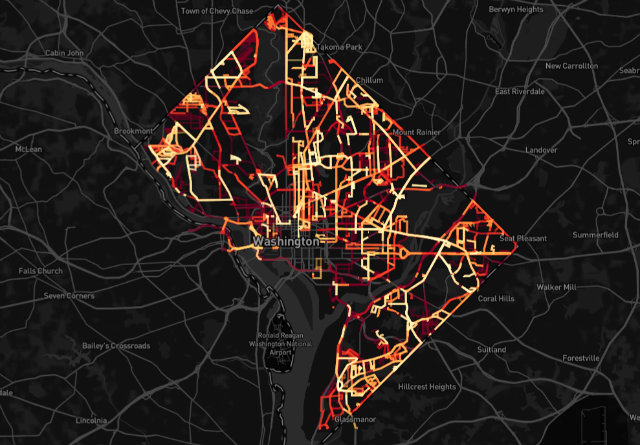 See interactive map here.
Updated with comment from the Office of the City Administrator
D.C. has made it pretty easy to check if your street has gotten plowed or a salt treatment. But that only gives a small snapshot of the city’s massive efforts to dig the District out.
Tom Lee, who works on data projects for Mapbox (and is a former DCist contributor), wanted to get a bigger picture look. Naturally, he made a map.
“D.C. publishes the locations of its plows in a kind of a lousy format that makes it hard to get them all in the same place. So I wrote a script that walks through the whole city and grabs all the plow locations,” Lee explains.
The brighter the route on the auto-updating map, the more recently it has been plowed.
Unsurprisingly, the map shows the diagonals and major arteries like North Capitol getting a significant amount of attention, and it appears to be evenly distributed throughout the city. You can also see how bright the routes are on the way to RFK stadium, where the plows dump their collected snow.
only a few residential areas getting plowed so far. would love to know whose friends live here… pic.twitter.com/S2ZJ2OtsvJ
— Tom Lee (@tjl) January 24, 2016
But as he was following along, Lee realized that a small pocket of upper Northwest was among the very first residential areas to see plow action last night. “I noticed that most of the early plowing was on the big arteries, but one notable exception was far upper Northwest. Some small residential streets there saw plowing earlier” than anywhere else. (We reached out to DPW for an explanation and will update this post with their response)
“Temperatures tend to be lower in upper Northwest, when compared to other parts of the city, which results in snow falling earlier there and reaching higher accumulations,” Olivia Walton Dedner, the communications director for the Office of the City Administrator, told DCist. “Light plow routes ring the District and are in Southeast and Northeast as well as upper Northwest.”
Moreover, the map would only reflect the work of D.C. plows. “Due to the severity of this storm we have brought in hundreds of contractors from as far away as Indiana and Massachusetts who are not equipped with GPS that feed into our system,” she said.