 Rachel Sadon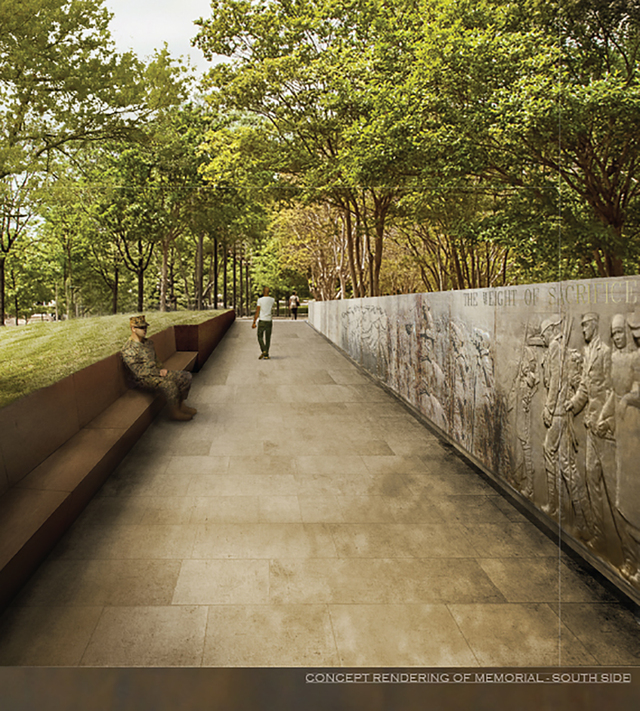
The World War One Centennial Commission has announced the winner of a design competition for a planned memorial in Pershing Park.
The commission chose “The Weight of Sacrifice,” by Chicago architect Joe Weishaar and New York sculptor Sabin Howard, from more than 350 entries and five finalists. The proposal uses two kinds kinds of sculpture and quotations from soldiers to “stress the glorification of humanity and enduring spirit over the glorification of war.”
Congress authorized the memorial last year for the 1.8 acre park, which is located at Pennsylvania Avenue NW and 14th Street NW. It is meant to honor the 4.7 million Americans who served in the war, and would join the nearby memorials of three other wars on the National Mall.
Each cubic foot of Weishaar and Howard’s design represents an American soldier lost in the war: 116,516 in total. From the project overview:
The raised figurative walls visually express a narrative of the sacrificial cost of war, while also supporting a literal manifestation of freedoms enjoyed in this country: the open park space above. The urban design intent is to create a new formal link along Pennsylvania Avenue which ties together the memorial to Tecumseh Sherman on the West and Freedom Plaza on the East. This is achieved by lowering the visual barriers surrounding the existing Pershing Park and reinforcing dominant axes that come from the adjacent context.
The raised form in the center of the site honors the veterans of the first world war by combining figurative sculpture and personal narratives of servicemen and women in a single formal expression. The integration of a park around and atop the memorial alludes to the idea that public space and personal freedom are only available through the sacrifice of our soldiers.
But plans to completely remake Pershing Park, which already includes a memorial to WWI (the park is named for U.S. Army General John Joseph Pershing), have proved controversial. Charles Birnbaum, of the Cultural Landscape Foundation, is among those leading the call for the M. Paul Friedberg-designed park to be protected or at least incorporated into the new design.
“The World War I Memorial Commission did meet with stakeholders, and they also knew that Pershing Park would likely be eligible to the National Register, which would restrict the impact on the park, but they never really listened,” Birnbaum, said in a release. “Instead, they opted for conflict over collaboration.”
Proponents say the park has fallen into disrepair and it is time to give it new life. The stated objective of the competition is “to transform Pershing Park from a park that happens to contain a memorial to a site that is primarily a national World War I memorial, within a revitalized urban park setting with a distinct sense of place that complements the memorial purpose.”
Several groups, including the National Park Service and the National Capital Planning Commission, will have to sign off on the design.
Weishaar is just 25 years old, according to the Chicago Tribune. “Just even making it to the second round of the competition was entirely overwhelming. It’s the greatest opportunity I’ve ever head in my life, and I’m enthralled to see where it goes,” he told the paper.