 Rachel Sadon
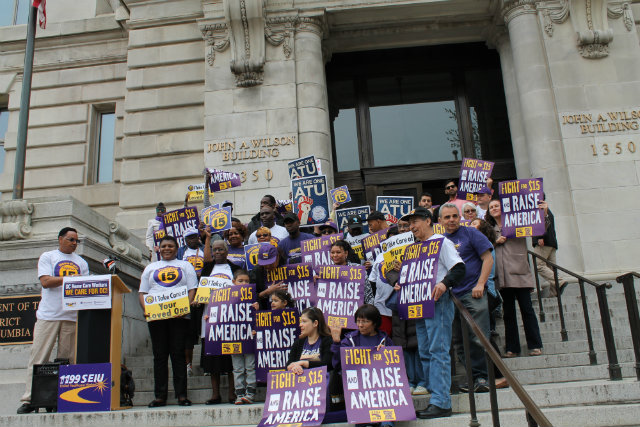 Photo by Rachel Sadon.
Seven in ten residents “definitely support” a $15 per hour minimum wage by 2020, according to a D.C. Vote-Washington City Paper released this week. But a judge ruled today that they shouldn’t get a chance to vote for it.
Last spring, a coalition of activist groups launched a campaign to get a measure on the ballot for a $15 minimum wage in the District. In July, the D.C. Board of Elections approved language for a ballot initiative over the protestations of business groups. That meant that they could go out and gather the more than 20,000 signatures necessary to secure a vote.
But Harry Wingo, then the head of the D.C. Chamber of Commerce, sued; he argued that the three-member board wasn’t “properly constituted.” Martin Austermuhle had a great overview of the somewhat complicated situation in WAMU last year:
By law, the board’s three members are appointed by the mayor and confirmed by the Council. They serve terms of varying lengths, and at least one has to be from the non-majority political party. (In D.C., that’s Republican or Statehood Green.)
The last appointments came in late 2011, when Mayor Vincent Gray picked three people for the board — Devarieste Curry, Stephen Danzansky and Deborah Nichols. They were all quickly confirmed, but their terms were limited. Nichols’ term expired in July 2012, Curry’s in July 2013 and Danzansky’s in July 2014. They were not reappointed, but have remained on the board through this year. (Curry resigned in April, but Danzansky and Nichols still serve.)
Since their terms expired, the board’s members made a number of routine—albeit significant—decisions, such as ruling on when elections should happen, who and what will make it on the ballot, and whether to certify election results.
Additionally—and this gets to the matter at hand—it was in July that the board, down to two people after Curry resigned, approved the language for the $15 minimum wage ballot initiative.
According to a court filing from Wingo’s lawyers, that’s a problem—because there’s a D.C. law saying that members of D.C. boards and commissions can only stay on for 180 days after their terms have expired.
A judge ruled in Wingo’s favor (he’s since left the DC Chamber of Commerce) that the board wasn’t properly appointed and thus the initiative was improperly approved. In other words, not only is the $15 ballot initiative in question, but so are a number of other decisions made by the city’s election board, including Mayor Muriel Bowser’s election and Initiative 71.
“The Chamber of Commerce is willing to blow up democracy just to keep wages low,” said Delvone Michael, executive director of DC Working Families and co-chair of the DC for $15 coalition, in a release. “Today’s outrageous ruling asserts that we do not have the right to determine our own destiny in the District of Columbia.”
Activists vowed to appeal the decision. “I’m confident that one way or another we will get to a $15 minimum wage in D.C. People want a higher minimum wage, and this decision will do nothing to chill the momentum behind ballot initiatives to raise wages across the country,” said Ryan Johnson, executive director of The Fairness Project.
But Bowser has been deeply skeptical of the ballot measure. “I don’t know that it is going to get on the ballot, so I’m going to see about that,” Bowser told DCist in December. “I think the Council actually went through the right process in raising the wage that has not put the District at a competitive disadvantage … Let me just put it this way: If it gets on the ballot, it wouldn’t affect the federal government or the D.C. government. That doesn’t sound right to me.”
In 2013, the D.C. Council passed a law raising the minimum wage from $8.25 to $11.50 by 2016 through gradual year-by-year increases. After this year’s hike, the minimum wage will be indexed to inflation from here on out.
But under the proposed ballot initiative, the wage would continue rising according to the following schedule: $12.50 in 2017, $13.25 in 2018, $14 in 2019, and $15 in 2020. The initiative would also raise the minimum for tipped workers to $15 by 2024.
Former Mayor Vincent Gray vetoed the so-called living wage bill in 2013, which would have guaranteed employees of large retailers—namely Wal-Mart—a minimum wage of $12.50 per hour, to keep their planned stores in the city. That ended spectacularly poorly.