Rachel Kurzius
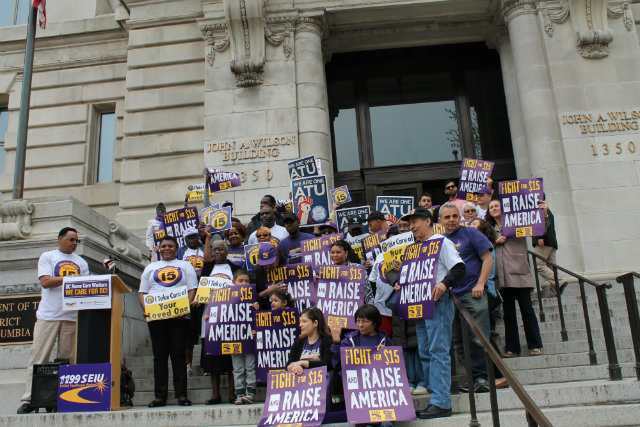 Photo by Rachel Sadon.
It’s still up in the air whether D.C. residents will get the chance to vote for a ballot initiative that would raise the minimum wage to $15 an hour—D.C. Superior Court Judge Maurice Ross declined to make a final ruling in court today.
But that’s not all that a lawsuit brought by Harry Wingo, then the head of the D.C. Chamber of Commerce, called into question. By charging that the D.C. Board of Elections wasn’t “properly constituted” when it approved of the ballot initiative’s language, the lawsuit in effect muddies the waters for all the BOE’s decisions during 2014, including the election of Mayor Muriel Bowser, Initiative 71, and more.
In late January, Ross ruled with Wingo that the elections board wasn’t properly appointed and, therefore, the initiative was improperly approved. The BOE, D.C. for $15, and the Office of the Attorney General filed a motion to reconsider shortly after.
“It certainly does open the Pandora’s box,” says Robert Marus, spokesperson for the Office of the Attorney General. “This is an important case. Leaving aside ideological issues, the legitimacy of the elections board is important for the stability of a democracy.”
Today, Ross heard arguments from AG Karl Racine (also elected in 2014), among others. After two hours of deliberation, he declined to issue a final ruling on the matter.
Marus says that “each judge at the Superior Court deals with timelines differently, and it’d be imprudent to say something, positive or negative” about the timeline. “It’s clearly a weighty legal question.”
But Delvone Michael, Executive Director of DC Working Families and Co-chair of DC for $15, says that this “is highly irregular and a little kooky.” Michael says that he is grateful for Racine’s support in court. “Up to this point, the AG is the only one speaking out on it,” he says. “It’s amazing that the mayor has her head in the sand.”
In 2013, the D.C. Council passed a law raising the minimum wage from $8.25 to $11.50 by 2016 through gradual year-by-year increases. After this year’s hike, the minimum wage will be indexed to inflation from here on out.
But under the proposed ballot initiative, the wage would continue rising according to the following schedule: $12.50 in 2017, $13.25 in 2018, $14 in 2019, and $15 in 2020. The initiative would also raise the minimum for tipped workers to $15 by 2024.
Seven in ten residents “definitely support” a $15 per hour minimum wage by 2020, according to a D.C. Vote-Washington City Paper poll.
Michael says the campaign is moving “full-speed ahead” and will be ready for the ruling whenever it comes.
“D.C. is the greatest city in the world, and unfortunately we also have one of the greatest income gaps,” Michael says. “It doesn’t have to be that way, but some people don’t mind.”