 Rachel Sadon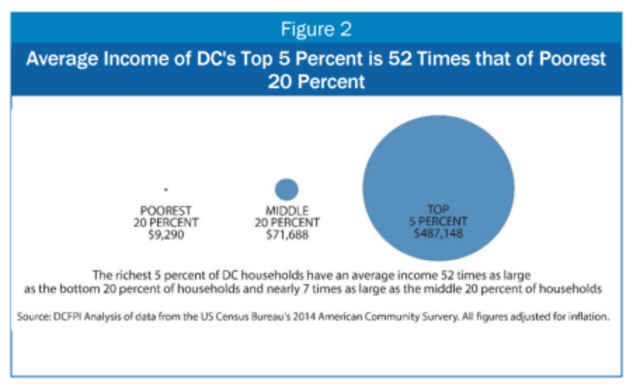
 Courtesy of DCFPI
The story of the rich getting richer and the poor getting poorer is playing out across the country, but few cities have the level of disparities seen in the District of Columbia.
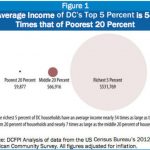
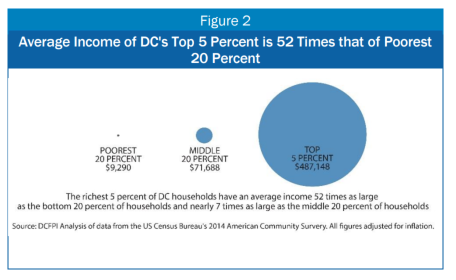
The top 5 percent of D.C. residents earned 52 times the income of the bottom 20 percent in 2014, according to a report released last week by the D.C. Fiscal Policy Institute. That puts the nation’s capital fifth in income inequality behind New Orleans, Boston, Atlanta, and New York City.
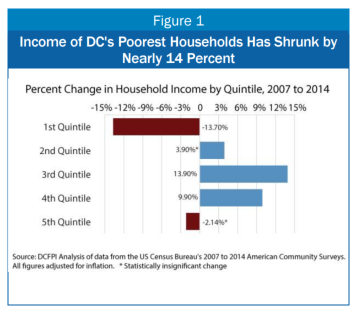
Right before the Great Recession, the poorest fifth of D.C. households earned just $10,800, when adjusting for inflation. Seven years later that figure fell by nearly 14 percent to $9,300. That is about equivalent to what low-income families earn in El Paso and Albuquerque—places with significantly lower costs of living.
Conversely, D.C.’s high earners are among the wealthiest in the nation—the third highest in fact, with the top 5 percent making an average household income of $487,000.
“Between the concentration of wealth at the top, and extreme poverty at the bottom, the nation’s capital is a poster child for income inequality,” said author of the report, Peter Tuths.
 Courtesy of DCFPI
Over the same seven year period after the Great Recession, the top 20 percent of earners was the only other group to see a decline in income. But at just 2 percent, that means that the income gap has only yawned wider.
That burden is primarily being borne by people of color and those who grew up in the District. Of the poorest group, nearly three-fourths of households were headed by people of color, and almost half were headed by someone who was born in D.C. (in the general population those figures are 31 percent and 17 percent respectively), according to the report.
“D.C.’s poor residents are suffering alone,” Tuths said. “The economic development that is pushing up housing costs throughout the city is leaving collateral damage in its wake.”