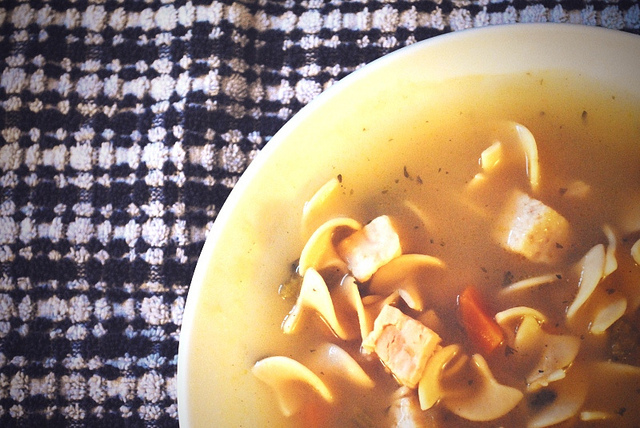
 Photo by Erin Kelly.
Each month The Federal Forager explores some of the perks, puzzles, and pitfalls of eating and living more organically, locally, sustainably, and creatively in the D.C. region.
By DCist Contributor Bridget Dicosmo
In a world where rustic, simple approaches to eating are gaining ground, it’s easy to see how something called “bone broth” has a certain primal appeal. Alliteration aside, it even sounds like something the Flintstones would imbibe. It’s certainly got a sexier title than its hardy workhorse cousin (or identical twin, depending on who you ask), “stock.”
A mainstay of the Paelo diet, bone broth has also been heralded as a wonder cure for “leaky gut” and all manner of digestive ailments, giving it the trappings of a “superfood.” It even fixed Kobe Bryant’s ankle.
As a rookie home cook, for years I’ve eagerly scooped any leftover bones from braised lamb shank or other meaty entrees into doggie bags, often to the raised eyebrows of my dining companion. At least once every two weeks, I try to toss the leftover bones, along with any veggie odds and ends, like carrot nubs and such, into a crockpot full of water. But I’ve always thought of the delicious, umami-rich liquid produced by this medley as stock, to be used throughout the week in soups, stews, and sauces, so the notion of bone broth as something different had me a little confused.
By Any Other Name
At the D.C. cooking school CulinAerie, chefs typically make stock in 40-quart batches at a time, using it “for everything,” i.e. sauces, soups, rice, orzo, basically anywhere you would otherwise use water, says Susan Watterson, chef and co-founder at CulinAerie. But Watterson, like me, is unsure about the label “bone broth,” saying she looked up the term after I contacted her for a chat on the subject.
One difference between stock and bone broth appears to be cook time: Bone broths involve far more time on the stovetop, sometimes in excess of 24 hours, according to The Nourished Kitchen. Additionally, classically-made stocks are unseasoned, not to be eaten as is but rather to be garnished and served as part of a finished dish, like rice pilaf, Watterson explains.
“If a customer asks for bone broth—which is a very popular question—we refer them to our chicken stock,” says Matt Carr, owner of Little Red Fox in Chevy Chase. “To me, the terms are interchangeable.”
Carr says Little Red Fox uses stock every day in soups, and it serves as the base for a pork vindaloo he makes every Thursday, adding, the “pork braises all morning in the stock and its aroma, especially during the winter, is so rich and comforting. “
And Melissa Beazer of Halsa says she loves using Halsa’s chicken bone broth to cook up grains. Moreover, it makes cooking easier, Beazer says, because “You don’t need a whole lot to brighten the flavor—you throw anything in a pot and you have soup.”
Nathan Anda, butcher and chef at Red Apron had been utilizing the bones for broth in Red Apron’s kitchen for years. But he didn’t offer it for sale in his shops until last winter when a close friend told him it had helped her in combating auto-immune disorders, says spokeswoman Megan Bailey of Neighborhood Restaurant group. At the D Street location, the broth is available in to-go cups alongside a menu of spice blends for steeping.
Putting the “Gel” in Gelatin
The best part of stock or bone broth is the collagen—the structural protein that inhabits the space between connective tissue of animals. That’s the good stuff, and it’s what gives bone broths and stocks their gelatinous goodness.
“To me the whole thing is about mouthfeel,” Watterson says. The gelatin causes stock to linger longer on the tongue, opening up the aroma and flavor in a way that a water-based soup or sauce can’t capture.
Many bone broth recipes on the internet call for beef bones, with marrow bones being particularly popular. Cows, however, are generally slaughtered at a ripe enough age that their bones doesn’t yield as much collagen as those from veal calves or chickens, Watterson points out.
Marco Canora, of New York City’s Brodo Broth Company says that while most French sauces begin with veal stock for this reason, beef bones can be, well, beefed up with the addition of knuckles or feet which have more collagen. “Many home broth makers believe that marrow bones are the best bone to make beef broth with—this couldn’t be further from the truth,” Canora cautions.
As for the strength of the health claims surrounding bone broth, there is some evidence that a substance found in broth called carnosine can help combat the flu virus, says Darya Pino Rose, neuroscience Ph.D and author of “Foodist”.
“The evidence isn’t particularly strong, but I wouldn’t be surprised if it were true,” Rose says, adding that while broth is certainly nutritious, it’s likely not a miracle cure; but rather “just good nutrition.”
Where to Sip
Red Apron (709 D Street NW)
Red Apron’s Penn Quarter location sells broth made from the bones of sustainably raised pigs, chicken, and beef simmered for at least 36 hours. It’s available in both 8 and 12 oz. servings and with a menu of spice selections for steeping.
Halsa (655 Michigan Avenue NE)
Halsa serves its chicken bone broth by 12 oz. cup for $4, which comes with shaved veggies and fresh herbs, and as a soup with rice noodles, chicken sausage, and eggs for $6.50. You can also grab a quart for $12.
Little Red Fox (5035 Connecticut Avenue NW)
Little Red Fox sells chicken and vegetable stock for $5.50 per quart. The chicken stock is made by simmering the bones, with meat still on them, along with celery, carrots, onions and a sachet of whole spices overnight for 16 to 18 hours.