 Rachel Sadon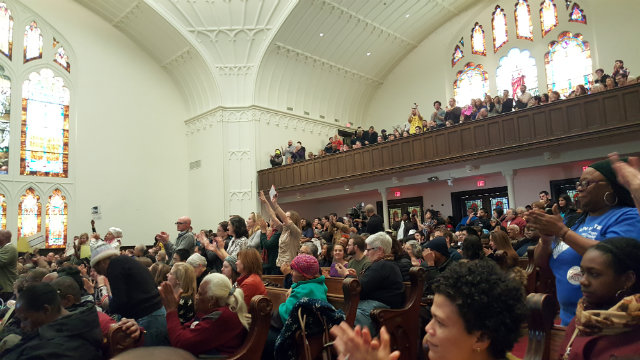
“Every night, seven to eleven people sleep on those steps outside. What we call steps, they call a bed,” said Ben Roberts, the associate pastor and director of social justice ministries at Foundry United Methodist Church. “It does not have to be this way.”
Hundreds of people headed up those stairs and into the Dupont Circle house of worship on Saturday morning to support that message—and hear from the mayor about her plans to end homelessness.
Mayor Muriel Bowser pledged that her “commitment is strong” at the Fulfill the Promise rally, which was organized by the The Way Home and Housing For All campaigns. “In a city that is as prosperous as ours, every person should have the opportunity for housing,” she said. Councilmembers Brianne Nadeau, Elissa Silverman, Vincent Orange, and Anita Bonds, and several high-ranking administration officials were also in attendance.
The audience, which quickly exceeded the number of seats available in the pews, was energetic as they heard about the policies and programs currently in place. People told of their success stories in permanent supportive housing, of using TOPA to purchase their apartment building, or utilizing the Home Purchase Assistance program to buy a house.
But speakers noted that it hasn’t been enough to stem the need, as rising housing prices continue to push longtime residents out and the homeless are still struggling on streets of the nation’s capital.
“The Way Home Campaign is proud of our city’s investments to end chronic homelessness by 2017, but we are running out of time,” said Emily Buzzell, the director of street outreach at Miriam’s Kitchen. “No one should be homeless, no one should be homeless for years, and no one should be dying on our streets because they don’t have a home.”
The coalition is pushing for an increase in funding for the Local Rent Supplement Program, Permanent Supportive Housing, and Targeted Affordable Housing, along with $100 million in the Housing Production Trust Fund. The mayor affirmed her commitment to keeping that level in the fund, which is used to help build or purchase new affordable housing units, and touted her creation of the Housing Preservation Strike Force, which focuses on protecting the current affordable housing stock.
“There’s no mayor that can make the rent lower,” Bowser said. “But what we can do, is make sure that the city is involved in supporting subsidized units and preserving housing.”
After Mayor Muriel Bowser departed—Bonds and a fair amount of the crowd left along with her—Vincent Orange presented his own ideas for addressing the housing crisis. His description of a plan to build 1,000 tiny units (people these days want to come home and “pull down their bed from the wall and listen to their boombox,” he said) prompted at least one person to shout back, “We don’t want no tiny houses.”
Much of the program, though, focused on the benefits of permanent supportive housing—wherein the chronically homeless are given homes first and then connected to counseling and services.
“I’m glad that people are supporting stuff like this—because it works,” said Waldon Adams, an advocacy fellow at Miriams Kitchen who was given housing after struggling for years with drug addiction and complications from HIV/AIDs. In a few weeks, Adams is celebrating his seventh year of sobriety and his fifteenth marathon, he told DCist. “Permanent supportive housing saved my life.”