Once the largest and only federally-run mental hospital in the United States, St. Elizabeths now sits largely abandoned on a sprawling corner of Southeast. For years, D.C. has been promising big changes to the 173-acre east campus (the west campus is slated as the new home for the Department of Homeland Security employees, though it is more than a decade behind schedule). But with a proposal to build a new pro-basketball complex garnering support from the current administration as well as both excitement and controversy in the community, movement finally seems imminent. In the meantime, DCist is digging into the archives to learn more about what it once was. Contributor and relentless explorer Pablo Maurer has roamed much of the grounds and scoured historical resources to find the stories hidden at St. Elizabeths for this series.
Rosemary Kennedy—a wide-eyed, beautiful, developmentally disabled 23-year-old, and the eldest sister of John F. Kennedy—was admitted to George Washington Hospital here in D.C. in November of 1941.
The visit would change her forever.
Propelled by a blend of altruism and professional ambition, a D.C.-area doctor, Walter Jackson Freeman II, had become obsessed by the idea that a wide spectrum of psychological problems—anything from relatively mild depression to the most debilitating mental disabilities—could be treated physically.
In the darkest days of mental health care, in the absence of any effective medication for mental illness, Walter Freeman and his colleague Dr. James Watts drilled into Rosemary Kennedy’s skull.
While Watts used a slender, metal instrument to remove small areas of brain tissue, Freeman monitored Rosemary’s mental state, asking her to count backwards from ten or sing a favorite song. Watts cut away until Kennedy became unresponsive.
The two doctors transformed Rosemary Kennedy from the lively, unpredictable, and curious young woman her father had feared would someday bring embarrassment to the family into an almost wholly new human being, barely able to speak and in need of permanent care.
Seventy-five years later, and a decade after Rosemary quietly passed away in a Wisconsin nursing facility, it is hard to forget Freeman’s quest to popularize one of the most controversial medical procedures in human history: the lobotomy. In the archives at GWU and in a ghostly morgue at St. Elizabeths Hospital, pieces of Freeman’s work come back to life.
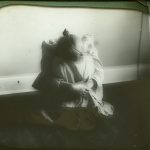
 The autopsy theatre at St. Elizabeths Hospital. (Photos by Pablo Iglesias Maurer)
Just off Martin Luther King Jr, Avenue in Southeast D.C., St. E’s east campus sits dormant—its silence shoved rudely about by earthmoving equipment in the distance. A small chunk of the campus is being transformed into the Wizards’ new training facility. The rest is in ruin.
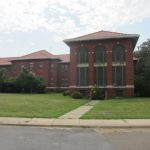
On the outer edge of the campus sits a nondescript, three-story brick building. Above its entrance are the outlines left by metal lettering, long since fallen away. “Blackburn Laboratory.” The floors of its long, empty hallways are covered in paint chips, its laboratories empty.
In the basement, something much darker: a large door opens into a massive “autopsy theatre.” In the center of the room, a metal table. Above it, lights and a scale for weighing organs. It looks like a set for a horror movie—the refrigerated storage units, drawers marked “autopsy saws,” a file cabinet full of cytology slides of brain tissue. This is where Walter Freeman got his start in D.C., in 1924.
His obsession with the human brain ran in the family. Freeman’s grandfather, William Williams Keen Jr., was a famed surgeon during the Civil War and became the first doctor in the United States to successfully remove a brain tumor (he did it without the use of local anesthesia, x-rays, or blood transfusions.)
Keen became a brain-surgeon rock star, treating multiple presidents and even helping to diagnose Franklin Delano Roosevelt’s polio. In Keen, Freeman found inspiration he had never found in his father. In his unpublished autobiography, a copy of which is in the archives at George Washington University, he describes his father as a humorless man, plying his trade as a general practitioner in a dimly lit room at their home overlooking Philadelphia’s Rittenhouse Square.
By the time Freeman arrived at St. Elizabeths at age 28, he’d developed his own designs on notoriety. Having worked only a few years in neuropathology, he landed at St. E’s through the recommendation of Keen, who worked connections to get his grandson a job running the newly-constructed Blackburn Lab. “Here I was, not yet 29,” Freeman writes, “and three steps from the Presidency of the United States. My boss was the Superintendent, his the Secretary of the Interior, and the latter’s the President.”
 Freeman (bottom row, far right) in front of the Blackburn Lab shortly after its opening. (Photo courtesy of the National Museum of Health and Medicine.)>
Wandering the never-ending hallways of the hospital, Freeman felt little sympathy for the patients at St. E’s.
“[They inspire] a weird mixture of fear, disgust and shame,” Freeman writes. “The slouching figures, the vacant stare or averted eyes, the shabby clothing and footwear, the general untidiness—it all aroused rejection rather than sympathy or interest.”
The treatments of the day—electroshock therapy, hydrotherapy and some limited psychotherapy—did little to address serious mental illness. Freeman, a self-described “confessed organicist,” set out to find a physical cause for these illnesses, primarily working in the hospital’s morgue.
He had a never-ending stream of test subjects. Asylums, which had largely become warehouses for the mentally ill, had mortality rates that were nearly five times higher than the rest of the population in the early to mid 20th century. With little to no treatment available, some patients left the facilities after experiencing a “remission,” but about 40 percent exited through the morgue.
In his research, Freeman performed thousands of autopsies at St. Elizabeths. In one study, he examined nearly 1,500 cadavers of schizophrenics. Using a hoist, he’d string them up by their ears in front of a grid on the morgue wall, then take their measurements. “It produced a rather grisly scene,” Freeman wrote, and added that the study produced nothing conclusive.
At times, Freeman had an audience in the morgue. He’d been brought on as a professor and later department head at George Washington University, and on Saturday mornings, visiting students filled the stadium seating in the place to capacity.
He relished the chance to entertain; goateed and bespectacled, he’d often call on students to assist in his autopsies. Dangling on a chain from his neck was a gold ring, one which he’d found stuck on the penis of a patient years earlier in Philadelphia. After filing it off, he’d preserved it and wore it as a bit of a badge of honor. In Jack El-Hai’s excellent biography, the author notes that Freeman, always trying to hold the attention of his students, would often “hold [organs] up—still dribbling blood—so that even his students in the back row could see.”
Hundreds of the brains he autopsied are preserved to this day at the National Museum of Health and Medicine. But Freeman approached the end of his ten years at St. Elizabeths having made little progress towards his goal of linking mental illness to a physical brain defect.
He left St. Elizabeths at the height of the Great Depression, during a time when St. E’s and most other mental health facilities were suffering greatly from financial strain. Freeman’s private practice had grown, and he worried as well about how his colleagues outside the hospital perceived him.
“The attitude of the physicians in Washington towards St. Elizabeths was one of grudging admiration for their scientific achievements,” Freeman writes in his autobiography, “tempered by a feeling of strangeness to which the staff responded with feelings of isolation and lack of appreciation. I never regretted the decision to leave.”
Thirty years later, Freeman would donate copies of many of his most important works to the hospital. His inscription: “To St. Elizabeths Hospital, where I worked 1924-1933, to find some answers to the problem of mental disorder, and where more problems arose than were ever answered.”
 Freeman and Watts. (Photo courtesy of George Washington University.)
In 1935, two years after he left St. Elizabeths, a chance encounter with Portuguese neurologist Egas Moniz at a neurology conference in London would change Freeman’s professional life, and the course of psychiatric care in the United States.
In the late 20’s, Moniz had developed cerebral angiography, a method of visualizing blood vessels in the brain. Like Freeman, Moniz took a keen interest in psychosurgery, and the two hit it off, remaining in contact for decades.
When Moniz began performing “prefrontal leucotomies”— removing sections of brain tissue in the frontal lobe to treat mental illness—a year later, Freeman would be the first to offer his congratulations, and the first doctor stateside to recommend their use. At GWU, he had found a new partner, Dr. James Watts, who shared Freeman’s organicist beliefs and was intrigued by Moniz’s claims of dramatic improvement in his patients post-leucotomy.
In the fall of 1936, Freeman and Watts slightly modified Moniz’s procedure, dubbing it the “lobotomy.” Soon after, they found their first patient.
Sixty-three-year-old Alice Hood Hammatt of Topeka, Kansas suffered from postpartum depression and thoughts of suicide. Freeman’s notes on her, which appear in El-Hai’s biography, read very differently in 2016 than they did 80 years prior. It’s worth noting that the large majority of lobotomy recipients in the U.S. at the time were women.
“She was a master at bitching and really led her husband a dog’s life,” wrote Freeman. “She worried if he was a few minutes late in coming from the office and raised the roof when things did not suit her. She was a typical insecure, rigid, emotional, claustrophobic individual throughout her mature existence.”
That sexism is present in many of Freeman’s notes and records at GWU. “Entranced by voices, this lady came down to earth and went back to keeping house,” reads a caption under a photo of one of his patients. “Simple schizophrenic patients become household pets after operation,” reads another.
Freeman and Watts considered their operation on Hammatt a success, and very quickly moved on to others. In the following three months, the duo performed 20 lobotomies, at times operating on the same patient more than once. By 1942, that number had grown to 200. In Freeman’s estimation, the majority of his patients had shown improvements in behavior, 23 percent showed little or no change, while the remaining patients had worsened.
Freeman was pleased, but he wanted more. The procedure pioneered by Moniz and later popularized by Freeman and Watts was costly and required an operating room. After hearing of a doctor overseas who’d experimented with operating on the frontal lobes through the eye sockets, Freeman found his next calling: the transorbital lobotomy.
The procedure began with electroconvulsive shock therapy to induce a seizure in his patient. Without the use of anesthesia and wearing neither a mask or gloves, he’d insert a metal ice pick—the first one came from his kitchen drawer—into the corner of the eye socket, hammering it through a thin layer of bone and into the prefrontal lobes. Moving the instrument back and forth, he’d sever the connections to the prefrontal cortex. The entire procedure took less than ten minutes. Freeman explains the procedure and demonstrates it in grisly detail in this instructional video:
The ice pick broke on more than one occasion, and Freeman commissioned Henry Ator, a Tenleytown machinist, to make him a new instrument, the orbitoclast. Some of Freeman’s very own surgical instruments, including a gruesome-looking ice pick, currently live in the archives at GWU.
 Photographs by Pablo Iglesias Maurer.
It didn’t take long for Freeman’s procedure to become popular. He embarked on a national tour of state-run mental hospitals, preaching the benefits of transorbital lobotomy. Overwhelmed by a rapidly expanding base of patients, administrators and psychiatrists were all too happy to embrace Freeman’s ideas. Watts, who believed that neurosurgery was best left to experienced surgeons in actual medical facilities, had seen enough. He largely severed his professional ties with Freeman in 1948.
Hospital administrators were swayed both by Freeman’s claims of success and by his showmanship. Performing an operation was, well, performing. He was a master showman who relished making his audience cringe. A witness remembers him thrusting a pair of orbitoclasts or ice picks upwards into his patient. “Then he looked up at us, smiling. I thought I was seeing a circus act…. It astonished me that he was so gay, so high, so ‘up.’”
During a lobotomy in 1951 at Iowa’s Cherokee Mental Health Institute, Freeman lost a patient when he stopped suddenly to pose for a photograph and accidentally inserted the orbitoclast too far into the patient’s brain. On a separate trip to West Virginia, he’d lobotomize 228 patients in 12 days, charging just $20 to $25 a procedure.
By his own count, Walter Freeman lobotomized 3,500 patients. He instructed hundreds of psychiatrists in his transorbital techniques and some 40,000 lobotomies were performed in the U.S.
In his personal van—“the Lobotomobile”—Freeman barnstormed and brainstormed throughout the United States. He called these “headhunting trips” (in his unpublished memoir, the chapter which covers this phase in his life is titled “Head-and-Shoulder Hunting in the Americas.”) He was an avid outdoorsman, and the trips doubled as vacations. “But they were also a field trip,” he wrote, “and I left a string of black eyes all the way from Washington [D.C.] to Seattle.”
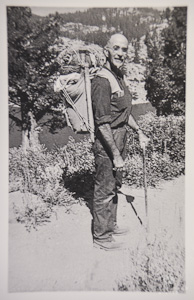 Freeman, hiking in California later in life. (Photo courtesy of George Washington University.)
Lobotomy fell out of favor in the mid 50’s and early 60’s when chlorpromazine, more commonly known as Thorazine, rose in popularity. The first true anti-psychotic, its creators pitched it as the “chemical lobotomy,” and it did wonders for many of the same patients Freeman would have previously lobotomized. He was unimpressed with the new medication, stumbling, late in his career, over his ego and stubbornness.
By 1967, a decade after he moved from D.C. to California, the mental health landscape had changed dramatically. That year, Freeman performed his final lobotomy, a repeat procedure on Helen Mortensen, a patient he’d already lobotomized twice. “This time, to my dismay,” Freeman writes “she had a hemorrhage and died in three days… This was the last day I operated.” Herrick Memorial Hospital in Berkeley, the only facility left that allowed Freeman to operate, revoked his privileges.
During excursions in his “Lobotomobile,” Freeman would often offer up his personal mantra: “Lobotomy sends them home.” Like around a hundred of his other patients, Helen Mortensen had gone home forever.
Freeman spent his remaining years doing what he loved the most, crisscrossing the U.S. in his automobile, tracking down former patients, writing detailed notes on their mental state as many as 35 years after their procedure. Some had written him letters of thanks. They felt better. Others couldn’t write him at all.
Death, from colon cancer, caught up with Freeman in 1972.
Seven years later, Watts remembered Freeman’s drive to popularize the lobotomy in the U.S.. His partner had had the best of intentions: “He was concerned about the lack of therapy for mental patients. He was disturbed because they were allowed to sit around and deteriorate. He didn’t blame anyone, but he just wanted to do something to correct the situation.”
There isn’t much regret in his voice, caught on the tape of an oral history interview: relic—with the journals, the unpublished memoir, the ice pick, orbitoclasts and ruined autopsy theatre—of a procedure that was both weapon and “cure.”
Special thanks to Jack El-Hai, whose biography of Freeman—The Lobotomist—provides a fascinating, in-depth look at Freeman’s life and work. Thanks as well to Vakil Smallen and the special collections team at GWU’s Estelle and Melvin Gelman Library, who were very helpful in my research.