Rachel Kurzius
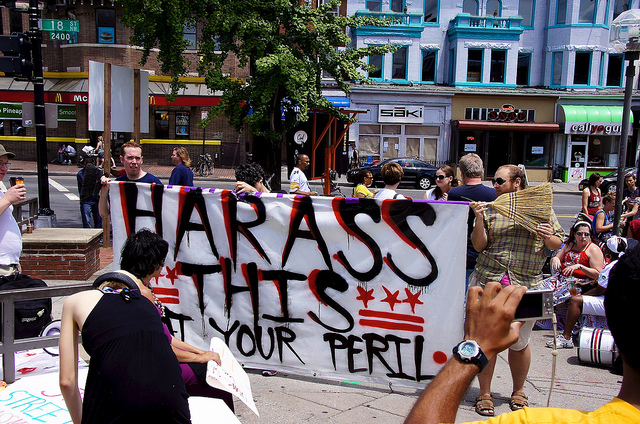 Photo by Ted Eytan
Updated with comment from DCCAH.
The next time you think about catcalling someone on D.C. streets, even the buildings might remind you to hold your tongue.
The D.C. Commission on the Arts and Humanities is establishing a $40,000 grant dedicated to anti-street harassment public art, along with Age-Friendly D.C. and the District Department of Transportation.
“I am extremely excited about it. We’ve had a lot of good conversations, and now it’s good to see some action,” says At-Large Councilmember David Grosso. “Art has been used for centuries to help the public understand complex issues. It’s an effective tool to get the message across.”
Grosso asked the D.C. Commission on the Arts and Humanities to consider funding grants for artists to address the issue using murals back in December, following the D.C. Council’s first-ever roundtable discussion on street harassment.
DCCAH Executive Director Arthur Espinoza said in response that, “The arts can serve as a catalyst for change and bring healing to a community. I am happy to explore what options may exist with regard to DCCAH participation to help remedy this serious problem.”‘
DCCAH Communication Specialist Jeffrey Scott says that the agencies “have been in conversation for several months” about the grant, and the funding comes from Age-Friendly D.C., though DCCAH will help manage the project.
Excited to share that @TheDCArts is creating a grant specifically to fund DC anti #streetharassment murals! #blessed pic.twitter.com/71xrcmCFEy
— CollectiveActionDC (@SafeSpacesDC) March 15, 2016
“We’ve wanted to do this since the beginning of time,” says Jessica Raven, interim director of Collective Action for Safe Spaces. She says CASS would like to partner with local artists, and work with folks like Jess Solomon and Tatyana Fazlalizadeh, who has brought her project “Stop Telling Women To Smile” to Philadelphia and Mexico City, among other locations.
This grant is modeled on a sustained public information campaign from Metro that targets sexual harassment.
“We know that Metro has changed people’s minds,” says Raven. “People are more likely to report harassment, and to know that they don’t have to be harassed.”
DCCAH will release an open call for artists to submit proposals later this week or early next week, Scott says. It could take the form of a mural, or a different medium of public art. The proposals will go through the usual panel process.
“We’d love to have them in all four quadrants of the city,” Raven says. “It should be a citywide art project.”
December’s roundtable discussion also kicked into gear other ways of handling street harassment. Ward 1 Councilmember Brianne Nadeau introduced legislation that would establish a task force to end street harassment. Additionally, Mayor Muriel Bowser’s Vision Zero plan—which aims to eliminate fatalities and serious injuries to people using D.C. transportation systems—includes the establishment of a task force to “develop policies and practices that thwart street harassment.”
For Grosso, the new DCCAH grant is just the start. “It’s not like we’ll have one $40,000 grant that’ll solve this issue,” he says. “We need a sustained effort.”
Last year, Stop Street Harassment, a Reston-based nonprofit, released a national survey that found 57 percent of women across the country had experienced verbal harassment, and 41 percent of all women had experienced physically aggressive forms of harassment. For men, 25 percent experienced street harassment, too, including 18 percent who experienced verbal harassment and 16 percent who experienced physical aggression.