Rachel Kurzius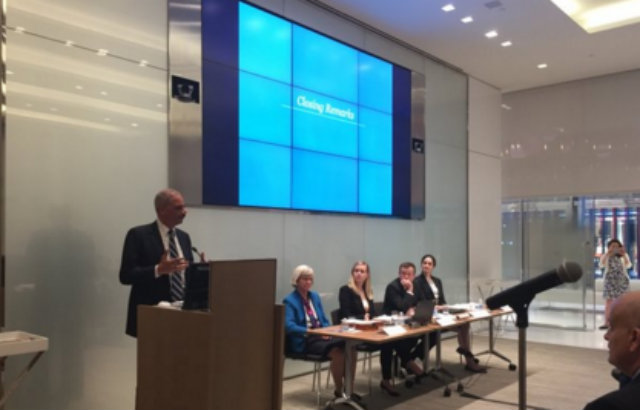
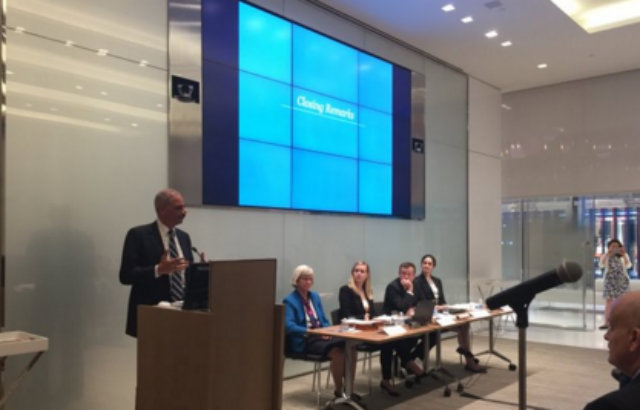 Former Attorney General Eric Holder addressing the crowd at the release of the report. (Photo via Twitter)
Thanks to D.C.’s lack of statehood and all of the rights that come along with it, women face a unique set of challenges —including the city’s inability to fund all forms of reproductive care and, according to a new report, significant disadvantages in the prison system.
D.C. women face a “dual track” at the D.C. Superior Court, the report from the Washington Lawyers’ Committee for Civil Rights and Urban Affairs and Covington & Burlington says. When they receive a sentence of nine months or less, women stay at local correctional facilities, while those handed down longer sentences go to federal prisons. The lack of federal female facilities in D.C., Maryland, or Virginia means that the closest place a woman with a long-term sentence will be housed is in West Virginia—though they can end up much, much further away.
“These women experience particular difficulty keeping in touch with their families and maintaining other ties that would help them reestablish themselves in the community after they are released,” the report says.
All of the other disadvantages that D.C. women enter prison with—education levels, employment experience, economic status, issues with mental and physical health, likelihood of experience with trauma—are “magnified” by being housed so far from their communities, said Eric Holder, the former Attorney General and partner at Covington & Burlington. “It has a negative impact on rehabilitation and family reunification.”
That applies to all 141 D.C. women currently in federal prison, though researchers believe 112 of them are within 250 miles of the District.
According to BOP staff, as of February 2016 15 D.C. women (presumably those at BOP facilities in Aliceville, AL and Tallahassee, FL) were housed between 500 and 1000 miles from the District, and 14 women (presumably those at Carswell and a BOP facility
in Waseca, MN) were housed more than 1000 miles from the District.
The researchers couldn’t get exact numbers, though. “For some reason, [the Bureau of Prisons] won’t divulge” the precise numbers, said Carolyn Corwin, senior counsel at Covington.
Corwin says the report’s top recommendation is to change the length of sentence that results in women going to federal prison from nine to 24 months. That way, more women can stay close to their families.
One audience member questioned whether staying local would actually help women. “I can assure you I would rather be in federal prison any day” than be in D.C. facilities, she said.
The report also suggests increasing visiting hours, particularly on weekend and federal holidays, and making it easier for women to contact their children and families using phone and video conference services.
Additionally, the report suggested increasing eligibility and funding for drug treatment and job training programs. Researchers found six month waiting periods at substance abuse treatment programs at Hazelton in West Virginia, the closest federal prison. (Hazelton is also over capacity currently, according to the report, meaning some women are triple bunking.)
Researchers said few D.C. women in federal prisons benefit from the job training programs that exist. “Job training offered at distant federal facilities may not match employment opportunities available to women who will return to the District,” the report says.
Patricia M. Wald, a retired chief judge for the U.S. Court of Appeals for D.C., described the frustration judges feel when sentencing women, knowing that treatment and training programs aren’t up to par to rehabilitate them. “It is not the devil, but hope in the details,” she said of efforts to improve the programs.
While the report says incidents of sexual abuse and harassment in prison have improved thanks to legislation and court cases, “statistical data suggest that sexual abuse of incarcerated D.C. women likely continues to be a problem that requires attention.” On this front, the report recommends “constant vigilance.”
The number of incarcerated women has increased by 646 percent between 1980 and 2010, according to the Sentencing Project—with more than 200,000 women behind bars, including in local jails.
“Women in prison are very invisible to those on the outside,” said Corwin, who added that that Holder’s participation in the report will help bring attention to the cause.
Holder said that the report’s findings are only the beginning. “It is one thing to have a great report,” he said. “Acting on those findings is of the utmost importance. Addressing these issues will address public safety … ultimately decrease public expenditures, and help rebuild communities.”
D.C. Women in Prison: Continuing Problems and Recommendations for Change