 Rachel Sadon
While the Healing Church of Rhode Island’s Anne Armstrong held up a joint and uttered a benediction—”anyone who comes to partake in good faith has a blessing from the almighty … amen”—a man with an impressive set of corn rows turned to those packed nearby and made his own offering.
“Who needs to roll up something?” asked Donald Pereira, a freshly made blunt hanging from his mouth and a gumball-sized hunk of weed pinched between his fingers. The Capsterdam University co-founder looked around, but most people nearby had come prepared.
Shortly thereafter, marijuana activist Adam Eidinger led the countdown. Five, four, three, two, one, bumpubudumbum, and plumes of marijuana smoke rose from the crowd. As people took hits from a wide variety of smoking devices, nibbled on edibles, tapped droppers of cannabis oil, and danced freely, one could be forgiven for thinking they were at a Grateful Dead concert rather than in front of the White House.
Despite the flagrant (and fragrant) cannabis consumption, just two people were cited at the peaceful, unpermitted protest, which was billed by DCMJ as a “rescheduling” of 4/20 to 4/2 to protest marijuana’s classification as a schedule one substance (also, Eidinger says, “because the president has been a big zero on marijuana reform”).
When the appointed time—yes, it was 4:20 p.m.—came for the collective inhale, Lauren Dove and Walter (who declined to give his last name) decided to pose for a photo in front of the White House rather than inside the tight group of several hundred people crowded around the organizers. “We got accosted [by MPD], which is to be expected during civil disobedience,” Walter said.
Police detained the pair, who had only met that afternoon while holding up a 51 foot inflatable joint together, and gave them each a $25 citation for public consumption of marijuana. A few minutes after they were released, yellow slips in tow, a fellow protester handed Walter a twenty and a five on the spot.
“Fuck yes, it was worth it,” Walter said. “I lost nothing. And I just smoked a joint in front of the White House.”
As for Dove, she was just pleased that the police gave back the pipe that she’s owned since she was 17 (they did dump the contents out, though).
The revelry continued unabated for another ten minutes or so despite a heavy police and Secret Service presence on Pennsylvania Avenue, which is District land and therefore subject to the city’s legalization law. The short version: you can grow, consume, and give away pot in a private home, but you can’t consume it in public or sell it.
U.S. Park Police ringed the edges of Lafayette Square, which is federal land, and watched the scene unfold. One officer, who was casually chatting up a protester about the animal rescue organization on her sweatshirt, said that if anyone smoking pot crossed the boundary, the park police would arrest them—on a “discretionary” basis. He then posed for a photo with a woman holding a black, white, and green marijuana flag. The officer’s supervisor called the woman over to admire the banner, and ask where she got it from.
MPD made more of a show of walking seriously through the crowd, but they said little to the protesters and didn’t attempt to break up the event.
After a few songs finished blaring over the loudspeakers, Eidinger declared “mission accomplished, people; message sent,” and much of the group paraded past the police and tourists as they headed up Pennsylvania Ave and turned right onto 14th Street.
But the day started out rather more chaotically than it ended.
Although protesters were able to bring a similarly constructed ‘pipeline’ to a Keystone XL protest a few years ago, the 51 foot inflatable joint was deemed a “national security issue” by the Secret Service. About twenty people held the surprisingly realistic rendering aloft, the tail end of it blocking traffic on 15th Street, while those in the front tried to convince the officers to let them past.
Unsuccessful, they turned around and hung out on the 15th Street sidewalk, where a crowd gathered as the organizers regrouped. Eidinger eventually took up a microphone to announce that they would abandon the float for the time being and march up to the White House. But hardly anyone moved from the giant joint’s side.
“Come on, stoners. Put down that fake joint for a real one!” he shouted, to little avail.
So instead, they started the speeches about fifty feet away, in front of the Treasury Building, with the musings of a man who said he was a former CIA officer. A few more people joined when Pam Zich shared her story of being treated with epilepsy drugs—the latest one came with warnings of homicidal ideations, paranoia, and delusions, among other frightening side effects—rather than cannabidiol.
Only once the joint was deflated, and after Kim Brown gave a rather rousing speech about the disproportionate effects of marijuana laws on African Americans, did the group coalesce. About forty five minutes after the event was slated to officially start, they marched up the block to the White House shouting “race is not criminal, America is not criminal.”
When they arrived, surprised tourists and the motley crew of other protest groups looked a little shell-shocked by the incoming wave of people, pot leaves, and liberty caps.
Darren and Tiffany Sefton, visiting from Los Angeles, watched for a minute before turning around and snapping a selfie with the White House in the background. “We don’t want to get caught up with the protest, though we don’t necessarily disagree with making it legal,” Darren said.
Other bystanders included an anti-abortion group, a man preaching on top of a metal box, a man with the group Food Not Bombs (“this is the not bombs part; we’re supporting a peaceful protest” said the guy manning a station with free energy bars and a rice concotion), and a single counter-protester.
Dressed as a rollerskating joint, Will Jones got into semi-heated arguments about the proper legal classification for marijuana with the protesters. Jones, who founded the anti-Initiative 71 group Two is Enough D.C., argued that “there is a false dichotomy that to end incarceration we have to legalize.” Holding a sign aloft that read “pot gummy bears targeting kids … not a fan,” he said that a legalized pot industry would be akin to tobacco 2.0. “Big industry preys on marginalized populations … they profit on addiction.”
The rest of the crowd of several hundred people, though, came to share their stories, hear from a wide variety of speakers, or simply to light up in defiance of the law (a handful of people didn’t quite make it to 4:20 p.m., despite organizers admonitions to wait to do so en masse).
Capitol Hemp co-owner Alan Amsterdam speculated that the crowd was so large, in part, because of Initiative 71. “People have come out of the closet as it were,” he said. “They are no longer living in fear. A lot of people I see here, I’ve never seen before [at a cannabis protest].”
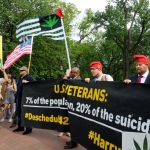
They heard from veterans, out-of-state activists, a libertarian Senate candidate in Maryland, and one man who has made many headlines for disregarding District law regarding marijuana.
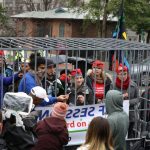
“Me and my employees, we protest on a daily basis,” said Nicholas Cunningham, better known as the man behind the Kush Gods business. Despite pleading guilty to two misdemeanor counts of marijuana distribution under a deal that precludes him from engaging in any marijuana transactions regardless of remuneration, Cunningham announced new initiatives to give free products to breast cancer patients and veterans. “We’re not going anywhere.”
That, generally, was the theme of the day. “We’re on the front line, we’re on the front lawn,” someone shouted. Even the giant joint made a reappearance. Protesters deflated the structure, unfurled it in front of the White House, and re-inflated it later in the afternoon in defiance of the Secret Service. “[The joint] was the biggest spectacle of the whole event,” said Rica Madrid, an organizer with DCMJ.
Though, arguably, the sight of a large mass of people toking up just feet from police officers in front of the White House, largely without consequences, may have overshadowed even that scene.
“We were expecting a mass arrest, so for everything to go peacefully was amazing,” said Nikolas Schiller, the co-founder of DCMJ. “It was an empowering day.”