 Rachel Sadon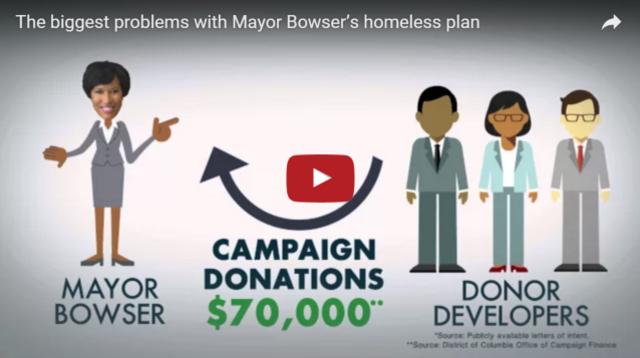
As the chorus of complaints surrounding the terms of Mayor Muriel Bowser’s homeless shelter grows louder, they are also getting more organized and professional.
Two sleek websites have cropped up in recent weeks by the groups We Are Responsible D.C. (W.A.R.D.) and D.C. Residents for Responsible Government. The latter is responsible for a polished animated video that paints the deal as a boon for campaign donors. Since it was published on Tuesday, the video has already been viewed more than 25,000 times.
“The mayor’s plan would benefit some of her biggest campaign donors far more than homeless families,” the voiceover intones. “They donated big bucks to get Bowser elected. She’s rewarding them with lucrative leases and construction contracts to build her shelters. She’s even trying to mask the outrageous costs by comparing to office buildings downtown.” The video goes on to tell people to contact D.C. Council Chairman Phil Mendelson (describing him as “a serious public servant dedicated to doing good things the right way”) with their complaints.
But unlike W.A.R.D., which has a spokesperson and whose members have shown up to public events, the people (or person) behind D.C. Residents for Responsible Government are laying low. On the website’s “about us” section, the group simply says “we have heard some of the rumors, but we are neither politicians, developers, nor bogeymen.” They didn’t respond to requests for comment.
Meanwhile, a small horde of anonymous Twitter accounts (some of whom are affiliated with those groups) have been lobbing objections left and right. And residents in Ward 3 coordinated a large walkout this week at a meeting to discuss the design. Previous efforts have included a small protest outside of the mayor’s State of the District address and a satirical Airbnb posting.
Amid the opprobrium, the mayor put out a rushed call earlier this week for an outside analysis of the plan, The Washington Post reported.
Pushback to the pushback has also emerged. The Washington Legal Clinic for the Homeless published a blog post last week that looked at whether the intense focus on the plan is motivated by classism, racism, and NIMBYism, writing:
“Another good way to determine if input is based on an “ism” is to see if the criticism is equally applied in other contexts. For instance, both residents and the Council have spent a lot of time focusing on whether the Administration is getting a good deal for its (our) money. It definitely looks like a lot of money at first glance, and the Administration needs to explain the costs in a more understandable way. We think the way D.C. gives away deals (and land) to developers in this city has got to change. But the amount of Council, media and public attention to the fiscal responsibility of these deals far outweighs the attention we have seen given to this issue in any other context.
The post, which explores several other ways to parse the criticisms, stemmed from the intensity and quantity of the grievances that have emerged, particularly at the hearing before the D.C. Council, said Amber Harding, an attorney at the clinic and one of the blog post’s two main authors. “You can’t really see into people’s hearts and see why they’re opposing the plan.”
The Washington Legal Clinic for the Homeless has been outspoken about the need to close D.C. General. The nonprofit generally supports Bowser’s plan, though they are opposed to the Ward 5 site and have a number of other questions and concerns (including the lack of private bathrooms). But those stem from thirty years of advocating for the homeless, Harding says, whereas it can be hard to tell what is motivating many of the opponents.
“There are definitely people out there that are attacking this for political reasons, as they would whatever Bowser does. And there are people that are attacking it because they don’t want homeless families in their neighborhoods, or they have these misconceptions,” she says. And the online anonymity certainly isn’t helping the conversation. “I would have a lot more respect if someone lived at D.C. General and was afraid to openly criticize the plan because of possible retaliation. But why does someone need that cloak of anonymity if they are just a neighbor?”
Despite its own strong presence on social media, the administration has largely stayed outside the digital fray on this issue. “Our hope is that on any policy debate, that we have a thoughtful engaged debate on these important issues, and I think that’s more productive and it is healthier when that debate is in the open,” said Bowser spokesman Mike Czin.
Most of the mayoral communication about the plan has come in the form of several community meetings (which critics charge haven’t been announced with enough notice). At the State of the District, Bowser was particularly dismissive of the complaints. “I urge us not to be distracted by arguments based on fear…..or convenience….or apples and oranges comparisons that falsely represent the cost of lifting families out of homelessness. Because make no mistake. If we fail to act—or if we do not move forward with one of the sites—we will not be able to close D.C. General. Not now, not any time soon, and maybe never.”
Even the plan’s supporters, though, say they wish the administration would engage more on some major issues.
“One of our biggest concerns is that there’s so much noise that, in part, the administration might be throwing up their hands and saying any opposition is illegitimate and that seems unfair,” Harding says. “I wish I had information to be able to counter what some of the opposition has said … but I don’t have enough details about why it costs what it costs.”
Speaking on the Kojo Nnamdi Show this afternoon, D.C. Council Chairman Phil Mendelson said he has his own concerns about the plan’s price tag—particularly because five of the seven family shelters will be on leased sites.
“I don’t agree that we should start over,” he said. But “the 2016 schedule is a bit optimistic,” given the cost issue and the need for zoning changes.