Rachel Kurzius
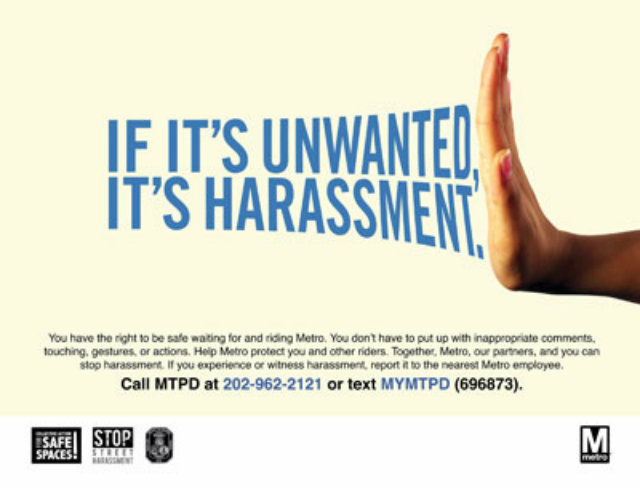 Via WMATA.
While sexual harassment on regional public transportation occurs at similar rates to the nation as a whole, riders are significantly more likely to face harassment on trains or in Metrorail stations than on the bus or at a bus stop. And more than three-quarters of people don’t report it.
Those are just some of the findings from new data compiled by Metro, which give a more clear understanding of riders’ experiences with sexual harassment.
The survey of 1,000 people found that 21 percent of people in the D.C. region have experienced sexual harassment on public transportation, which compares to 18 percent nationwide.
In news that will surprise few, women (28 percent) are more than three times as likely as men (9 percent) to experience that unwanted attention—which includes verbal harassment (by far the most common), leering, following, being rubbed up against in a sexual way, transphobic or homophobic comments, flashing, groping, public masturbation, and sexual assault.
Of the riders who reported being sexually harassed, 62 percent of said it happened while on a Metro train and 61 percent while in a Metro station, whereas 36 percent of riders said they were harassed on a Metrobus and 32 percent at a bus stop.
While 77 percent of people said they have never reported sexual harassment, those who knew about Metro’s public information campaign were twice as likely to report an incident.
“That puts data to the anecdotes we’ve heard that seeing the signs makes people feel more safe,” says Holly Kearl, founder of Stop Street Harassment. SSH and Collective Action for Safe Spaces partnered with Metro on the survey, one of the first of its kind conducted by a public transit authority.
Kearl says that the “challenge for us as advocates is explaining why reporting is a good thing. Reporting can help us better understand where and when harassment is happening so we can have a more targeted response.”
SSH, CASS, and Metro are teaming up at five Metro stations—Metro Center, Tenleytown, Shaw-Howard, Takoma Park, and Clarendon—during rush hour to raise awareness about efforts to prevent sexual harassment.
Metro has already committed to another round of anti-sexual harassment advertisements for 2016. Additionally, the D.C. Commission on the Arts and Humanities is establishing a $40,000 grant dedicated to public art addressing the issue.
If you have been harassed, threatened, or assaulted on Metro, you can: call (202-962-2121), text MyMTPD (696873), or fill out an online form.