 Rachel Sadon
 Courtesy of DCFPI
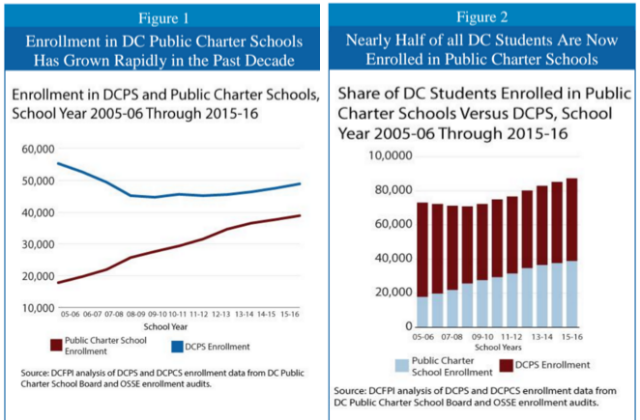
Although D.C. Public Schools has seen an uptick in its population over the past fives years, following years of a steady decline, the city’s charter school population is still growing at a faster clip—and quickly catching up to DCPS.
In the past ten years, public charter schools saw the number of students they serve more than double. With enrollment of 39,000 in 2016, the sector now accounts for 45 percent of D.C. students, according to a new report by the D.C. Fiscal Policy Institute. Over the past five years, public charter school enrollment grew most in Wards 5 and 8, followed by Ward 4.
Population data tells a slightly less straightforward story of DCPS, which enrolled 55,000 students in 2006, and saw a dip before climbing back up to 48,000 students in 2016.
Put another way, both systems saw gains in the past five years, but the charter sector grew much faster—32 percent in comparison to 6 percent for DCPS.
Still, those rates are closer than in the five years prior, between the 2005-2006 and the 2011-2012 school years, when charter schools were growing at a rapid clip of 65 percent while DCPS enrollment was falling by 17 percent.
In addition to enrolling more students, both systems are graduating a higher percentage of high school students in four years. According to figures released by the DC Office of the State Superintendent of Education, DCPS is now at a 64.4 percent four-year graduation rate, and public charter schools are at 71.7 percent.
But a set of tests taken last spring found only 25 percent of students are tracking to be “college and career ready” in 10th grade English, and 10 percent in geometry. The results also showed a large achievement gap by race/ethnicity. While 82 percent of white students were deemed “college and career ready” in English II, for example, only 20 percent of black students and 25 percent of Hispanic students were.
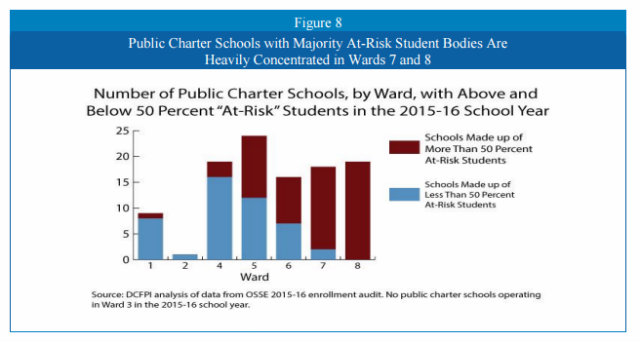
Meanwhile, the DCFPI study showed students considered “at risk” make up a majority of the population in all Ward 8 charter schools, and most of those in Ward 7.
 Courtesy of DCFPI
The report concludes with recommendations for “better coordination and planning” between the two sectors, as each continues to grow.
“Greater transparency from the public charter school sector, and better coordination and planning between DC Public Schools and public charter schools, are key to ensuring that enrollment growth is managed in a way that produces the best outcomes for D.C.’s students and families,” writes Peter Tuth, the report’s author.