 Rachel Sadon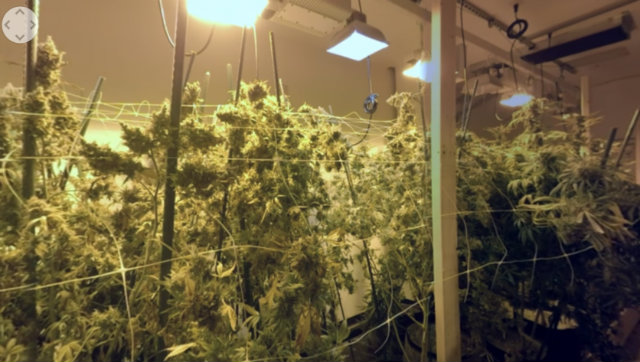
“How do we show people something that’s really difficult to see and make them aware that this is pretty damn awesome?” asks Mike Cuthriell, the president of Metropolitan Wellness Center. One of the answers he came up with: a virtual reality tour, showing not only the dispensary in Capitol Hill but several of the cultivation centers that provide the marijuana used in their products.
The marijuana industry in D.C. is, by law, something of a mystery. Members of the public can’t visit cultivation centers unless they are employees or vendors. Distribution centers—the pharmacies of the medical marijuana world—are only accessible to those who are already registered patients. And the businesses can’t even advertise what they do on their storefronts.
“Even for the everyday cannabis user, they have no idea” what hundreds of pot plants look like growing side by side, or even what lies in store at a dispensary, Cuthriell says. “My eyes always get big when I walk into our cultivation facilities and I’m used to this.”
Nearly two decades after D.C. legalized medical marijuana, three years after it was actually enacted, and seven months after supply issues were largely fixed, there are just 3,600 people with medical marijuana cards in D.C.
In Arizona, there are around 100,000 people enrolled in the medical marijuana program, which came online at almost exactly the same time as D.C. and started with similar restrictions. Per capita, that amounts to three times as many patients, or 1.5 percent of Arizona’s population to 0.5 percent of the District.
A couple of factors may be at play here, including the convoluted history of D.C.’s medical marijuana law, restrictive early regulations, the number of people with government jobs, and the additional confusion surrounding legalization.
Here’s the short version of a very long history: Almost 70 percent of D.C. residents voted in favor of a ballot initiative to create a medical marijuana program in 1998. Congress blocked its implementation for more than a decade, after which came a three-year-long regulatory process. It wasn’t until 2013 that medical marijuana was actually available for purchase in the District. Even then, the program was tightly controlled on both the demand and supply sides, with restrictions on what kind of illnesses could qualify and how many plants cultivators could grow. In the face of overwhelming public support for reforming the law, the D.C. Council expanded the list of qualifying ailments (and eventually did away with it entirely) and doubled the amount that the businesses could grow.
Those changes certainly helped the rolls increase, but the District is still far off from other states with medical marijuana programs.
Cuthriell suspects that information and confusion over Initiative 71, which allows for possession of recreational marijuana but not its sale, wound up dwarfing the medical marijuana program. “People in D.C. were already unaware that the medical program was coming online and then all of a sudden the news was around decriminalization and then then legalization … there’s a lot going on.”
On top of that, the local industry hasn’t done much advertising. In part, that’s because Google, Facebook, and Twitter don’t allow it, Cuthriell says. “Almost everyone we serve said they didn’t know about the program.” Aside from a print ad or two, Metropolitan Wellness Center has only relied on in-person events to get the word out—until now.
To help reach new audiences, the business teamed up with a San Diego-based virtual reality studio for a video that is part educational experience, part marketing effort. The 360° tour can be experienced with or without virtual reality devices like Google Cardboard or the Samsung Gear VR.
To get the shots, Cuthriell sent a rig surrounded by 14 GoPros into two cultivation centers, along with his own dispensary, to show the process from start to finish. The company VRTÜL then stitched the footage together for an immersive look into the spaces. They debuted the tour at the National Cannabis Festival last month to long lines.
“You see these commercial grade agricultural systems [and] you cant help but drop your jaw a bit,” Cuthriell says, pointing out that viewers get a sense of everything from water management to how the harvesting process (an unrelated forthcoming web series about the city’s weed scene might also help).
And then there is the dispensary itself, which curious would-be patients can’t enter until they go through the process to get a medical marijuana card.
“We really do compete with the black market … But it is nothing compared to what you get experience-wise if you walk into a dispensary,” Cuthriell says, citing the 50 products they carry and strains of weed that have been “literally engineered” to address medical ailments. Take a trip and see for yourself.