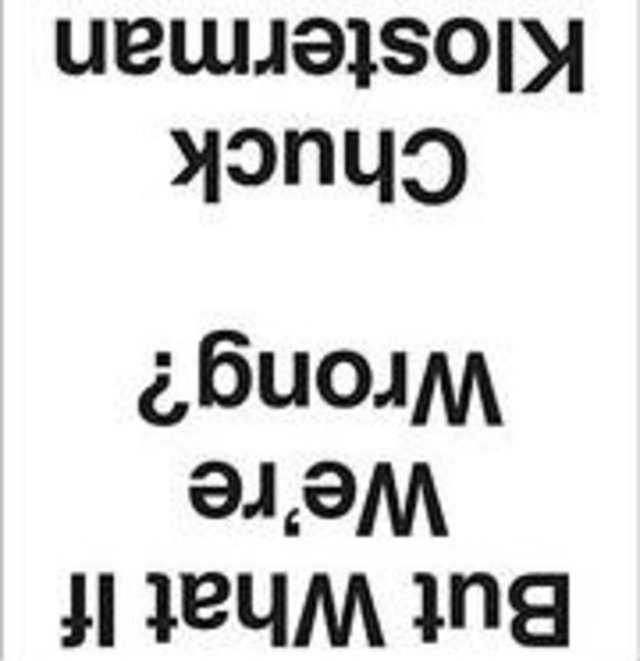
 Chuck Klosterman answers a lot of questions in his new book. Which rock musician will be remembered as the standard bearer for the genre in 100 years? What are the limits of American democracy? What’s the most realistic TV show ever made? What would happen if the entire world were just a simulation crafted by superior beings?
There’s a catch to these answers, though — don’t expect them to be right.
“It’s not a book for a gambler. There are some predictions, but for the most part the predictions serve as counterweight to what we assume is the most likely outcome,” Klosterman tells DCist. “It’s a book of alternative prediction. It makes no sense to write a book called But What If We’re Wrong but then to simply say, ‘But I’m right.’”
Instead, the journalist and culture critic introduces what he sees as an unexplored method for thinking about society and culture in But What If We’re Wrong: Thinking About the Present As If It Were the Past. He considers it his best book, the closest in its finished form to what he imagined when the idea first sparked. That initial idea and the many that followed will be among the topics of discussion when he comes to Politics & Prose on Friday night.
Though most of the writing took place in the last year, Klosterman said he’s had a rough idea for the book for about five years. His operating premise required him to question that which few people ever question, a daunting task for even the most curious philosophers. But if there was a period of human history in which people were convinced en masse that the sun orbited the earth, he argues, surely there are aspects of our world today that will seem similarly retrograde in future centuries.
The book includes interviews with noted scholars across disciplines: scientists like Neil DeGrasse Tyson and Brian Greene; TV critics like Alan Sepinwall and Emily Nussbaum; authors like Junot Diaz and Kathryn Schulz; musicians like Ryan Adams and David Byrne. Klosterman approached them not to prove them wrong, but to find out what they think, then work on his own to envision disproving that.
“What I said to them is, ‘I’m not trying to contradict what you believe about the future. In all likelihood what you believe is also what I believe. I’m just curious, what is the likelihood that you might be wrong about these bedrock ideas,’” Klosterman says.
A few potential sources eluded his grasp. Novelist Jennifer Egan was one. Modern literary titan Jonathan Franzen was another. Neither answered his email requests for comment. In Franzen’s case, Klosterman expects he was simply too busy with his own pursuits.
Klosterman’s trademark fleet prose and witty asides pop up frequently from the very first page, on which he urges readers not to read the book as a non-consecutive series of disparate essays, like several of his previous books. Throughout the text, he employs footnotes, some of which provide additional information, others of which offer glimpses into his more frivolous obsessions and tangential trains of thought. If you ever wondered about Klosterman’s thoughts on David Foster Wallace’s Infinite Jest, memories of working at SPIN Magazine or criticisms of Michiel Huisman’s character on ABC’s Nashville, this is the book for you.
Much of the book is pessimistic, as Klosterman lays out scenarios for the death of football as an American pastime and the erasure of the Beatles and Bob Dylan from the annals of rock legend. But there’s a glint of optimism as well. Setting aside a brief section on climate change, this book about the distant future assumes that people in that distant future will have the same general concerns as we do today. Even as Klosterman imagines that time will erode even the most significant social and scientific phenomena of our modern times, he’s also imagining a time in which people will still exist to look back. His predictions might turn out to be wrong, but they might not be, and someone will eventually render a verdict one way or another. The future may be uncertain, but at least there’s something to anticipate.
Even if you don’t agree with Klosterman’s views, he thinks he’s completed the task he set for himself.
“I’m not trying to persuade people to think like me. I’ve never had any desire to enforce a reality where people share my views. That said, I don’t see how it could be anything but positive if the kind of person who reads this book realizes that there is not much value in certitude,” Klosterman says. “Part of being a smart person is accepting that anyone can be wrong about anything. It doesn’t make you smarter to act like you’re the only one who knows the truth, because you don’t.”
Chuck Klosterman will discuss the book at Politics & Prose at 7 p.m. on June 10; the event is free.