Rachel Kurzius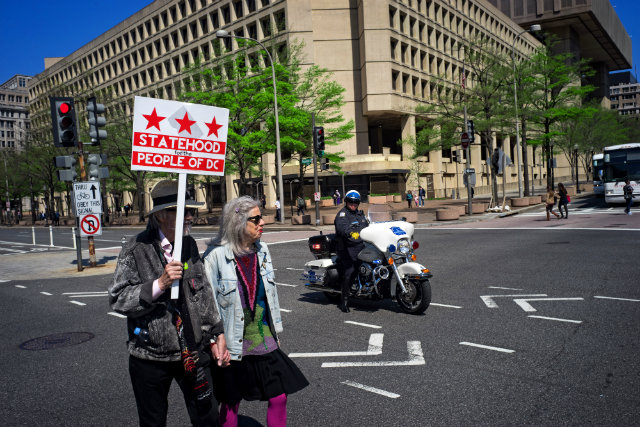
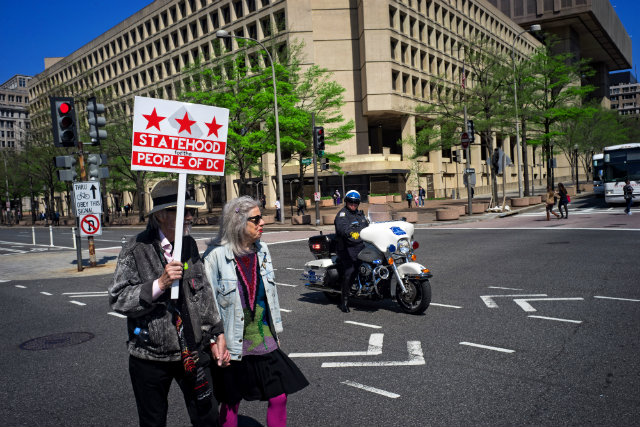 Photo by Mike Maguire.
You definitely weren’t alive for the first Constitutional Convention, and perhaps you missed D.C.’s last foray into constitution-writing in the 1980s, but never fear—a new one kicks off tonight.
To become a state, you’ve got to have a constitution. And officials pushing for D.C. to become the 51st star on the flag want residents to chime in about how exactly this state would function, from its three branches of government to the annual budget. Hence, a constitutional convention.
In April, Mayor Muriel Bowser announced a renewed push for statehood that would put an initiative on the November ballot. Members of the New Columbia Statehood Commission released a draft constitution in early May. It outlines how the state of New Columbia, as it’s called in the draft, would function as a government.
For instance, under the draft the mayor would become the governor of the state, representing the executive branch. The body currently known as the D.C. Council would become the legislative branch, called the House of Delegates. It would have the same number of people, 13, and be comprised in the same manner—with one from each district, four at-large members, and one chair. New Columbia would start picking up the tab for the judicial branch. The governor would also nominate judges, something that the president does in the status quo. Residents would continue to elect an attorney general, as they began doing in 2014.
Since its release, the draft constitution has been open for comment online. Already, people have submitted nearly 200 public comments, spanning topics like the proposed state name, whether to retain a Bill of Rights, and if the proposed state’s legislature should remain the same size as the D.C. Council.
Today, individuals can give testimony regarding the Bill of Rights, Article I, which concerns the legislative branch, and Article VI, which is about initiatives, recalls, and referendums. Friday and Saturday’s sessions will offer time for the other sections of the constitution, like the judiciary and executive branches.
Tonight’s portion of the convention takes place at the D.C. Taxicab Commission (2235 Shannon Place SE, Room 2032) at 6:30 p.m.
Once the convention wraps on Saturday, the New Columbia Statehood Commission will determine whether or not to make changes to the draft before submitting it to the Council and then to the Board of Elections. Bowser, D.C. Shadow Senators Michael Brown and Paul Strauss, U.S. Shadow Representative Franklin Garcia, and D.C. Council Chair Phil Mendelson comprise the commission.
Bowser has proposed what’s called the “Tennessee Plan,” because in 1796 Congress allowed the then-federal territory to become a state following a vote from residents and the ratification of a constitution. Then, so-called New Columbia would have one voting representative in the House of Representatives and two senators.
However, it seems unlikely that the House of Representatives, which is currently trying to repeal D.C. budget autonomy on two fronts, would act as it did in 1796.