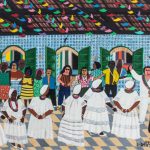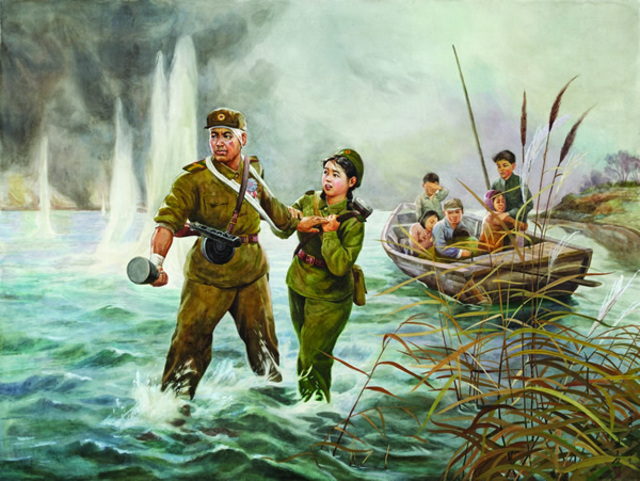
 Pak Ryong-sam.Farewell, 1977. Chosonhwa. 48 ½ x 64 inches.
Presented with an exhibit of North Korean art, the casual gallery visitor will likely think of one thing: propaganda. But a new exhibit at the American University Museum at the Katzen Arts Center hopes to show a beauty beyond ideology.
Georgetown University artist-professor BG Muhn, who was raised in South Korea, journeyed across the DMZ to visit his formidable neighbors, and after nine trips over five years has realized his dream: to exhibit the contemporary art of North Korea in the United States. Contemporary North Korean Art: The Evolution of Socialist Realism is a must-see exhibit. While a handful of U.S. galleries have shown North Korean landscapes, never before have American audiences seen social realist paintings that depict the lives of the people of North Korea.
One naturally questions the accuracy of the scenes depicted in these works, but Muhn insists that we should not dismiss it as simply propaganda. Museum Director Jack Rasmussen agrees: “With North Korea, mostly it is the State whose interests are promoted, but the art is no less beautiful for it. We may not agree with the ideology, but we must agree to take every opportunity to appreciate the beauty that we share beyond our differences.”
In a lecture at the exhibit opening last weekend, Muhn emphasized the extensive training of North Korean artists, their exquisite attention to detail and mastery of facial expressions, and the difficulty of working in the unforgiving traditional art form of Chosonhwa, which involves traditional ink wash painting on rice paper. Artists working in this medium often spend months or years creating studies for each piece, because mistakes can’t be painted over.
On Muhn’s many trips to North Korea, he received unprecedented access to interview artists and art historians across the country who, “without exception … shared their personal experiences with great candor.” While their work conforms to themes prescribed by the State (glorifying workers and the military, celebrating historical events), artists told Muhn they do have freedom of expression, and the style and details of each piece are not censored. They noted that North Korean artists create art to serve the people, and choose a style that their fellow countrymen will understand. One told Muhn that while he is aware of Western art forms like abstraction, “it doesn’t fit with our society.”
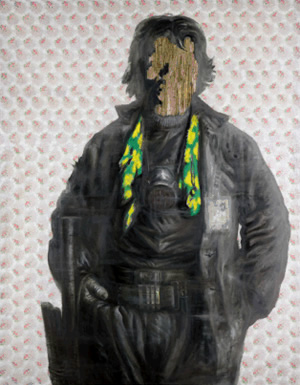 Hwang Jai–Hyoung, An Industrial Worker, 162.2×130.3cm, Oil on canvas, 2004
 Organizing this exhibit, the first of its kind, was no easy feat. While the North Korean government was open to this work being exhibited in the United States, officials were unwilling to loan paintings to Muhn or American University. So Muhn partnered with Mr. Ji Zheng-tai, who runs Beijing’s Mansudae Art Museum, to purchase the work directly from the artists. (Muhn purchased 17 paintings himself and borrowed six of them from Mr. Ji for the exhibit). Muhn notes that when this work was sold, the North Korean artists received money from the sales; the government only collects money from purchases of commercial work like calligraphy.
Contemporary North Korean Art runs concurrently with South Korean Art: Examining Life Through Social Realities. Curated by Gimchoe Eun-Yeong, this exhibit encourages viewers to examine stark contrasts in the artwork created in these once-united countries. Such differences are exemplified by Hwang Jai-Hyoung’s An Industrial Worker (right), which depicts a coal miner covered in coal dust, his identity obscured. This protest art—inspired by Chinese artist Yue Minjun— is a powerful retort to the glorified workers depicted by North Korean artists.
Contemporary North Korean Art: The Evolution of Socialist Realism is on view at the AU Museum at the Katzen Arts Center (4400 Massachusetts Ave NW) from June 18-August 14. Gallery hours are Tuesday-Sunday, 11:00 a.m. to 4:00 p.m.
Also on view this summer at the American University Museum:
Bandits & Heroes, Poets & Saints: Popular Art of the Northeast of Brazil, a fascinating, informative look at artwork from the blending of African and Portuguese cultures in Northeastern Brazil. Don’t miss Culture at the Katzen from 2 to 4 p.m. on August 2 for a discussion followed by a film screening of Brazil Inconvenient Truth, or check out the Brazilian-themed Young Patron’s Happy Hour from 6 to 7:30 p.m. on July 28.
The Looking Glass: Artist Immigrants of Washington features ten D.C. artists who immigrated here from Latin America, including F. Lennox Campello and Carolina Mayorga.Through August 14.
Art Cart: Honoring the Legacy showcases the work of D.C.- and New York-based artists over age 62 who are participating in American University’s senior artists documentation and preservation project. Through August 14.
Contemporary North Korean Art: The Evolution of Socialist Realism runs through August 14 at the American University Museum at the Katzen Arts Center, 4400 Massachusetts Ave NW.