Photo courtesy of AIDSVu
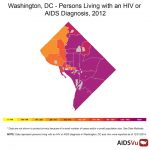
District residents now have an online tool that visualizes where new cases of HIV are occurring across the city. AIDSVu released today an interactive map and report that shows the rate of diagnoses in the District, using data from the District and the CDC.
Previously, AIDSVu, which is an online resource produced by Emory University and Gilead Sciences, Inc., only mapped the total number of HIV cases. In 2013, more than 15,000 people were living with diagnosed HIV, according to the report—74 percent of them were black, 16 percent were white, and 7 percent were Hispanic/Latino. Upper Northwest, east of the park, saw a significantly lower number of diagnoses.
Broken down by ward, the map shows that Ward 7 had the highest number of new diagnoses at 500 between 2010 and 2014. The second highest count went to Ward 8 at 484, followed by Ward 5 at 425. Wards 1, 4, and 6 had more than 300 new cases, while Ward 3 came in at 53. Viewers can take a look at the data by ZIP code and census tract, or filter by age, race, and sex.
Across the country, AIDSVu’s maps show show that the South is being hit especially hard by HIV. While southern regions only represent about 37 percent of the country’s population, these states account for 50 percent of all new HIV diagnoses and 47 percent of deaths among persons diagnosed with HIV. In 2014, eight of ten states with the highest rates of new HIV diagnoses were in the South. The District is included in this group with Louisiana, Florida, Maryland, Georgia, Texas, Mississippi, South Carolina.
The highest recorded number of HIV cases in D.C. was reported in 2007 with 1,333 cases, but the number of new cases has been on the decline. In February, a report released by the District’s Department of Health showed that, for seventh year in a row, D.C. has experienced a decrease in annual new HIV cases.
In December, on World AIDS Day, Mayor Muriel Bowser signed the HIV Fast-Track Cities Declaration, outlining goals to end the world’s AIDS epidemic by 2030. The goal by 2020 is: “90 percent of D.C. residents with HIV will know their status, 90 percent of persons living with HIV will be in treatment, 90 percent of persons with HIV will achieve viral load suppression.” In addition, “the District will see a 50 percent decrease in new HIV cases,” Bowser said. (Part of the plan, as reported by Slate is a campaign to get more black women using the daily HIV prevention drug PrEP).
And after it was reported last year that D.C. also has some of the country’s highest rates of chlamydia, gonorrhea, syphilis, and hepatitis, Michael Kharfen of the DC Department of Health told DCist that the agency is making aggressive efforts to reduce those cases as well.