Last summer, D.C. residents and tourists alike contracted ball pit fever, thanks to the wildly popular exhibit The Beach at the National Building Museum. This year’s follow-up, part of the museum’s Summer Block Party series, promises to be cooler — literally.
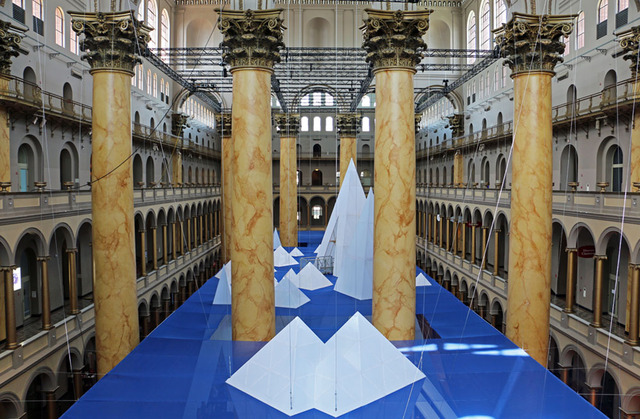
From July 2 through Labor Day, the museum’s cavernous great hall will be home to ICEBERGS, an interactive exhibit comprised largely of triangular structures designed to imitate the look and feel of nature’s chilliest land masses. Outfitted with a slippery slide and balcony overlook, the installation provides a comfortable simulacrum of winter during D.C.’s most sweltering months.
Museum organizers are conscious of the increased attention on the museum’s summer offerings following their viral success with The Beach. But they also didn’t try to top themselves in the traditional sense.
“I don’t think this is going to be a selfie bonanza,” Brett Rodgers, the museum’s vice president of marketing and communications, told reporters at a press preview. One sign encourages visitors to post pictures on social media (#ICEBERGSDC), but Rodgers said he thinks this exhibit will engage visitors in new ways.
Instead, they approached nationally renowned artist and designer James Corner — whose credits include Manhattan’s High Line and Freshkills Park in Staten Island — to find a new way to fill the enormous volume of space at the museum’s disposal. Corner said his team tossed around a few failed ideas, including a topographically accurate meadow, until they landed on icebergs.
Museum staff didn’t warm to the idea immediately. “They went a little white with fear,” Corner says. “This is a pretty complicated and herculean effort.”
The exhibit is divided by a blue scaffold 24 feet above the ground that acts as “sea level.” Beyond the refreshing escape from the summer heat, Corner said the icebergs will provoke conversations about climate change and encourage visitors to contemplate the future of the environment.
Carrying the project from concept to execution proved challenging, Corner said. The initial iceberg design was far more ambitious than the final product, with a wider variety of shapes. Carpenter Chris Maclay tells DCist that the tight three-week window to construct the actual exhibit left his 15-member team working 8 to 12 hours a day, seven days a week to finish in time. They almost didn’t.
Thursday morning, work on the exhibit was 95 percent complete, Maclay said, with a few minor touches on the outer scaffolding and the admissions iceberg left to be done. Maclay says he’s happy with the final product, especially since he knew going in that he had a formidable task ahead of him.
Now Maclay can sit back and enjoy the frozen treats on offer in one of the icebergs all summer long: Japanese shaved ice from Daikaya in Chinatown, which customers can eat while sitting on ice floe-shaped bean bags. The restaurant approached the museum about a partnership last fall before the idea for ICEBERGS had been conceived. The wintry theme proved an ideal opportunity for the Japanese joint.
Other local restaurants — will offer food and drinks during the exhibit’s evening hours from 6 to 10 p.m. on Wednesdays, Rodgers said. Educational and extracurricular programs will augment these events each week: NASA Goddard scientists will showcase their sea ice-measuring technology on July 13, and on August 10, a design challenge will help visitors imagine how Jack from Titanic could have survived.
If early reactions are any indication, the exhibit will be popular with kids. A few children who attended the press preview gleefully traversed the floor and tumbled down the slide. And for those feeling nostalgic for The Beach, take note: Maclay says parts of the ICEBERGS floor are constructed from last year’s recycled leftovers.
ICEBERGS opens tomorrow and runs through Sept. 5, 10 a.m. to 5 p.m. Monday through Saturday, 11 a.m. to 5 p.m. Sunday and 6 to 10 p.m. on selected Wednesdays. Tickets are $15 and available on the museum’s website.