 Rachel Sadon
Following a series of incidents in which people jumped the White House fence to varying degrees of success (or failure by the Secret Service, depending on how you’re looking at it), a 2014 security report concluded that a better, taller fence needs to be erected “as soon as possible.” A few years later and we are finally seeing the light at the end of the design stage tunnel.
The National Capital Planning Commission, which is charged with planning for the federal government in D.C., reviewed options from the United States Secret Service and National Park Service yesterday, and commented favorably on the “comprehensive, permanent measures to address the security needs of the White House complex.” The Commission of Fine Arts gave approval for the concept last month.
The NCPC approved additional temporary deterrents last year, which amounts to a second layer of steel spikes on top of the fences. But the permanent solution would involve raising the height from its current perch around 7 feet to 11 feet and 7 inches.
They considered several options for the fence top, commenting that the first might be too ornate for the White House’s neo-classical style and dismissing the third entirely for being too drab. But the second option proved just right, or as close as you can get with a federal planning agency (the NCPC has provided guidance for additional study).
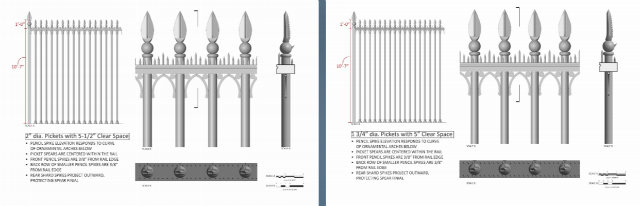 The second option “provides an appropriate
hierarchy of ornamental and security elements, and limits the visual weight of the fence
top,” according to the commission. (Courtesy of the NCPC)
Still, as NPS and the USS noted, several additional steps remain before they can start building the fence. They estimate that construction will begin in 2018.
After the White House is complete, planers will turn to making security enhancements to the neighboring Treasury Building and Eisenhower Executive Office Building.