Rachel Kurzius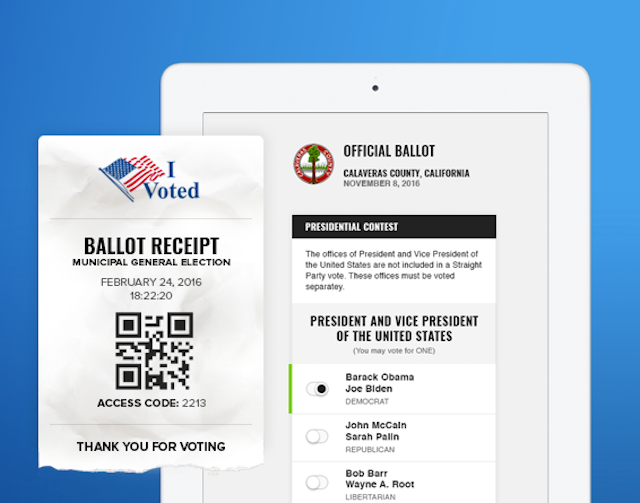
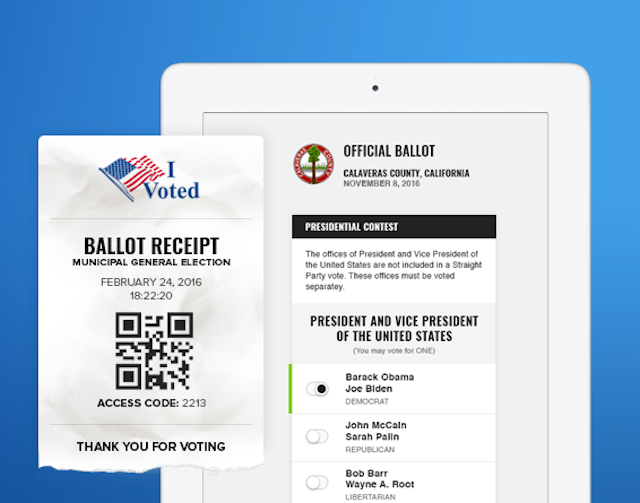 Image courtesy of InnoVote.
When voters line up in November to cast their ballots, they’ll do by going to their specific polling place, marking paper ballots, and inserting them into a tabulator.
But if the people behind InnoVote have their way, soon citizens will be able to vote on their phones or tablets using open-source software, meaning that anyone can access and and study the source code.
“Right now you have companies that are making software for elections, and if there are bugs or security flaws you have to find it after the fact,” says Stefan Nagey, one of the co-founders of InnoVote, which is based in D.C. “InnoVote is going to be released as open source so anyone who is interested can look at this software and look for security problems and bugs. Sunlight is the best disinfectant.”
One example of a bug—the D.C. Board of Elections app inadvertently changed some voters’ party affiliations during the primary, forcing folks to cast special ballots.
“Glitches like that are endemic to small scale software development,” says Nagey. “DCBOE is not a software company. Things exactly like this is what we see as the core of what we are addressing.”
DCBOE spokesperson Margarita Mikhaylova did not have any updates on the investigation into the app’s glitches.
But while the idea of using an iPad to vote can feel less secure or seem like opening the door to hackers, InnoVote’s founders Nagey, Martin Ringlein, and Adam Scharfer maintain that it’s more traceable and accountable than the status quo.
The software uses Blockchain, a transaction database technology originally developed to help transfer Bitcoins that financial service firms and big banks are now using.
Blockchain “has far more checks and balances, far more control, than any paper-based system could,” says Nagey. “In the current system you could have a ballot box get lost. We create a paper trail with multiple audit trails at every step of the process. Instead of being at the precinct only, it’s at a precinct and a central location, duplicated thousands of times.”
While D.C. requires a voter-verified audit trail for elections, known as a paper trail, it doesn’t literally require paper.
Mikhaylova could not comment directly on any one voting platform, but says, “I don’t know of anything that would” prevent DCBOE from using open source software in the future. Currently, the agency is leasing equipment with a two-year renewal option.
Before InnoVote comes out with a platform for voting itself, Nagey says its first product will be a mobile signature collector for petitions.
Right now, that isn’t permitted in D.C., where people collect significantly more signatures than necessary to ensure their petitions don’t get invalidated. Legislation under review at D.C. Council would change that. The Ballot Access Modernization Amendment Act of 2015, introduced in May of last year, would allow for signature collection via mobile devices and apps.
Nagey says the mobile signature collector, like the voting platform, will save jurisdictions money.
InnoVote cancelled a Kickstarter fundraising campaign earlier this July, after raising a little more than $3,000 toward its $50,000 goal. “The response from the general population wasn’t what we had hoped in our best case scenario, but was in line with what we expected,” says Nagey, who notes that the company got a more robust response from investors and elections officials.