 Rachel Sadon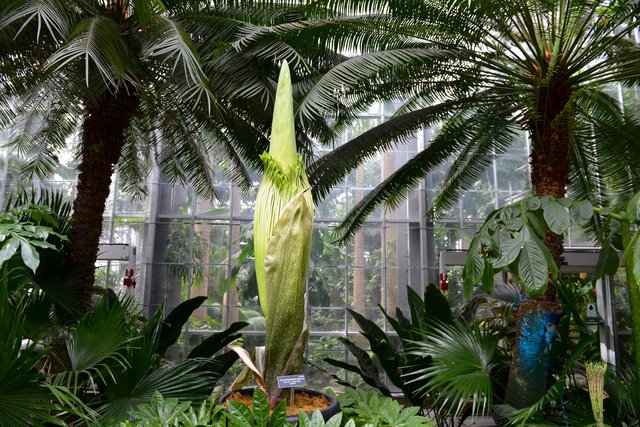
A steady stream of visitors have been making the pilgrimage to the U.S. Botanic Garden, while thousands of others anxiously tune in to the livestream, to see one of nature’s truest oddities: the corpse flower, a plant which grows for years before blooming for roughly a single day, and emitting a holy stench while it’s at it. But D.C.’s specimen is still likely a few days away from committing olfactory assault.
New York’s Amorphophallus titanum opened first, and Gothamist reports that it currently smells like “rotting overcooked cabbage” (though we’re not entirely sure how they’re distinguishing it from the stink of NYC streets in the summer). The line to meet the flower stretched to more than 200 people today, some of whom were waiting at the gates in the morning, after it finally opened. Crowds of New Yorkers had also flocked to the New York Botanical Garden’s Enid Haupt Conservatory last weekend in the hopes of checking out the bloom, but it didn’t quite cooperate with their schedule.
The same could happen here, as the U.S. Botanic Garden is predicting it will open between Saturday and Tuesday. It is “most likely the middle to end of those four days,” said Devin Dotson, a Public Affairs and Exhibits Specialist at the USBG. “Granted, it could be a bit of a diva, and she could hang on to the spotlight a bit longer than that.”
Still, signs indicate that the six-year-old specimen is plodding along nicely. After shooting up multiple inches a day to nearly 7 feet, vertical growth has slowed down, Dotson says, which means that the plant can concentrate its energy on developing the inflorescence (which appears to be a single blossom but is actually a collection of flowers). Some signs of red are peeking out, too. “That’s really a big indicator” that the smelly spectacle is near, Dotson says.
The last time the garden brought a corpse flower to the conservatory from their production facility in Anacostia, it took three weeks to bloom, according to Susan Pell, the science and public programs manager at the Botanic Garden. But temperatures were much milder, and the oppressive heat this month seems to have cut the time in half.
Back in 2013, a number of the 130,000 visitors expressed disappointment that they didn’t get to experience the plant’s legendary funk. That’s because it only emits compounds that attract pollinators on one evening, the night when it first blooms, starting in the late afternoon. “By 10 p.m., it is really stinky and it just keeps getting stinkier until about midnight or so, before tapering off,” Pell says. The next day and night, there’s still some lingering offensiveness but not exactly rotting elephant levels of unpleasantness. “If [visitors] want to get that super stink, they’ll want to come that night that its fully open,” she advises. To accommodate the stench seekers, the Botanic Garden will stay open until 11 p.m. for the two nights it is in bloom (they stayed open until 8 p.m. last time around).
It is hard to think of any other plant that can draw the kinds of attention that cookies and Teslas do, though Dotson says that plant enthusiasts also come out for the one-time bloom of a century plant. It is also a chance for botanic gardens to show off their skills and public benefit.
“It’s a really big horticultural commitment … there’s nothing predictable about this plant,” Dotson says of the years and effort it takes to cultivate a corpse flower. “We can really fill a role to present these that people can’t get otherwise.”
He adds: “There’s definitely a morbid curiosity.”