Chef Jerome Grant has dreamed of leading the kitchen at the National Museum of African American History and Culture for five years, ever since he got wind that Restaurant Associates would be putting in a proposal for the eatery—now called Sweet Home Cafe.
“I really wanted it to be me coming into this place, so I strived really hard to get here and had a lot of awesome things that happened to me along the way,” says Grant, who previously worked his way up from sous-chef to executive chef at the award-winning Mitsitam Native Foods Café—the food destination inside of Smithsonian’s National Museum of the American Indian.
As fate would have it, Restaurant Associates, which also manages Mitsitam, won the contract for Sweet Home Cafe in partnership with Thompson Hospitality, the country’s largest minority-owned food service company. The cafe is slated to open on September 24, along with the museum.
And Grant, who was raised just outside of D.C., is indeed the executive chef. “For me, it really ties in my personal story,” he says, explaining his journey from Fort Washington, Maryland to culinary school in Pennsylvania, then to the Virgin Islands to sharpen his skills, and back to the D.C. region. As a black man in the Smithsonian’s first museum dedicated to African Americans, he’s proud to be “doing something that’s extremely important—especially in a community where I’m from.”
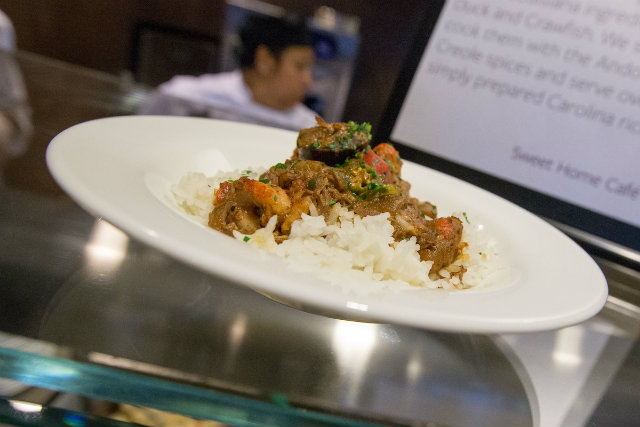
The cafe’s offerings are divided into regions including the agricultural south, creole coast, north states, and western range.
Southerners will identify with items such as brunswick stew, which features braised chicken and rabbit, corn, tomatoes, and lima beans. Folks from the creole coast are represented with offerings like a Louisiana Catfish Po’ boy that’s topped with smoked red pepper rémoulade and green bean pickles. Northerners will find familiar items such as a New York City oyster pan roast. And west coasters are identified by “Son of a Gun Stew” with braised short ribs, turnip, corn, potato, sundried tomato, and barley.
Each of the four regions has several dishes, which are priced from about $8 to $15. There are also plenty of tasty desserts.
The range of options provides a broader view of the African diaspora, even for blacks. “You’re going to learn more about your culture and more about other African Americans—we’re not all the same,” says celebrity chef Carla Hall, the “culinary ambassador” for the cafe. While items such as buttermilk fried chicken, macaroni and cheese, greens, and cornbread are there for the taking, the menus aren’t limited to soul food because blacks have influenced multiples types of cuisine, she continues.
Like Grant, being part of the project is sentimental for Hall, and not just because she’s black. Although she recently opened a restaurant in New York, the Nashville native calls D.C. home. “Even though this is on America’s front yard, I live here—so I feel like it was an incredible opportunity for a hometown girl,” says Hall, who went from being a contestant on Bravo’s Top Chef to co-hosting ABC’s The Chew. She has also worked on Page, a restaurant at DCA, and the reinvention of Eatonville as Mule Bone.
“I was beyond honored,” Hall continued, adding that she accepted the gig as the cafe’s “culinary ambassador” even before she knew what her role would entail.
In the early stages of the project, she worked with a team to come up with concepts for the menus using research conducted by culinary historian Jessica Harris, among others. Now, she says, her job is “really to get people excited about coming here and making this just as much a part of their museum experience as the museum itself.”
Meanwhile, Grant has to contend with being measured by his previous position at Mitsitam, which provided the inspiration for Sweet Home Cafe’s regional concept. Moreover, that eatery’s success has “changed the guests’ and museum’s expectations,” Albert Lukas of Restaurant Associates told The Washington Post.
In theory, the comparison makes sense, Grant says, “but it’s two different animals” in terms of cuisines. However, if critics want to compare the quality of the food, “it will be on par, if not better” than Mitsitam’s offerings, he assures. Ultimately, Grant continues, his job is “doing right by the culture.”
A standout entree for Hall is the “Smoking Hot” Caribbean-style Pepper Pot, which is found among the northern dishes. “It’s unique to chef Jerome’s background—he’s of Caribbean and Jamaican descent, and it’s something that is very close to his heart. And I feel like I’m getting to know him through that dish.”
The pepper pot is also a showcase of Guyanese cuisine, made by a group of people with a surprisingly heavy population up north, Grant says. “We’re identifying these things based on the migration of African Americans throughout the United States,” he continues. “But the great thing is that, within our culture, there are so many other cultures—and it all wraps together.”
And as the seasonal menus continues to evolve, Grant will have plenty of chances to serve black history on a plate as he basks in his dream job. “To this day, even this morning, walking into this museum really gives me the chills—it’s actually done,” he says. “This has been a goal to be here for the past five years of my life and being here now has completed my story, I think—I’m sure I have a lot more living to go, but I can just stay here for the rest of my life and be fine.”