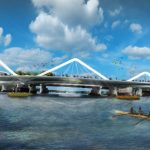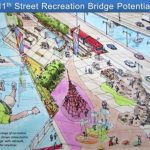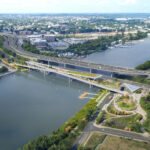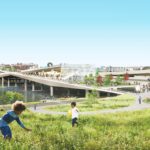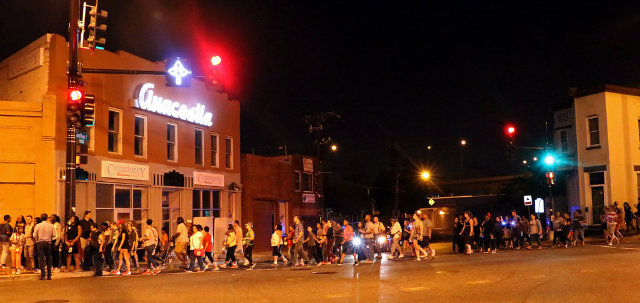
As the sun set over the 11th Street bridge on Saturday, Scott Kratz turned around to see what he describes as “fireflies” flickering behind him. Kratz, the director of 11th Street Bridge Park, was among a crowd of nearly 300 people who walked from Yards Park to the Anacostia Arts Center.
Many of the participants carried homemade lanterns to symbolize journeys that took place in the mid 1860s, when African American families walked across the then-Navy Yard bridge to build homes in the developing community of Barry Farm/Hillsdale. The project was established by the Freedmen’s Bureau to address a housing problem facing immigrants who came to D.C. during the Civil War.
While District residents associate present-day Barry Farm with crime and contentious development, the creation of the community over a century ago was a pioneering initiative for its earliest inhabitants, many of whom were former slaves. It gave them the opportunity to actually own properties, once the homes were built.
The idea for the Lantern Walk, which was co-presented by the 11th Street Bridge Park and Washington Performing Arts, came from an archived document that says many settlers “worked on their lots in the light by lantern, lamp and candlelight, clearing off brush and putting up temporary board shacks. The hills and valleys were dotted with lights, and the sounds of hoe, pick, rake, shovel, saw, and hammer rand through late hours of the Night.”
While the neighborhood’s history is chronicled at the Smithsonian’s Anacostia Community Museum, it isn’t taught in schools, said Selwyn, a Maryland resident by way of Trinidad and Tobago, who joined the walk with a friend and her two children. “It’s interesting to learn the history and roots of the neighborhood—especially at a time when our country is trying to reshape itself” in terms of race relations, he said.
In addition to providing a history lesson, the walk was also just “a really cool idea,” said Sharretta Benjamin, who came out because she thought the event would be “something fun to share” with her daughter. Benjamin and 16-year-old Shayla, created lanterns during a workshop at Yards Park before the walk kicked off. With pleasant weather and the backdrop of the Anacostia River, the lantern making process was “peaceful and soothing,” she said.
Local musicians including the National Symphony Orchestra Brass Trio, Zeyu Victor Li, Daisha Martin, and SongRise DC also helped set the scene.
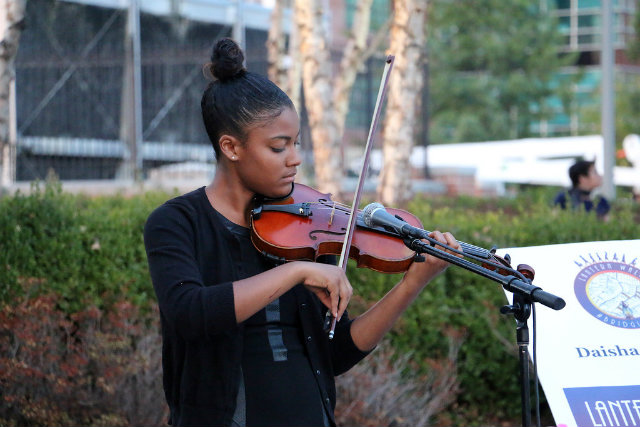 Live entertainment at Yards Park before Lantern Walk. Photo by Januari Jai Media
Many participants created their lanterns at community events over the past month, said Melissa Green, director at ArtReach, a year-round museum outreach program housed at THEARC.
During each session, ArtReach would supply containers and photos of people like Frederick Douglas, places such as Barry Farm, and Southeast landmarks like The Big Chair, which were used as decoration, said Green, who was pleased that the culminating walk had a “fantastic” turn out.
Adults who made the 19th century journeys brought along their children, the smallest of whom who were carried in wheelbarrows and hand carts, according to the historical document. The modern-day Lantern Walk reflected that, as babies in strollers and elderly residents traveled side-by-side, going from the western to eastern sides the Anacostia River.
But in contrast to the journeys of the past, comprised of only African Americans, this weekend’s walk was made up of a racially and culturally diverse group of people. Kratz said he walked alongside a longtime Capitol Hill resident who had never been to Anacostia before. Part of this was made possible by the 11th Street Bridge Park’s ongoing efforts to unite residents from Anacostia and Navy Yard, neighborhoods linked by the 11th Street bridge.
The walk was led by the African Heritage Dancers and Drummers, which provided a ceremonial rhythm, along with the Tech Prep Titant group who drummed behind the crowd. Walkers were greeted at the Anacostia Arts Center by Crush Funk Brass Band, along with food, and music by a local DJ.
Meanwhile inside of the center’s black box theater, local artist John Johnson led a “Playback Theater” performance, an improv show that was inspired by audience members’ experiences of the day. In one sketch, they riffed on something that Yvonne, a proud fifth generation Anacostia resident, said: Many people never experience her neighborhood because “Southeast gets such a bad rap.” But the walk provided an opportunity to share the area’s legacy.