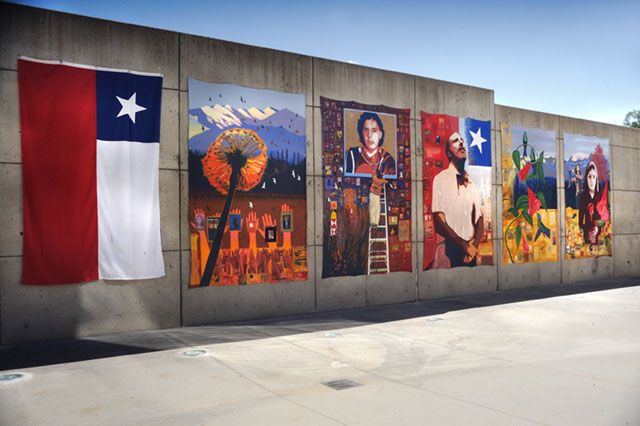
 Francisco Letelier’s “Todas las Manos.” Courtesy of the artist.
Los Angeles muralist Francisco Letelier thinks of his chosen medium as a conversation. “I’m a social animal,” he says. “I have a great desire to share.” For Letelier, murals are a collaborative art, and he returned to the Washington area to work with artists from the Latin American Youth Center on a five-panel mural that commemorates a dark anniversary: the assassination of his father.
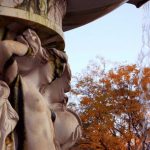
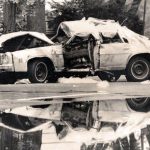
Forty years ago today, a car bomb exploded on Sheridan Circle, killing Chilean diplomat Orlando Letelier and Ronnie Karpen Moffitt, whose husband Michael (who survived the attack) was working for Letelier. An economist, Letelier had been a senior fellow at the Institute for Policy Studies. Francisco was 17 at the time and attending Walt Whitman High School in Bethesda (my father was working at the Philippine Embassy on Sheridan Circle at the time; I was nine).
“It took 40 years of history to get here,” Letelier, now 57, says.
Called “Todas las Manos” (“All the Hands”), the pentaptych installation is now on view in the sculpture garden at the American University Museum. Although the Washington area is no stranger to vivid neighborhood murals, Letelier’s work touches on issues that you are unlikely to find in your typical side-alley mural.
Two of the panels depict the car bomb’s victims, Letelier and Moffitt, while other sections focus on related subjects—subjects that may not be apparent at first.
Take the mural’s second panel, whose central element is an inviting portrait of hummingbirds pollinating blossoms of copihue, the national flower of Chile. As Letelier explains, this piece is a multi-layered metaphor, with folk art becoming a form of political resistance; behind this natural beauty you see reproductions of declassified, redacted documents pertaining to the assassination.
This subtext is an example of the kind of conversation that Letelier hopes we can engage in. “I’ve got one foot in Chilean history and one foot in D.C. on the eve of an election in which people are getting more polarized. And I’m reminding people that no matter how it ends up…we’re going to have to reconcile. We still need to come together and imagine one nation.”
Francisco Letelier first came to the United States in 1960 after his father lost his job in retaliation for his support of Salvador Allende. The family returned to Chile from time to time and in 1964 prepared to return home for “what we thought was an inevitable Allende victory.” After he was finally elected in 1970, Latelier recalls, “ironically Allende said to my father, ‘Orlando, you’ve been in D.C. for ten years—I need you there!’”
Three years later, Orlando Letelier returned to Chile to serve under the Allende government, months before Augusto Pinochet rose to power in the aftermath of the September 11th coup. Along with other members of the Allende government, Orlando Letelier became a political prisoner, and was tortured.
In 2010, documents revealed that, just days before Letelier’s murder, then Secretary of State Henry Kissinger had recalled an order warning the Chilean government against carrying out assassinations. Asked about this, Francisco Letelier did not mince words.
“When we look at history, we know that [Kissinger’s] the guy who ordered the illegal bombing of Cambodia and Vietnam. We’re talking about the deaths of tens of thousands of people. So it’s not far-fetched to imagine that he turned a blind eye to the killing of one Chilean.”
Letelier thanks Peter Korbluh from the National Security Archives for continuing to pursue justice, “by clearing the historical record. We’re not people that want to kill the murderous bastards or act in anger, we just want the truth to come out. “
This isn’t the first time Francisco Letelier has addressed his father’s memory in a mural. On the first anniversary of his father’s death, he worked on a commemorative mural in Rock Creek Park. “Coming back here, my father is a person I talk about in opportune moments in order to create bridges with people who may not know anything about Chile. I talk with incarcerated youth, I’ve talked with communities in conflict in Northern Ireland and Latin America and on the West Bank of Palestine.”
Conversation doesn’t mean an echo chamber. “One of the guarantees of democracy is that there will always be different ends of the continuum. So Chile is very much like the United States in that respect. Sometimes people say to me, ‘But certainly you got rid of Pinochet, I can’t believe people still support him!’ But have you looked up your local Klan chapter lately? Have you looked at elections in Germany lately?” Letelier says. “The way things are in Chile is just like they might be in Los Angeles or New York City. It’s a hard nut to crack.”
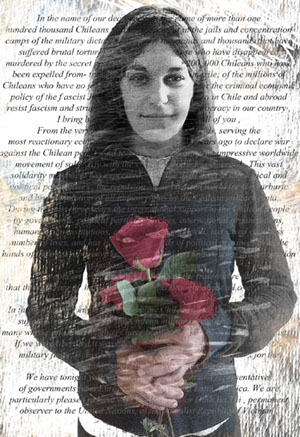 Francisco Letelier, “Scarlet Oak,” a panel depicting Renee Karpen Moffitt, who was a 25-year old newlywed when she was killed.
D.C. art lovers may be used to stumbling upon murals on the street, and it’s for this very reason that Letelier is happy that “Todas las Manos” is on display at American University. “Maybe we could have gotten a permanent site somewhere in an alley. But that’s not a noble site. This was a great place to create this mural and installation. We were able to reinforce the importance of the project.” The murals will tour other sites around the area, including Wilson High School, which has a tragic connection to one of the panels.
A part of the mural, “Native Son: Rodrigo Rojas”, is dedicated to a young man who, like his friend Francisco Letelier, came from an exiled family. “I was just a few years older than him, but we were always together,” Letelier says. In 1986, the 19-year-old Rojas returned to Chile, where he and his friend Carmen Gloria Quintana took photos at a demonstration. Soldiers captured the young photographers, doused them with gasoline and set them on fire.
As remote as the Chilean conflict may seem, this incident demonstrates that all politics in indeed local. “He went to Wilson High School, he participated in the Latin American Youth Center. He walked these streets. He’s not just a Chilean kid—he’s a kid from here.”
Moreover, the Letelier family has always had strong ties toe the land where they lived in exile. “I have a picture of my father riding a horse wearing a Chilean poncho and with the saddle he used in Chile, but the photo was taken in Shenandoah, where we had a piece of land,” the artist says, stressing the need to bridge cultural differences. “We really don’t understand the reality of people, say in the Midwest. This is a huge swatch of continental land mass, and we tend to act like we know what they’re about. But surprisingly we don’t know.”
How do we bridge this?
“I don’t have any easy answers. But I think we need to create conversation and cultural experiences and be inquisitive and curious to explore these things. To create and circle around and say, ‘Yes. This is a conversation we need to have,'” Letelier says. “What happens is that we’re know-it-alls. I hate to sound trite and say ‘we have to get out of our own way.’ We need to kind of revisit some things that we think we know all about. “
Despite the volatile history of his homeland and the increasing divisiveness of his adopted country, Letelier has hope. “I’m an optimist. I’m the kind of person that believes in the future and in young people. I want to imagine a future with a people that will be at the reins of power that gives them hope and enrolls them in discovering vast new territory. I continue to do that. That’s who I am.”
Todas las Manos will be on display through October 23 in the Sylvia Berlin Katzen Sculpture Garden at the American University Museum at the Katzen Arts Center, 4400 Massachusetts Ave NW.