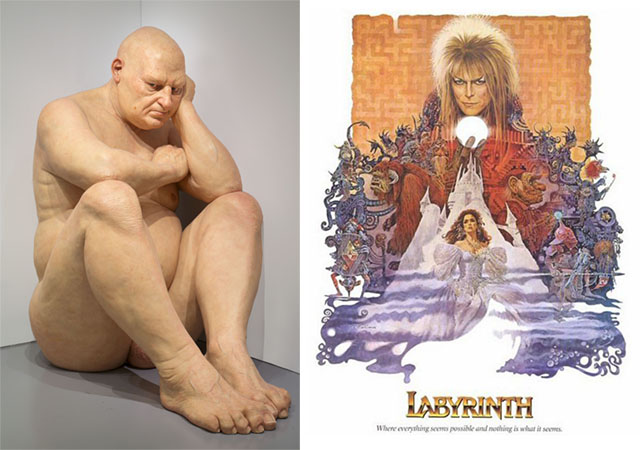
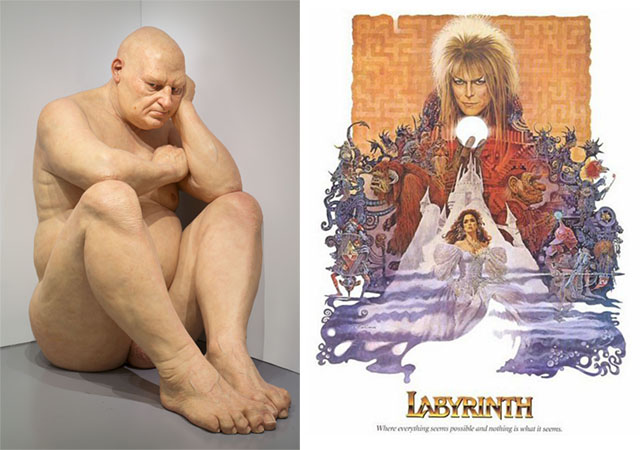
 Ron Mueck, Untitled (Big Man), 2000 (Cathy Carver/Hirshhorn), and a poster for Labyrinth (courtesy of the Hirshorn)
Goblins, get ready! Attendees at this weekend’s screenings of Labyrinth at the Hirshhorn are encouraged to attend in cosplay. But if fans of the film were aware of a particular connection the movie has to the Hirshhorn’s permanent collection, the gallery might see more skin than blonde rockstar wigs.
To celebrate the film’s 30th anniversary, the Hirshhorn is hosting free screenings of Jim Henson’s 1986 film in the Ring Auditorium. The much-loved film, wherein a 15 year old played by Jennifer Connelly has to save her baby brother from a goblin king, has grown larger in the pop culture consciousness due to the passing of its iconic star, David Bowie. Even before it became a cult classic, Labyrinth always had deep local ties. Henson grew up in Hyattsville and attended the University of Maryland, where he created the live action puppet show Sam and Friends and a character that would develop into Kermit the Frog.
But the film’s creatures also have a connection to something that local art fans may recognize. Some of Labyrinth‘s key puppet work was created by Australian-born sculptor Ron Mueck, whose massive sculpture Untitled (Big Man), was acquired by the Hirshhorn in 2002. The sculpture, which has been rotated in and out of exhibition, has long been a visitor favorite and is currently on view again.
Before moving into a fine art career, Mueck played a key role in the Australian film industry in the late ’70s and early ’80s, producing design work that proved influential to the scene.
“Mueck’s work is materially based on the craft he developed as a puppeteer,” said Stéphane Aquin, the museum’s chief curator. “Very few artists have attained this level of perfection of craftsmanship in the realm of hyperrealistic sculpture. It’s something he developed in the movie industry and then took in his own direction.”
In addition to his puppeteering work, Mueck also provided the voice for the beast Ludo in the film. After Labyrinth, Mueck continued his collaboration with Henson on The Storyteller, a live action television series that originally aired on HBO in 1988. Mueck later move into advertising, utilizing his expertise to design photorealistic animatronics.
But the limitations of sculptures that did not look perfect from every camera angle frustrated the artist. It was his experience working in movies that helped push Mueck down his most successful path, creating enduring works that present a depth of detail and richness that transcends the mundane trappings of reality. In the exaggerated creatures of Labyrinth, you can see the DNA of Big Man.
“There are many artists who work in multiple mediums and have two identities,” said Aquin. The gallery hopes to show audiences a link between those two halves with this screening. Mixing media this way illustrates a willingness of Aquin to use the museum to bridge the gap between fine art and other modes of expression entwined with the artists on display. Aquin cited the connection between the music of The National and Icelandic artist Ragnar Kjartansson, who will get his first US museum survey at the Hirshhorn starting next month.
In the future, Aquin hinted, the museum may collaborate with Mueck on a larger retrospective, one that would give the gallery the opportunity to screen more of the films he’s worked on during his storied career. For now we can bask in the shadow of David Bowie as the Goblin King—and the Big Man.
Labyrinth screens Saturday, October 1 at 3 and 5:30 p.m. at the Hirshhorn, located at 700 Independence Ave SW. Free.