By DCist contributor Elena Goukassian
A new group exhibit at the National Museum of Women in the Arts is a thoughtfully curated show with an eye toward diversity. It’s a welcome correction to the art world gender gap, even though the works on view vary widely in quality.
Owners of one of the largest private art collections in the world, Miami’s Rubell family has fairly strong ties with D.C., and works from their collection often end up in town. The work in No Man’s Land, all by female artists, began as a much larger exhibition at the Rubell Family Collection in Miami. That show ran concurrently with Art Basel Miami Beach and was well received in Florida, but was so huge that it became overwhelming, covering all 450,000 square feet of the museum. Even that wasn’t enough space; the museum had to rotate works in and out of the galleries in order to show everything they wanted.
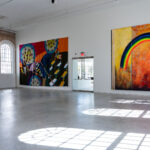
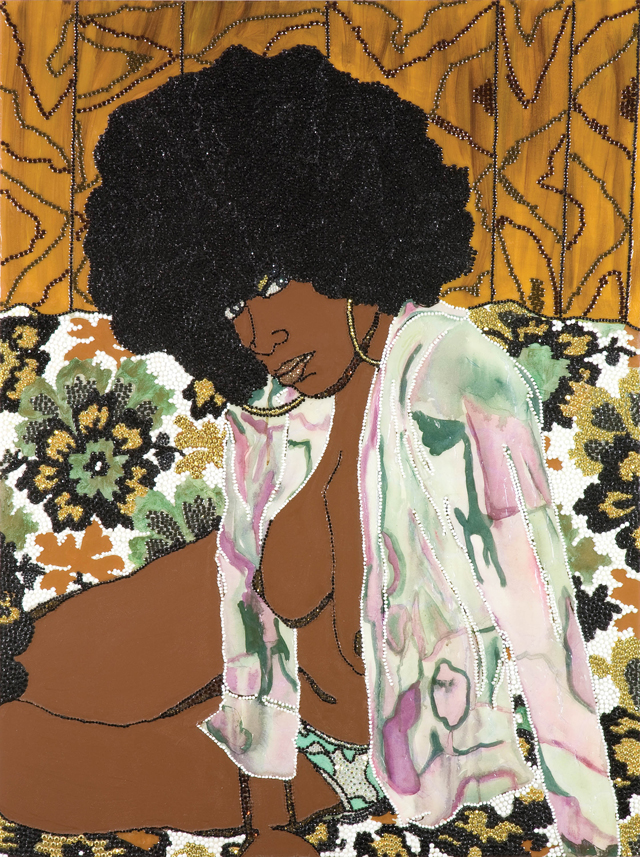
At NMWA, No Man’s Land is much smaller and more focused. The curators chose 59 works of painting and sculpture—the most traditional, and traditionally male-dominated, media. The show’s 37 contemporary female artists hail from 16 countries across five continents, and the show is divided into two sections. One focuses on interpretations of the female body, and the other on traditionally “feminine” craftwork.
The exhibit has an almost tongue-in-cheek focus on nudes, craft, sculpture, and painting, though the success rate is inconsistent. German artist Rosemarie Trockel’s knitted paintings are responses to the “masculinity” of traditional painting. Perhaps the most high profile bomb is the tawdry nutcracker mannequin by Jennifer Rubell. Yep, that’s the Rubells’ daughter. It seems her Lysa III is included for its interactive properties—you, too can crack a nut in her vagina!—and makes for an unusual selfie.
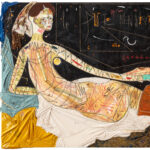
The paintings on display are more successful than the sculpture. Two artists stand out in particular. Iraqi artist Hayv Kahraman has two paintings in the show, both influenced by a mix of traditional Persian miniatures, Japanese woodblock prints, and Italian Renaissance traditions. One of them, Migrant II, looks like a playing card, representative of the double identity that immigrants are often forced to embody in their adopted home countries.
Right next to Kahraman’s work hangs Rozeal’s Sacrifice #2, which looks like a black woman popped into a traditional Japanese painting. It’s a take on a 19th-century woodblock print by Tsukioka Yoshitoshi, a master of Ukiyo-e. Rozeal—a D.C. native—blends the aesthetics of traditional Japanese woodblock with African American culture as a nod to the bizarre (and racist) Japanese ganguro subculture, which seeks to emulate American rap culture through skin darkening, long fingernails, and bleached hair.
Other highlights include Trockel’s aforementioned knitted paintings—literally knit woolen designs stretched to look like canvases—and Dianna Molzan’s paintings on top of meticulously shredded canvases. Noteworthy pieces by Brazilian Sonia Gomes and Baltimore’s Shinique Smith straddle the line between painting and sculpture. A canvas by Yayoi Kusama provides a small preview of her upcoming blockbuster retrospective at the Hirshhorn.
No Man’s Land runs through January 8 at the National Museum of Women in the Arts, 1250 New York Ave NW, nmwa.org, $10.