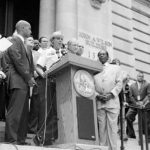
 As MPD searches for a new chief, residents testified about the state of crime and policing in the District. (Photo by Julie Strupp)
By DCist contributor Julie Strupp
As the Metropolitan Police Department searches for its next leader, more than 100 advocates and concerned citizens passionately debated crime and policing in the District at a public oversight panel last night that lasted past midnight.
Frequently raised topics included excessive use of force, body cameras, racism, training and regulating special police, and what community policing should look like in practice, as well as the type of person that residents would like to see take the helm in the wake of Cathy Lanier’s departure.
Ward 5 councilmember and Committee on the Judiciary chair Kenyan McDuffie hosted the hearing, which started at 5 p.m. and lasted over seven hours.
Long-serving Chief of Police Cathy Lanier stepped down last month to take a security job with the National Football League after holding the position for nine years. She was widely popular, but notable critics included Black Lives Matter activists and members of the D.C. police union. Peter Newsham, who served as an assistant chief since 2002, is currently filling in as interim head of police.
“I thought the roundtable was very successful. We heard from dozens of public witnesses into the early morning hours about the need for the Metropolitan Police Department and our next chief to enhance community policing strategies, embrace transparency, and engage the public in the department’s operations,” McDuffie told DCist today. “We also heard calls for continued investments in public-health based crime prevention and intervention programming that involves our human services, education, and workforce development agencies. These priorities will be central to the Council’s consideration of the next nominee for chief of police.”
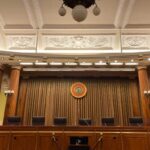
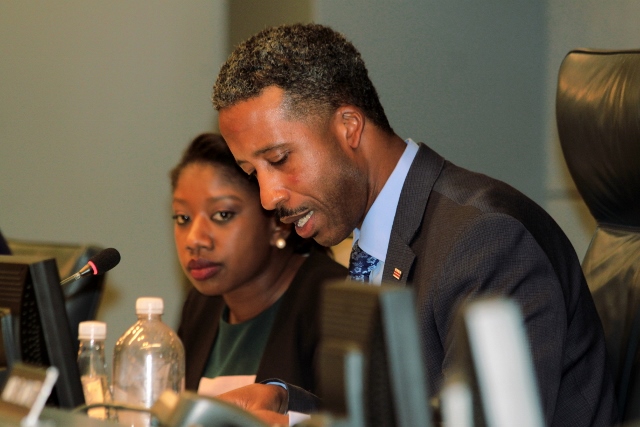 Ward 5 Councilmember Kenyan McDuffie convened the hearing, which lasted over seven hours. (Photo by Julie Strupp)
This discussion comes in the wake of several high-profile incidents, as well as a perceived lack of accountability for those actions.
Last year, a black teen was forcibly detained at Eastern Market after a woman called the cops because she felt “uneasy” at the ATM; while MPD concluded that the officers were justified, Jason Gooslby is suing the city for failing to prevent false imprisonment, assault, and battery. Black 18-year-old Ralphael Brisco was shot and killed by police in 2011; the officers responsible were cleared of charges last year.
“There is clear evidence that the behaviors and practices of the police are less desirable, let’s say, in majority black areas. If we want to actually start to move this conversation forward, we have to stop hiding behind neutral words like implicit bias, or disparity, or whatever,” Eugene Puryear, a member of the Stop Police Terror Project told the committee. “It’s racism, plain and simple.
This September, a D.C. police officer fatally shot unarmed black motorcyclist Terrence Sterling in Mount Vernon Square. Police officials say the body cameras were turned off during the shooting—but not deliberately.
“The body camera issue is a key issue. We were told that allegedly all officers would have them by this fall. I was actually on a panel…not that long before Terrence Sterling was killed and an MPD officer who was on that panel was asked ‘what if someone turns off a body camera?’” Black Lives Matter organizer Aaron Goggans testified. “[The police officer] assured over 100 citizens that this could never happen, that the cameras could never be turned off, that under all circumstances everything would be captured at all times.”
Although there has been an overall downward trend in crime in the District over the past 20 years, 2015 was punctuated by a spike in homicides. Many witnesses at the panel argued that this reduction in crime has happened in primarily white and wealthy areas, while other parts of the city remain unsafe.
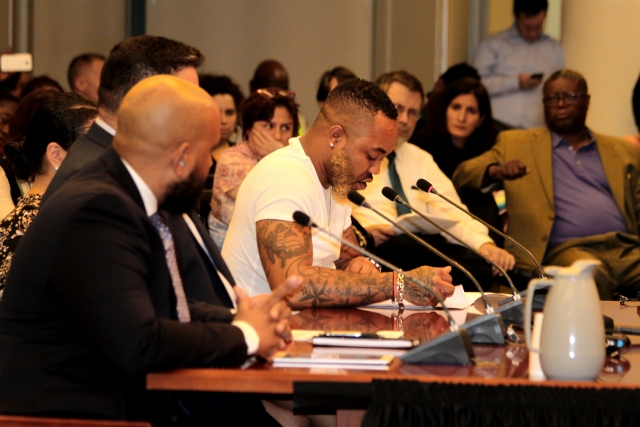
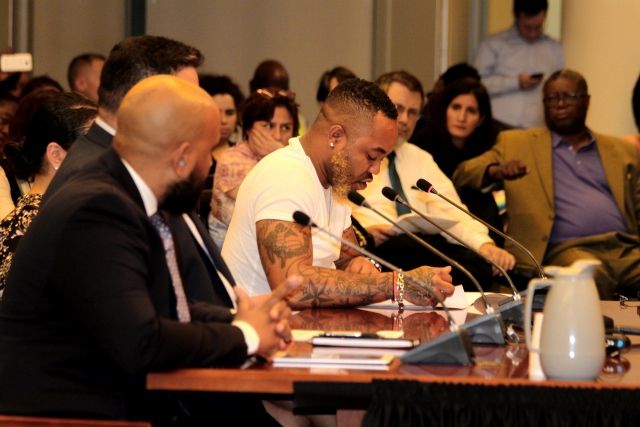
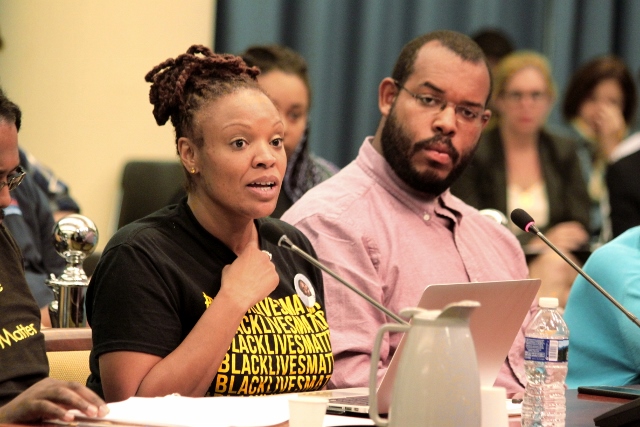 Several activists affiliated with the Black Lives Matter movement testified. (Photo by Julie Strupp)
Another repeated issue of concern centered around special police officers, who often work for private contractors and therefore aren’t subject to the same transparency rules as police. They can, however, make arrests and carry guns, despite only having about 40 hours of training compared to the 28 weeks required for a D.C. Metropolitan police officer.
In May, two special police officers were indicted on involuntary manslaughter charges after last year’s fatal altercation with 74-year-old James McBride at MedStar. And 27-year-old Alonzo Smith was also killed in an altercation with two special police in Southeast almost exactly a year ago. His death was ruled a homicide, but the U.S. Attorney’s Office for D.C. announced last month that there wasn’t enough evidence to prosecute. His mother, Beverly Smith, is still seeking justice.
“No amount of training will stop the excessive use of force by special police officers and MPD alike,” Smith said to the committee. “However, holding them accountable by prosecuting them with jail time will cause them to reconsider their actions.”
Other advocates said increasing training requirements for special police would go a long way towards building public trust. Mayor Muriel Bowser and Lanier proposed enhanced requirements earlier this year.
A large portion of the discussion centered around community policing, which is technically defined as “a system of allocating police officers to particular areas so that they become familiar with the local inhabitants.” The problem, several witnesses and Councilmember McDuffie noted, is that this term seems to have as many definitions as there are people who use it.
Other witnesses urged better understanding and compassion on the part of police for people dealing with mental illness. Studies show people with mental illness are 16 times more likely to be killed during a police encounter and almost half of the people who die at the hands of police have some kind of disability.
“Please, please, please Metropolitan Police Department, have more sympathy, compassion and empathy for those that are going through a mental health crisis,” urged Grace Odrick, a Ward 6 resident who says she has a mental disability. “Often times those with mental illness have to deal with the mean stigma of having this illness, being hated, not accepted, mistreated, misunderstood.”
When asked what police could do better, she responded, “Is it so hard to just listen?”