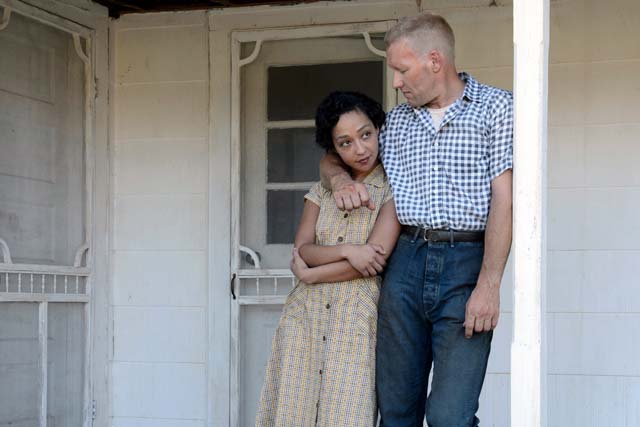
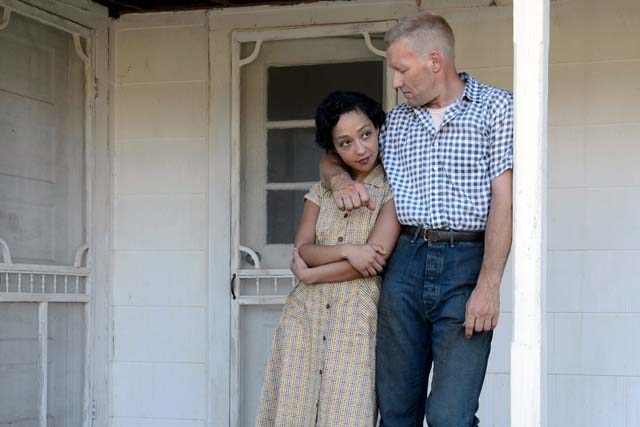
 Ruth Negga and Joel Edgerton (Ben Rothstein/Focus Features)
Director Jeff Nichols’ latest film is an Oscar-baiting prestige drama about a dark time in our nation’s history. Beginning in 1958, Loving chronicles the long legal battle over the state of Virginia’s anti-miscegenation laws, which kept the married interracial couple Richard (Joel Edgerton) and Mildred Loving (Ruth Negga) from their home and families.
We watch as Richard and a pregnant Mildred are torn from their beds in the middle of the night and thrown into holding cells, They’re forced to accept a plea agreement that means that if they set foot in Virginia over the next 25 years, they will be sent back to prison.
Years pass as they attempt to raise their children in D.C., but Mildred longs for the open fields of Caroline County. With the help of ACLU attorney Bernard Cohen (Nick Kroll), they appeal their case all the way to the Supreme Court, where their love story turns into legal precedent.
Loving may seem like little more than paint-by-numbers drama. Audiences have likely already seen a movie just like this, probably on television. But an offbeat filmmaker like Nichols seems to promise some deviation from a well-meaning but tired formula. Unfortunately, for much of the film’s running time it’s easy to forget Nichols is at the helm. Too many scenes come off like the faded shadow puppets of a more lively production. Like the reserved, stirring performances of its leads, Loving‘s passions lay under the surface, This isn’t a rapturous declaration of equality so much as a simple statement of inalienable facts.
To his credit, Nichols’ approach works well in key scenes. As the film depicts the tribulations of a man trying to protect his family, it fits right in with the themes of the director’s previous films like Take Shelter and Midnight Special. His touch is felt in the stomach-churning suspense of the Lovings driving along moonlit country roads to sneak back home, and in the lingering, leering looks their neighbors give them as they walk down the street.
In his finest moments, Nichols captures the paranoia of living among people who don’t see you as human with the kind of intensity usually reserved for genre films. A well-timed cameo from Nichols’ favorite Michael Shannon, as Time magazine photographer Grey Villet, makes the viewer yearn for a charisma that is otherwise lacking in this staid picture.
There is power in this kind of cinematic abstraction. Edgerton and Negga don’t have a conventional love story chemistry, but there’s an endearing innocence about them. There’s a certainty to their love for one another that cuts through the sociopolitical implications of their court case. Yet this reduces history to a tale of love conquering all. It wasn’t that simple. The film focuses on white versus black, but the real story is much more complex.
Mildred, also of Rappahannock descent, allegedly didn’t even identify as black, but the film omits any reference to her indigenous roots. As always, the intersection of race and legality in the country was characterized by crucial gray shades that Loving reduces to the digestibility of a Hallmark card. That the colors on that card are muted and arty isn’t enough to hide its retreaded sentiment.
—
Loving
Written and directed by Jeff Nichols
With Joel Edgerton, Ruth Negga, Will Dalton
123 minutes
Rated PG-13 for thematic elements
Opens today at Regal Majestic, Landmark E Street Cinema, Landmark Bethesda Row, AMC Magic Johnson Capital Center 12, Angelika Mosaic