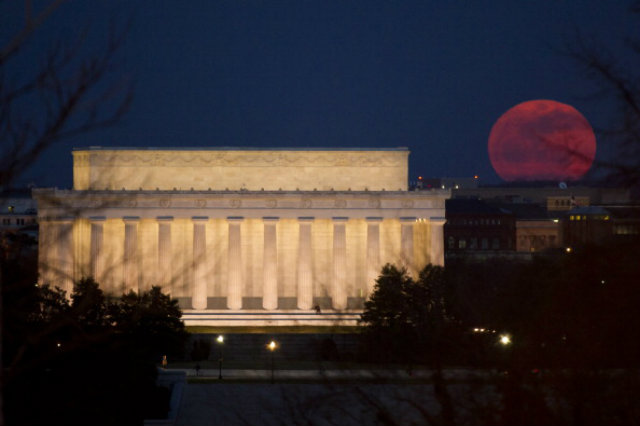
 “Super Perigee Moon” rises near Lincoln Memorial in March 2011 (Photo by Bill Ingalls/NASA via Getty Images)
The moon will be closer to the Earth than it’s been all year, early Monday morning. In fact, it’ll be the closest it’s been to the planet since January 26, 1948.
While there was some debate over whether September’s Harvest Moon was also a “supermoon,” there’s no denying this one.
In three days, the moon will be 221,524 miles away from the center of the Earth—that’s just 85 miles from the closest it can possibly approach us. And since, on average, the moon and Earth are about 238,900 miles apart, this qualifies as an “extreme” occurrence, according to Space.com.
The moon will reach its closest point at 6:15 a.m., and it’ll be full at 8:52 a.m. At that time, it’ll be a supermoon—a term coined by astrologer Richard Nolle in 1979, which means a full moon coincides with with perigee (the moon’s closest point to Earth). NASA explains it this way:
The moon’s orbit around Earth is slightly elliptical so sometimes it is closer and sometimes it’s farther away. When the moon is full as it makes its closest pass to Earth it is known as a supermoon. At perigree — the point at which the moon is closest to Earth — the moon can be as much as 14 percent closer to Earth than at apogee, when the moon is farthest from our planet. The full moon appears that much larger in diameter and because it is larger shines 30 percent more moonlight onto the Earth.
Monday’s instance is also known a “Beaver Moon” because it’s happening during the time of the year when American settlers trapped beavers ahead of winter.
Still, moon watchers who don’t want to wake up early will largely get the experience on Sunday night, too. “I’ve been telling people to go out at night on either Sunday or Monday night to see the supermoon,” said Noah Petro, deputy project scientist for NASA’s Lunar Reconnaissance Orbiter (LRO) mission. “The difference in distance from one night to the next will be very subtle, so if it’s cloudy on Sunday, go out on Monday. Any time after sunset should be fine. Since the moon is full, it’ll rise at nearly the same time as sunset, so I’d suggest that you head outside after sunset, or once it’s dark and the moon is a bit higher in the sky. You don’t have to stay up all night to see it, unless you really want to!”
At its closest, the moon will appear 8 percent larger across and 16 percent greater in area than an average full moon, Sky and Telescope reports. And it’s possible that it will look even larger if you see it near the horizon because of a term that scientists call “Moon Illusion.” “Images that show a huge full Moon rising dramatically above a city skyline don’t match the reality that your eyes see because the camera is magnifying the view.”
According to NASA, there won’t be a supermoon this large until 2034.