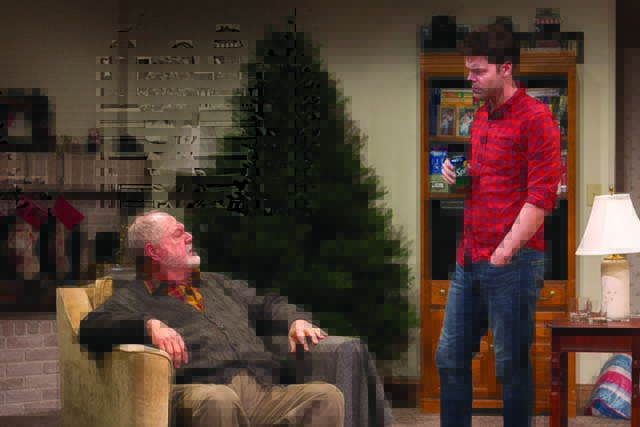
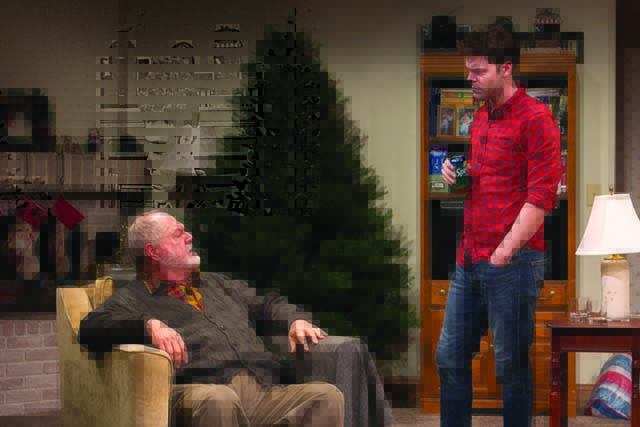
 Michael Winters and Avery Clark (Teresa Wood)
By DCist contributor Seth Rose
In the scramble for explanations after last week’s election, the conversation can’t help but revolve around straight white men. They voted for Trump in record numbers, and the mad dash to understand why has consumed liberal America while it licks its wounds and waits for the president-elect to assume office. Playwright Young Jean Lee’s Straight White Men is one entry into this conversation, and it might have more insight into the topic than any number of pundit’s musings.
The straight white men in question are three brothers and their father Ed (Michael Winters) coming together over Christmas. Things start off more in the direction of a sitcom than a political screed: the brothers wrestle, make bawdy jokes and prank each other as their camaraderie is established. These antics are often hilarious despite occasionally pushing the bounds of silliness, and they do give us some glimpses into their politics: they play on a Monopoly board rebranded as “Privilege” and render an absurd, ironically racist Oklahoma number written as a protest in high school by Matt (Michael Tisdale). They are bros in more than one sense of the word, but they’re socially conscious, or at least they say they are.
During an early workshop for the show, Lee, who is Korean-American, asked a room of mainly women, queer people and minorities what they think the ideal traits of a white man should be. They listed ones close to the modern liberal conception of how white men can help the oppressed: willingness to listen, prioritize their concerns, and step aside to elevate the voices of their non-white, non-male brethren. When Lee wrote a character based on those traits, the same room didn’t lavish the praise she expected. Instead, they called him a loser.
This disconnect made its way to the heart of Lee’s final draft.
The brothers have achieved varying degrees of success. Drew (Avery Clark) is a writer and teacher and Jake (Bruch Reed) a banker, but Matt has been forced to move home with his father and work temp jobs to pay off his student loans. After he has an unexplained breakdown during dinner, his brothers and father try to understand why.
Jake’s response is intriguing: as far as he is concerned, Matt is fulfilling the prophecy of the Ideal Straight White Man, therefore nobody should worry about him. He’s quiet, out of the way and not taking up space that could be better filled by a woman or person of color. For Jake, being a “loser” as a white man is a triumph, not a failure, and Matt is a sort of totem for “social consciousness” as Jake immerses himself in the very straight and very white world of banking.
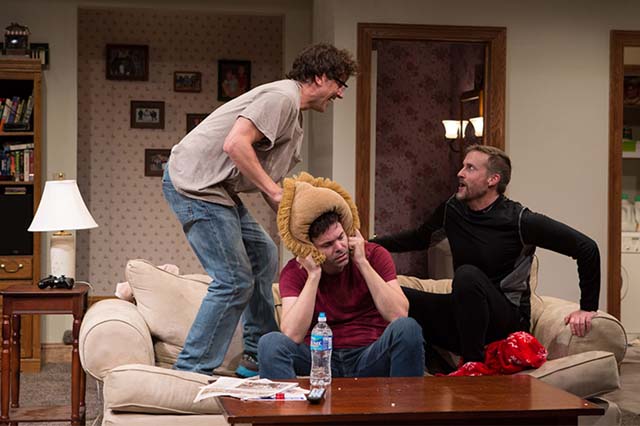 Michael Tisdale, Avery Clark, and Bruch Reed (Teresa Wood)
Lee is no stranger to plays that tackle identity politics, and in the past has described a desire to “put a little piece of gravel into [an audience’s] brains that irritates them”. Tackling explicitly white racial politics was a new challenge for her, but she does it with a careful subtlety that makes some important and uncomfortable claims. Straight white men in America are caught in a situation where they are asked by one side to embrace their racial identity in often boisterous and violent ways, and by the other to suppress it as strongly as possible.
In the words of Jake, to “sit down and shut the fuck up”. Whatever the moral justifications of the latter, enough embraced the former to put Donald Trump in the White House.
We never hear from Matt exactly why his breakdown occurred, whether it was run-of-the-mill depression or the influence of the dark side of privilege theory or some mix of both. Lee is too smart of a playwright to make that explicit. Instead, she gives us just enough to make us ask difficult questions of ourselves: could an ideology that de-emphasizes the power of white men be dangerous for those with depressive thought patterns that might already push them to drop out of society? Can we truly raise up others without also raising ourselves? Is there a room for a white identity that does not push against the identities of others? None of these questions are answered, and indeed the play can barely be said to have an ending at all. That makes it perfect for a time when many of us don’t seem to know the way forward.
As we continue to struggle with white identity in a country that just asserted it in massive numbers, Lee might be one of the first voices we should listen to.
Straight White Men has been extended at the Studio Theatrem and now runs through December 31. Tickets can be purchased here