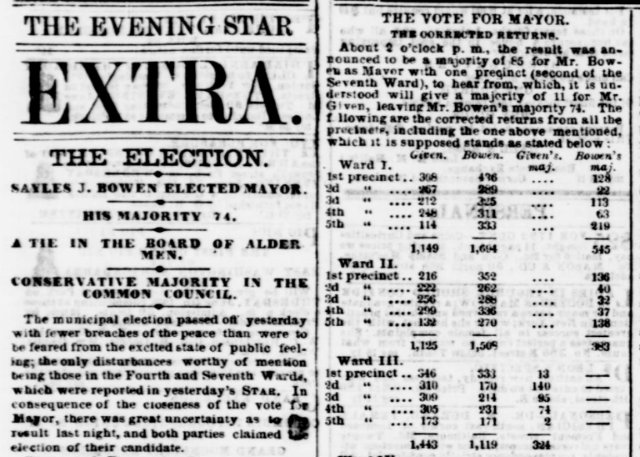
 “In consequence of the closeness of the vote, there was great uncertainty as to the result last night,” the Evening Star reported on June 2, 1968. (Courtesy of the Library of Congress’ Chronicling America: Historic American Newspapers collection)
By DCist contributor Christopher Young
It’s hard to imagine a sleepier election than the District’s mayoral primary. Mayor Muriel Bowser’s nomination for the Democratic party appears all but certain as the incumbent faces two challengers with little name recognition and limited campaign war chests.
This month, however, marks 150 years since one of the District’s closest, most contentious mayoral elections—a post-Civil War contest that pitted the city’s white voters against African Americans voting in the first mayoral elections since Congress granted them suffrage in 1867.
The 1868 mayoral ticket featured two candidates: John T. Given, a conservative local businessman dubbed “the white man’s candidate,” and Sayles J. Bowen, a native New Yorker and staunch abolitionist who enjoyed multiple government posts, including city postmaster.
Bowen’s candidacy galvanized black voters desperate for better lives after the Civil War. African Americans in what was then called “Washington City” were notoriously mistreated, and they saw Bowen, an ally of President Abraham Lincoln, as a champion for civil rights.
Many white voters, however, viewed Bowen’s campaign as a significant threat. As the June election neared, Democrats developed deep animosity for the Republican candidate, with many fearing that the city would erupt in bloodshed as African Americans cast their ballots.
On Election Day—June 1, 1868—black and white voters turned out in droves. And in the end, Bowen, on the shoulders of African American voters, prevailed over Given by just 83 votes.
Then the riots began.
The Evening Express called the aftermath of the election a “Carnival of Blood.” A few days after the election, a Washington correspondent for the Cincinnati Commercial reported that “large crowds of colored men roamed indiscriminately, all night, over the city, ransacking restaurants, drug stores and shoe stores, assaulting, beating, and in one instance killing a white man on Pennsylvania Avenue.”
The Georgetown Courier, a Democratic newspaper, described the post-election chaos in especially hellish terms: “The races are now pitted against each other in deadly animosity and but very little added excitement is required to drench the streets of the capital with human blood.”
Even though Bowen was declared the winner, controversy over the election results lasted weeks. Democrats accused Republicans of election fraud, and many refused to acknowledge Bowen as the city’s 20th mayor.
On the day Bowen was sworn in, outgoing Mayor Richard Wallach “refused to give up the keys and papers of the Mayor’s office,” the Washington Evening Star reported on June 8, 1868. “Mr. Bowen, acting under legal advice, had the doors of the office opened by a locksmith and effected an entrance. He is now (3 p.m.) in peaceful possession of the office.”
Bowen’s short reign as mayor, however, was anything but peaceful.
Although the progressive Republican is credited with securing jobs and greater rights for African Americans, Bowen’s penchant for alienating his enemies and his failure to manage the city’s finances ultimately spelled his demise when voters returned to the polls to oust him from office in 1870.
“Just because his term foundered doesn’t mean his election wasn’t historic,” said J.D. Dickey, author of “Empire of Mud: The Secret History of Washington, D.C.” “The man was ahead of his time.”
During his administration, Bowen employed former slaves on public works projects intended to modernize the nation’s capital. He helped pass civil rights laws that banned public places from discriminating against African American customers. And Bowen continued the fight to develop and support black schools, a campaign he began well before he became mayor.
“The Bowen administration created conditions under which African Americans could play an active role in political life,” author Robert Harrison wrote in “Washington During Civil War and Reconstruction.” “Its employment program furnished work to many African American men whose families would otherwise have been brought close to starvation.”
But Bowen’s term as mayor was marked by major failures.
His ambitious efforts to modernize the city’s infrastructure caused the city’s debt to balloon from $1 million to $2 million. Despite the excess spending, residents saw little improvement. The city remained in such a dismal state in 1869 that a New York Times correspondent described the District as “lying around loose as if an earthquake had shaken it.”
Critics also accused Bowen of corruption, charging that the mayor awarded contracts to friends and political allies.
Over time, even Bowen’s supporters turned against him. And in June 1870, Bowen suffered an embarrassing defeat at the hands of his opponent Matthew Emery. In all, Bowen lost his bid for reelection by more than 3,200 votes and failed to win the majority in any of the city’s wards.
Given his failures as mayor, Dickey says he’s a difficult politician to celebrate. Still, Dickey says, Bowen was a “transformative figure” who helped provide a glimpse of “the progressive future of the District.”
Bowen’s civil rights achievements certainly weren’t lost on African Americans who lived through post-Civil War hardships. After his death in 1896, Col. Perry Carson, a prominent African American political leader, wrote a letter to the editor in the Washington Post to pay tribute to the former mayor.
“Sayles J. Bowen despised no man on account of color … he looked beyond the shade of the skin and into the heart. Negroes of this city should revere and honor him as long as memory lasts,” Carson wrote.
“He was their friend when friends were few; he was their champion in time of need; he was the foundation that supplied the hope of greater blessings to come. Peace to his ashes.”