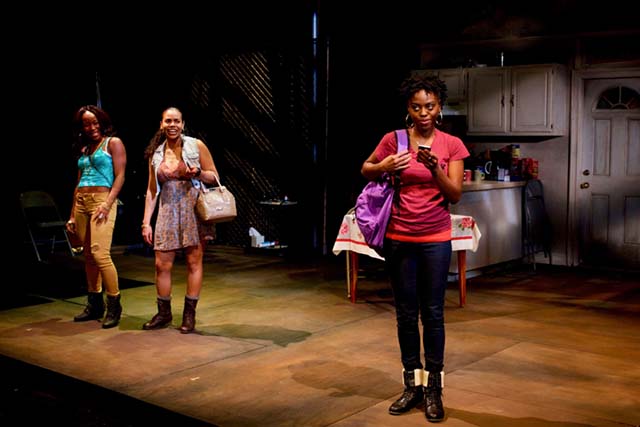
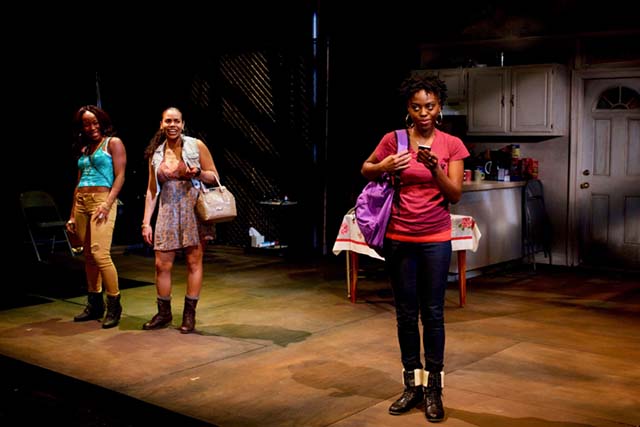
 Renee Elizabeth Wilson, Ghislaine Dwarka, and Kashayna Johnson (Photo by Ryan Maxwell)
A seeming teen soap opera gives way to stirring social commentary with the unique portraits of three young women of color in In the Mosaic Theater Company’s production of Kirsten Greenidge’s Milk Like Sugar.
You might be forgiven for thinking the play was an artsy take on the after-school special. It begins with three teenage girls swigging from a bottle of liquor outside a tattoo parlor. These close-knit teens form a pact to get pregnant at the same time so they can throw a triple baby shower, get designer diaper bags, and bask in the adulation of their peers. Margie (Ghislaine Dwarka) already passed her test, and the group’s aggressive ring leader Talisha (Renee Elizabeth Wilson) is making headway with her older boyfriend.
Annie (Kashayna Johnson) is the lone holdout. She’s made the mistake of targeting Malik (Vaughn Ryan Midder) as the prospective father of her child. Malik is obsessed with getting out of the ‘hood and making something of himself, so he wants zero part of any recreational baby making schemes. Annie’s seduction struggles cause her to reevaluate her world and where she exists within it, leading to a kaleidoscopic range of perspectives on teenage life in urban areas.
The set-up initially feels like a neoconservative wet dream, reducing the girls to the lazy welfare queen stereotypes. But that misdirection is part of what gives Milk Like Sugar its power. Lulling audiences into prejudging its characters, the show sneaks up on you with its emotional punches. In early scenes, Margie and Talisha are more concerned with the material gains of motherhood, but Annie focuses on the opportunity to create someone who will love her for her, filling the void left by her own mother’s coldness.
Annie’s scenes with her mother Myrna (Deidra LaWan Starnes) are heartbreaking. Myrna is in a sense the Ghost of Christmas Future, a living preview of the end game that will come from the girls’ self destructive cycle. Their troubled relationship adds color to the peer pressure at the play’s center. It’s fascinating that loyalty to friends can be twisted into abusive manipulation, but the root causes of that misguided fealty prove resonant.
If Milk Like Sugar is flawed, it’s in the play’s sometimes inscrutable dialogue, written in an generic slang meant to give the characters a universality that might have been lost by settling on a specific vernacular. The approach works well on the page, but the cast delivers these lines with a frustrating formality. Rather than letting the improper contractions roll naturally, this speech robs the banter of its musical tenor, placing rhythmic stumbling blocks at the center of important emotional beats.
Still, director Jennifer L. Nelson stages an engrossing coming-of-age story, one rife with inspired needle drops, from Otis Redding’s “Try A Little Tenderness” to the best use of Nicki Minaj’s “Moment 4 Life” since the heist scene from Harmony Korine’s Spring Breakers.
The girls’ obsession with the social status of smartphones gives the production a specifically millennial POV. But the show is more impressive when it digs deeper into the emotional detritus of the girls’ lives.
Milk Like Sugar runs at the Atlas Performing Arts Center (1333 H Street NE) through November 27th. Tickets are available here.